how a peptide is made today
The Purification Nobody Sees
A synthesiser makes a crowd of near-identical chains. A steel column the width of a drainpipe, a rack of collection tubes and a chemist with a spreadsheet decide which of them becomes the product — and how much of the batch is thrown away to get there.
The column stands on its own frame in the corner of the room, a steel tube roughly as wide as a drainpipe and taller than a person's forearm, packed tight with silica beads whose surfaces have been coated with long, greasy hydrocarbon chains. Beside it a pump the size of a washing machine pushes a mixture of water and acetonitrile through the bed at pressures that would burst a garden hose. At the far end, a fraction collector — a rack of tubes on a moving arm — waits. On the screen above, a single line crawls along the baseline. The crude peptide from yesterday's synthesis, dissolved and filtered, has just gone onto the head of the column. This is how peptides are purified after synthesis: by preparative reversed-phase chromatography, a scaled-up version of the analytical technique, which separates the wanted chain from its near-identical failures and hands a chemist a series of fractions to accept or reject.
The history of that technique — the botanist's tube of chalk, the Nobel Prize, the pumps — and what a purity percentage on a certificate describes have been told on this site before. This is the other side of the same instrument: not the small column that measures purity, but the big one that makes it, and the decisions that happen at the collector which never appear on any document.
What comes off the resin
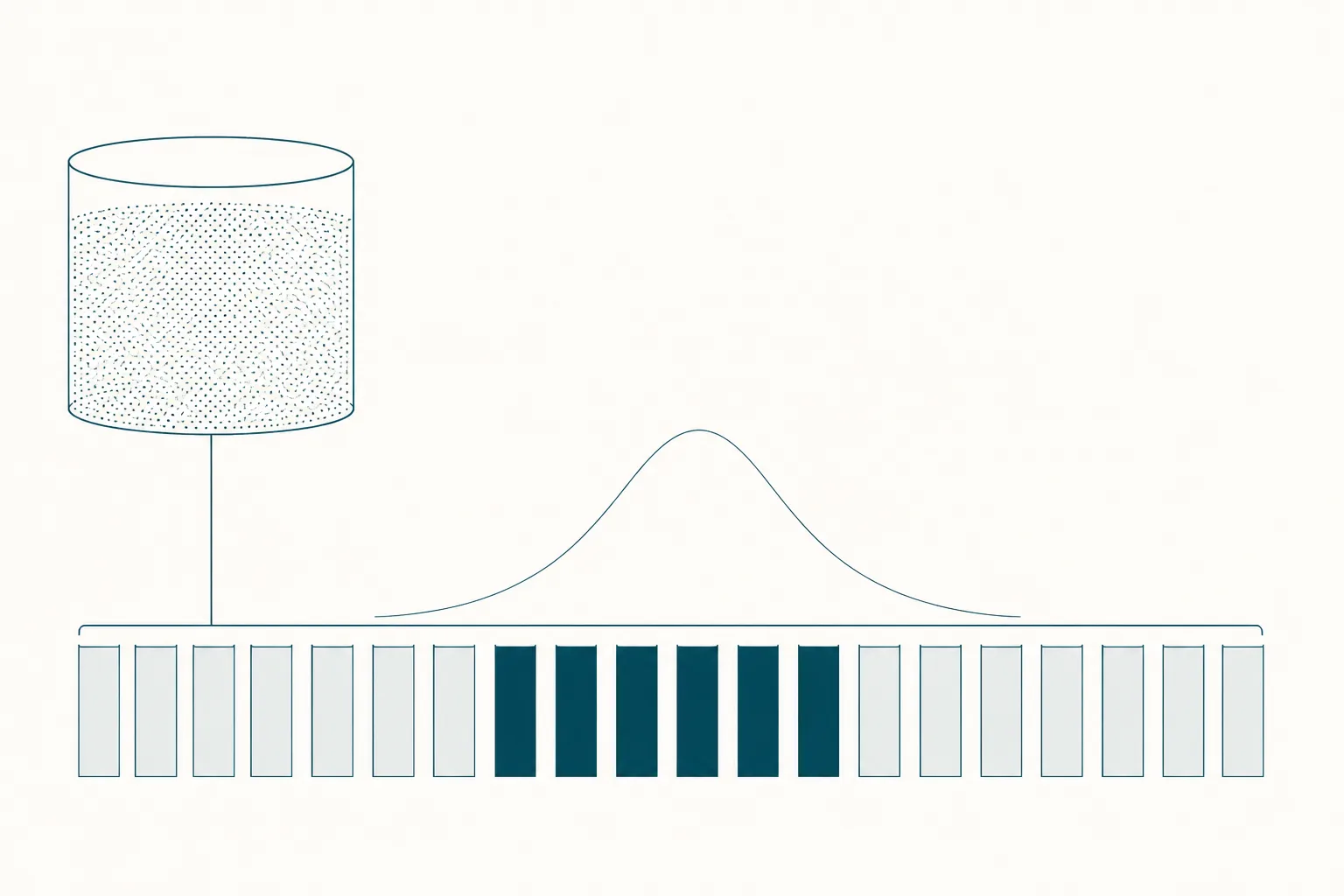
It helps to be precise about what the column receives. The crude material from a solid-phase synthesis is not a slightly dirty version of the product. It is a population. The target sequence is usually the largest member of it, and around it sit chains missing a single residue at one position or another, chains capped short after a failed coupling, chains carrying a leftover protecting group, chains in which one residue has flipped to its mirror-image form, and fragments modified by the acid cocktail that released them. Many of these differ from the product by one amino acid out of thirty, or by a single small chemical group.
That is the whole difficulty. Separating a peptide from a solvent is trivial. Separating it from a molecule that has the same length to within a residue, nearly the same charge and nearly the same polarity is the central technical problem of peptide manufacturing, and the reason reviews of large-scale production treat purification rather than synthesis as the usual bottleneck 1.
A column pushed past its comfort
An analytical column is run gently. It receives a tiny sample, far below what its packing could hold, so that every peak comes out sharp and symmetrical and the areas can be compared honestly. A preparative column is run to make money, and that means loading it until it is nearly saturated. Grams of crude go onto a bed that an analyst would feed in micrograms.
At those loadings the chromatogram changes shape. Peaks broaden and lean. The product peak develops a sloping front or a trailing tail, and the small impurity peaks that were cleanly separated at analytical scale start to ride on its shoulders. The gradient — the slow increase in organic solvent that coaxes each component off the greasy surface in turn — is flattened out across the region where the product elutes, buying a little more separation at the price of a longer run and more solvent 5. Operators speak of it as a negotiation: how much crude per run, how shallow a gradient, how many runs a batch will take.
The collector and the spreadsheet
As the product begins to emerge, the fraction collector starts cutting the flow into tubes — sometimes by time, sometimes triggered by the detector signal. A single run can produce dozens of fractions. None of them is judged by eye. Each is sampled and run on a small analytical column, and the results go into a table: fraction number, main-peak purity, the identity of the largest impurity.
The pattern is almost always the same. Fractions from the heart of the peak are very pure. Fractions from the leading edge carry the impurities that elute just ahead of the product; fractions from the trailing edge carry the ones that elute just behind it. Between the heart and the edges is a gradient of compromise, and somewhere in it the chemist draws a line.
| Where in the peak | Typical content | Usual fate |
|---|---|---|
| Leading edge | Product mixed with earlier-eluting impurities | Set aside; sometimes re-purified |
| Heart | Product at or above specification | Pooled as the main lot |
| Near the heart | Product just below specification | Pooled only if the lot still meets specification |
| Trailing edge | Product mixed with later-eluting impurities | Set aside; sometimes re-purified |
That pooling decision is the unphotographed moment at which a batch acquires its purity. Add two marginal fractions and the yield rises while the purity of the pool drops a fraction of a point. Leave them out and the lot is cleaner and smaller. The final figure on a certificate is the consequence of dozens of such judgements, usually made against a written specification, occasionally made against a deadline.
Why purity costs yield
The trade-off follows directly from the shape of the peak. Product and impurity overlap at the edges, so every step towards a higher specification means discarding more of the overlapping region — and that region contains product. Going from a pool that is good to one that is very good rarely costs a little. It tends to cost disproportionately, because the last impurities to be removed are the ones that travel closest to the product.
Set-aside fractions are not always waste. They can be combined and run again, which recovers some product at the cost of more time, more solvent and more column wear — or, in continuous multicolumn processes first described in the mid-2000s, passed automatically from one column to the next while pure product is drawn off 3. Whether that is worth doing depends on what the peptide is worth, and it is one of the clearer places where a regulated pharmaceutical process and a low-cost catalogue process diverge. The first recycles, documents and justifies. The second may not.
The liquid bill
Purification is also where much of the solvent goes. Each preparative run pushes many column volumes of aqueous acetonitrile through the bed; a batch may take many runs; the fractions must then be stripped of solvent. Industry analyses of peptide manufacturing identify chromatographic purification, alongside the synthesis itself, as a dominant contributor to the enormous mass of material consumed per kilogram of product, and flag reducing it as one of the field's main environmental challenges 2. The waste stream is a real line on the balance sheet, which is one reason purification capacity rather than synthesis capacity so often sets the pace of a plant.
Where trifluoroacetate enters
There is one more ingredient in the mobile phase, present at only a fraction of a per cent, and it has consequences out of all proportion to its quantity. Trifluoroacetic acid is added to both the water and the organic solvent in most peptide purifications. It keeps the mobile phase acidic, so the peptide's charged groups behave consistently, and its trifluoroacetate anion pairs with the positively charged sites on the peptide — the free amino end, lysine, arginine, histidine — masking their charge and sharpening the peaks. It is also volatile, so most of it evaporates later. It is, for chromatography, very nearly the ideal additive 5.
Most of it evaporates. Not all. The trifluoroacetate ions paired with the peptide's basic groups stay behind as counter-ions, and when the pooled fractions are dried, the product is not the bare peptide but a trifluoroacetate salt. The more basic residues a sequence carries, the more counter-ion comes with it, and in a strongly basic peptide the salt can make up a noticeable share of the powder's weight.
For decades that was treated as a detail. It stopped being one when researchers found that trifluoroacetate at very low concentrations reduced the proliferation of bone-forming cells and cartilage cells in culture, and pointed out that peptides purified by this route routinely carry it into experiments 4. A counter-ion that was supposed to be a bystander turned out to be capable of producing a result of its own.
Manufacturers have a remedy, and it costs yet more yield. The purified peptide can be put through a second chromatographic pass with a different acid in the mobile phase, typically acetic or hydrochloric, or through an ion-exchange step that swaps trifluoroacetate for acetate or chloride. The product that emerges is an acetate or hydrochloride salt. Each extra step loses material and adds time, which is why the trifluoroacetate salt remains the default for a great deal of research-grade material and why the counter-ion is worth reading on any document that reports one.
From fractions to powder
At the end of the campaign the pool sits in a large vessel: litres of water and acetonitrile carrying the purified peptide. Most of the acetonitrile is removed by evaporation under reduced pressure. What remains is an aqueous solution, and the conventional way to turn it into a stable solid is to freeze it and pull the ice off as vapour — the step that produces the white cake in the bottom of a vial, and a process with its own physics and its own ways of going wrong.
It is worth pausing on what has been done by this point, because none of it is visible in the product. A purified peptide and a barely purified one are both white powders. The difference lies in how many runs were made, how shallow the gradient was, where the lines were drawn at the collector, whether the edges were recycled, whether the counter-ion was exchanged. The purity figure summarises those choices in a single number. The counter-ion, and what its chemistry means once the powder is weighed and dissolved, is a technical subject in its own right — and that is where this story hands over.
References
- Large-scale synthesis of peptides
- Sustainability Challenges in Peptide Synthesis and Purification: From R&D to Production
- A continuous multicolumn countercurrent solvent gradient purification (MCSGP) process
- Trifluoroacetate, a contaminant in purified proteins, inhibits proliferation of osteoblasts and chondrocytes
- Reversed-Phase High-Performance Liquid Chromatography