the instruments
The Column That Separated Everything
A Russian-Italian botanist poured a leaf extract through a tube of powdered chalk and watched it split into coloured bands. A century later, the same idea decides whether a peptide can be called pure.
In a laboratory in Warsaw around 1903, a botanist named Mikhail Tswett was trying to settle an argument about leaves. The question was whether the green of a plant was one pigment or several, and the difficulty was that every method of extracting it produced a single muddy green solution that refused to be interrogated further. Tswett packed a narrow glass tube with powdered calcium carbonate, poured his extract in at the top, and then washed it downwards with a solvent. The green column began to stratify. Within minutes there were distinct bands — yellows above, two different greens below, sitting in the white powder like layers in a cliff face.
He had not merely answered the question about chlorophyll. He had invented a way of separating things that do not want to be separated, and because the first demonstration happened to involve pigments he named it after colour: chromatography, colour-writing. It is one of the great misleading names in science. The colour was incidental. What mattered was the tube.
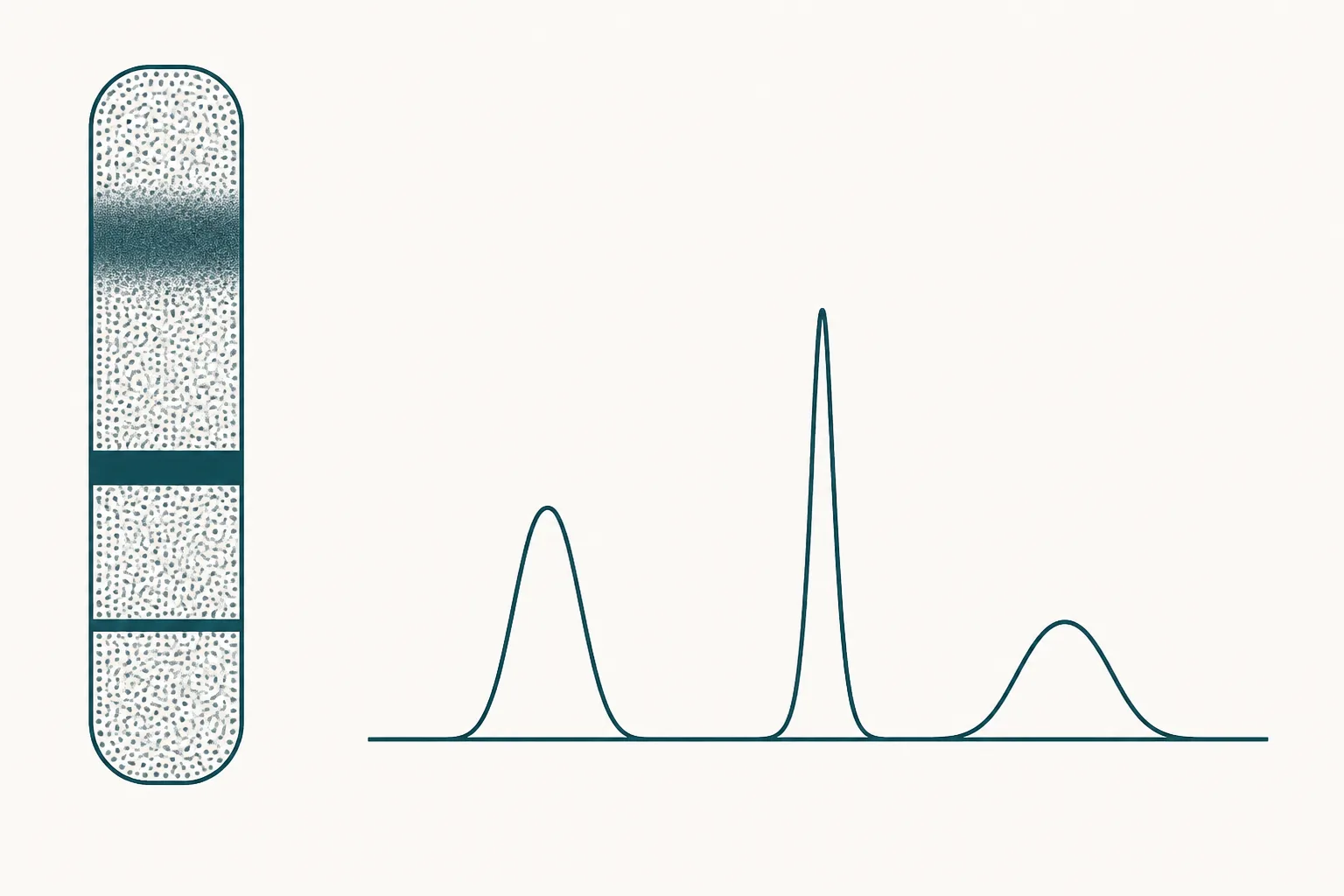
A botanist with a glass tube
The mechanism Tswett had stumbled into is worth stating plainly, because everything that follows is a variation on it. Two phases are involved: something that stays put — the powder in the tube — and something that moves, the solvent flowing past it. Every molecule in the sample divides its time between the two. A molecule with a strong affinity for the powder spends most of its time adsorbed and creeps down the column. A molecule that prefers the solvent spends most of its time moving and travels quickly. The difference need not be large. It only has to be consistent, because the column applies it thousands of times over, and small consistent differences repeated thousands of times become enormous ones.
Tswett published in Russian and German journals between 1903 and 1910 and was then, for practical purposes, forgotten 1. Part of the reason was scientific: an influential chemist of the day disputed his conclusions about the pigments, and the dispute contaminated the method along with the finding. Part of it was linguistic and geographic. Part was simply that the technique looked like an obscure botanical trick rather than a general principle. It was not seriously revived until the early 1930s, when chemists working on carotenoids picked it up again, and by then Tswett had been dead for over a decade.
Two liquids, and the prize that followed
The next move came from an unglamorous direction: the British wool industry. Archer Martin and Richard Synge were trying to work out the amino acid composition of wool proteins, and were defeated by the same problem Tswett had faced — a mixture of very similar molecules and no way to resolve them. Their innovation, published in 1941, was to replace the adsorbing powder with a second liquid, held immobile on an inert support, so that molecules partitioned between two liquids rather than sticking to a solid 2.
That paper is remarkable for a second reason. Alongside the practical method it laid out a theory of what a column is actually doing, borrowing the idea of theoretical plates from distillation engineering, and in doing so it turned chromatography from a craft into something that could be designed. It also, almost as an aside, suggested the separation could be run on a sheet of filter paper instead of in a tube — which is what paper chromatography turned out to be, and paper chromatography is the technique that made it possible to work out the sequence of insulin later that decade.
Martin and Synge took the Nobel Prize in Chemistry in 1952. Martin's lecture is worth reading for the tone alone: it treats the method as an engineering problem with an unfinished specification, and spends much of its length on what was still wrong with it 3. Two things it flagged — that speed was limited by how fast the liquid could move, and that efficiency improved as the packing got finer — describe precisely where the field went next.
Pressure, particle size, and the pump
The theory of column efficiency that emerged through the 1950s carried an inconvenient consequence. The finer the particles packed into the column, the shorter the distance a molecule has to diffuse to reach the stationary phase, the less its band spreads out as it travels, and the sharper the peak that emerges. Smaller is simply better, and by a large margin.
The problem is that packing a tube with very fine particles is also an excellent way of blocking it. Gravity, which had pulled Tswett's solvent through his chalk, cannot push liquid through a bed of ten-micron particles at any useful rate. If the field wanted the efficiency, it had to supply the pressure, and that meant pumps that could deliver a steady flow against hundreds of atmospheres, columns built to contain it, injectors that could introduce a sample into a pressurised stream without depressurising it, and detectors that could read a peak passing in a few seconds.
Csaba Horváth's group at Yale reported one of the first working instruments of this kind in 1967, under the name fast liquid chromatography, separating nucleotides on a pressurised column of pellicular particles 4. Within a decade the approach had a settled acronym. It originally stood for high-pressure liquid chromatography, an honest description of the engineering; the industry later rebranded it high-performance, which is better marketing and slightly less informative.
The technique that happened to suit peptides
Classical chromatography used a polar stationary phase and a non-polar solvent. Reversed-phase inverts both: the stationary phase is made deliberately greasy, typically silica with long hydrocarbon chains bonded to its surface, and the mobile phase is water mixed with an organic solvent. Molecules are retained according to how much of a water-averse surface they present. Start with mostly water, so everything sticks at the head of the column, then raise the organic fraction steadily and each component releases at the point where the solvent has become hospitable enough for it.
It suited peptides almost by accident, and unusually well 5. A peptide's retention depends on the collective hydrophobicity of its side chains, which means sequence differences translate into retention differences. Two chains differing by a single residue often separate cleanly. The water-and-organic mobile phase, usually with a small quantity of an acidic additive to sharpen the peaks, does not denature anything irreversibly for a short chain, and the solvent evaporates readily afterwards — so the same run that analyses the material can be scaled up to purify it, and the collected fraction dries down to solid peptide.
That last property is why the technique became the backbone of the field rather than one tool among several. Synthesis on a solid support delivers the wanted chain mixed with chains that missed a coupling, chains that lost protection early, and reagent residues. Reversed-phase separation is what turns that mixture into a defined product. It is the purification step and the assessment step, performed on the same instrument with the same chemistry.
What a purity number does and does not say
So a number entered ordinary circulation. Run the material, let the detector record absorbance as each component leaves the column, integrate the area under every peak, and express the main peak as a percentage of the total area. That is where a figure like 98 per cent comes from. It is a real measurement, reproducible, and far more informative than nothing.
It is also narrower than it sounds, in four specific ways that are rarely printed beside it.
- It is relative, not absolute. The figure compares peaks to each other, so it describes composition among the things that both eluted and absorbed — never the fraction of the vial's contents that is peptide.
- It is blind to whatever does not absorb at the chosen wavelength. Peptide analysis usually reads the amide bond in the low ultraviolet, which sees the backbone but is largely deaf to salts, counterions and residual solvent.
- It reports one method's view. Anything that co-elutes with the main peak is counted inside it. A closely related impurity — a chain missing one internal residue, or an oxidised variant — is exactly the kind of thing most likely to travel alongside the parent.
- It says nothing about mass or identity. A pure substance that is the wrong substance produces an excellent chromatogram.
None of this makes the number dishonest. It makes it partial, which is the ordinary condition of every analytical measurement, and it is why a chromatographic purity figure is conventionally reported next to a mass measurement rather than instead of one. The two instruments answer different questions and neither answers the other's. A column tells you how many distinct things came off it and in what proportion. It cannot tell you what any of them are.
That division of labour is the quiet end of a long story. Tswett's tube of chalk resolved a question about leaf pigments that had been argued about for decades, and did it in an afternoon, and was then ignored for twenty-five years. Its descendant is now so routine that its output is a single figure on a document, quoted without the wavelength, the gradient or the column that produced it — the sure sign of an instrument that has finished being interesting and become infrastructure.
References
- M. S. Tswett and the discovery of chromatography I: Early work (1899-1903)
- A new form of chromatogram employing two liquid phases. 1. A theory of chromatography. 2. Application to the micro-determination of the higher monoamino-acids in proteins
- The Development of Partition Chromatography (Nobel Lecture)
- Fast liquid chromatography: an investigation of operating parameters and the separation of nucleotides on pellicular ion exchangers
- Reversed-Phase High-Performance Liquid Chromatography