how a peptide is made today
The Freeze-Dryer and the Cake
The white puck at the bottom of a vial is the fossil of a three-day process: a solution frozen on a steel shelf, its ice pulled off as vapour under vacuum, its last traces of water coaxed out by gentle heat. Every feature of the cake records something about how that went.
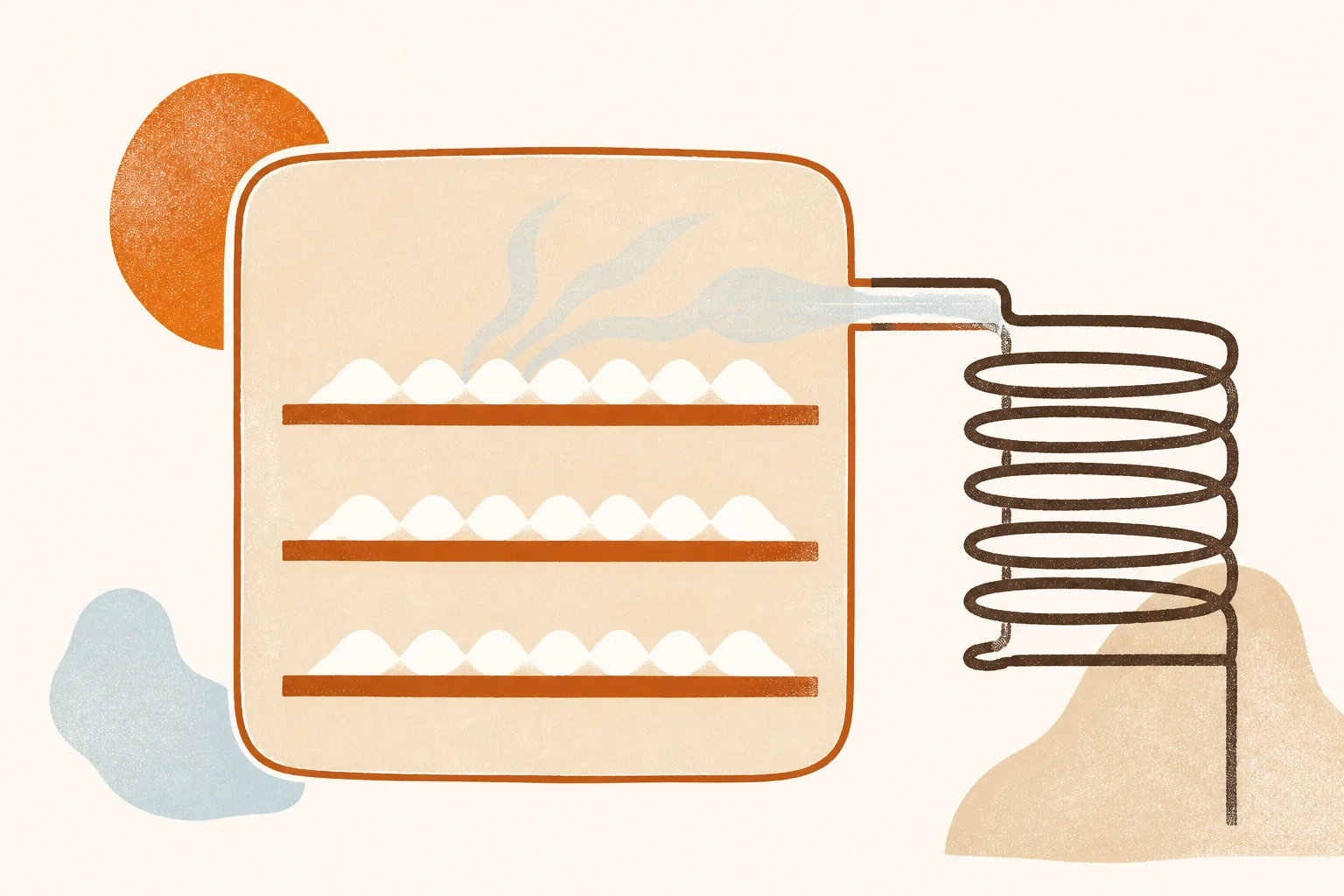
The loading happens fast, because nothing is supposed to warm up. Trays of filled glass containers, their rubber stoppers perched half-in so that vapour can escape past a notch in the side, slide onto steel shelves inside a chamber the size of a wardrobe. The door swings shut against a thick gasket. Coolant begins to circulate through the shelves, and over the next few hours the clear liquid in each container turns opaque and white as it freezes solid. Then the pumps start. Freeze-drying — lyophilisation, in the industry's word — works by freezing a solution and then, under a deep vacuum, turning the ice directly into vapour without it ever melting, before a gentler heating removes the water still clinging to the solid. What is left behind, days later, is the cake: a dry, porous skeleton of whatever was dissolved in the water.
The cake is not incidental to the process. It is the process, preserved. Its height, its texture, the way it sits against the glass, whether it has shrunk or cracked or slumped — each of these records something about what happened on the shelves, and learning to read them is a small skill with a long history in pharmaceutical manufacturing.
Why anyone goes to the trouble
Water is where most of a peptide's chemical misfortunes happen. Dissolved, the chain is free to move, to meet other molecules, to have its backbone bonds attacked and its more vulnerable side chains altered. Remove the water and those reactions slow to a crawl, because the molecules are locked into a solid with nowhere to go. That is the whole purpose of the exercise: to take a purified solution that would degrade in days or weeks and turn it into something that can be stored and shipped.
The obvious alternative, simply evaporating the water with heat, would cook a fragile molecule and leave it as a glassy smear that dissolves reluctantly. Freeze-drying removes the water at low temperature and leaves behind a structure with an enormous internal surface, which is why a good cake takes up liquid again in seconds. The price is time, energy and a machine that is expensive to buy and run. Reviews of the field open, with some candour, by pointing out that many commercial cycles are neither as robust nor as efficient as they could be 1.
The freeze sets the architecture
Freezing looks like the simple step. It is arguably the most complicated 2. Pure water in a clean container does not freeze at zero degrees; it supercools, staying liquid well below its freezing point until something triggers the first crystal. When nucleation finally happens it spreads rapidly, and the degree of supercooling at that moment decides the size of the ice crystals. Deep supercooling produces many small crystals. A shallow one produces fewer, larger ones.
That matters because of what happens next. As the ice forms, the dissolved peptide and any other solids are squeezed into the narrow spaces between the crystals, concentrating into a thin, glassy or crystalline web. When the ice is later removed, the spaces it occupied become the pores of the cake. Small crystals leave small pores, which resist the escape of vapour and slow the drying; large crystals leave wide channels. Because nucleation is random, containers on the same shelf can freeze differently and dry at different rates. Techniques that force every container to nucleate at the same moment, or that hold the frozen product just below its melting point for a while to let small crystals grow into large ones — annealing — exist largely to tame that randomness 2.
Primary drying: ice without melting
Once everything is frozen, the pumps pull the chamber down to a pressure of a fraction of a millibar. A condenser — a coil or plate held far colder than the product — sits in or beside the chamber. Then the shelves are warmed, slightly. At that pressure the ice cannot melt; given a little heat, it sublimes, passing straight from solid to vapour. The vapour drifts to the condenser and freezes there. Over the course of primary drying, most of the water in the load moves from the containers to the coil.
Inside each container, the process has a shape. Sublimation starts at the top surface and a drying front moves slowly downward, leaving dried cake above it and frozen solution below. Vapour from the front must find its way up through the pores already emptied, which is why pore size matters so much. The heat to drive sublimation comes up from the shelf through the glass. Too little and drying takes forever. Too much and the product itself warms.
That is the central constraint of the whole cycle. Every formulation has a critical temperature — a collapse temperature for amorphous solids, a eutectic temperature for crystalline ones — above which the freeze-concentrated web softens enough to flow. If the product at the drying front rises above it, the pores the vapour needs slump shut and the structure caves in 1. The art of cycle design is to run the product as warm as possible, because every degree speeds sublimation, while never crossing that line. A few degrees of margin can make the difference between a cycle of one day and one of several 14.
Secondary drying and the stopper
When the ice has gone the cake still holds water — not as ice, but bound to the solid itself, spread through the glassy web. Secondary drying drives it off. The shelves are warmed further, often to around room temperature or above, and held there for hours while the water desorbs and makes its way to the condenser. The target is a low residual moisture, typically a few per cent or less, decided in development for each product because too much water speeds degradation and, for some formulations, too little can also cause trouble 1.
Then comes a moment of quiet engineering elegance. With the chamber still under vacuum, or backfilled with dry nitrogen, the shelves are driven together hydraulically and every half-seated stopper is pressed fully home at once. The containers are sealed before the door opens, so the dried cake never meets the humid air of the room.
Reading the cake
The ideal is sometimes called an elegant cake: a uniform, matt-white cylinder occupying the same volume as the liquid did, with smooth sides and a flat top. Pharmaceutical products often achieve it with the help of bulking agents — a crystalline sugar alcohol such as mannitol gives a firm, bright structure; amorphous sugars give a denser, glassier one. A research peptide filled with no bulking agent at all is a different object. A small amount of solid spread across the volume of the original solution leaves a thin, fragile skeleton: a small puck, a papery film, sometimes little more than a haze on the glass. Its unimpressive look reflects how little solid was there, not how badly it was made.
An industry working group that set out to define what cake appearance is acceptable made the essential distinction between features that are cosmetic and features that indicate a failure 3. The first category is broad.
| What you see | What usually happened | Usually a concern? |
|---|---|---|
| Cake pulled slightly away from the wall | Normal shrinkage as the solid dried | Usually cosmetic |
| Fine cracks or a split top | Stress in the drying solid | Usually cosmetic |
| Dense skin or crust on the top surface | A concentrated layer formed during freezing | Can slow drying; formulation-dependent |
| Partial slumping or visible loss of structure | Product exceeded its collapse temperature | Yes — may raise moisture and slow dissolution |
| Shiny, glassy pool at the bottom (meltback) | Ice melted before it sublimed | Yes — drying was incomplete |
The authors were careful not to overstate the case either way. Collapse does not automatically mean a damaged molecule, and many products tolerate a degree of it; it does usually mean higher residual moisture and slower reconstitution, and it always means the cycle did not behave as designed 3. What the cake cannot reveal is identity or purity. It is a record of the physics of drying, and nothing else.
The end of the line
A freeze-dryer is the last piece of heavy equipment most peptides pass through. After it come the crimping machine that fixes an aluminium seal over each stopper, the inspection line, the label, the box. By the time the container leaves the plant, every decision that shaped the cake — how the solution was formulated, how it froze, how warm the shelves were allowed to get, how long secondary drying ran — has been made and cannot be revisited.
Which is also the point at which the story changes hands. The cake leaves the chamber dry and sealed. From then on the questions are about keeping it that way: how moisture creeps back through a stopper, what temperature and light do over months, when a cake that looks different is telling you something and when it is only showing you how little powder there is. Those are questions of storage and handling rather than manufacture, and they belong to a technical manual rather than a magazine.
References
- Design of freeze-drying processes for pharmaceuticals: practical advice
- The freezing step in lyophilization: physico-chemical fundamentals, freezing methods and consequences on process performance and quality attributes of biopharmaceuticals
- Lyophilized Drug Product Cake Appearance: What Is Acceptable?
- Practical Advice on Scientific Design of Freeze-Drying Process: 2023 Update