how a peptide is made today
Inside a Solid-Phase Synthesiser
The invention of the method is a famous story. The working day is not. One shift at a modern synthesiser, from a weighed-out resin to the grey pellet at the bottom of a centrifuge tube, and the arithmetic that decides how much of it is worth keeping.
The shift starts with a balance, not a machine. Before anything is switched on, someone weighs out a few grams of resin — pale, free-flowing beads that look like fine sand and feel like nothing at all — and tips them into a glass vessel with a sintered disc at the bottom. Then a solvent goes in, and the beads do something unexpected: they swell, visibly, to several times their dry volume, like a sponge taking on water. That swollen bed is where the peptide will be built. This is how peptides are manufactured today: one amino acid at a time, on the surface and inside the swollen body of those beads, in a cycle of deprotection, coupling and washing that a synthesiser repeats once for every residue in the sequence, before the finished chain is cut free on the last day.
The origin of the method has been told on this site before — the chemist, the bead, the Nobel Prize. This piece is about the working day that the idea turned into sixty years later: what the operator actually watches, the small tests that decide whether a step has worked, and the unforgiving arithmetic that governs everything that comes off the resin at the end.
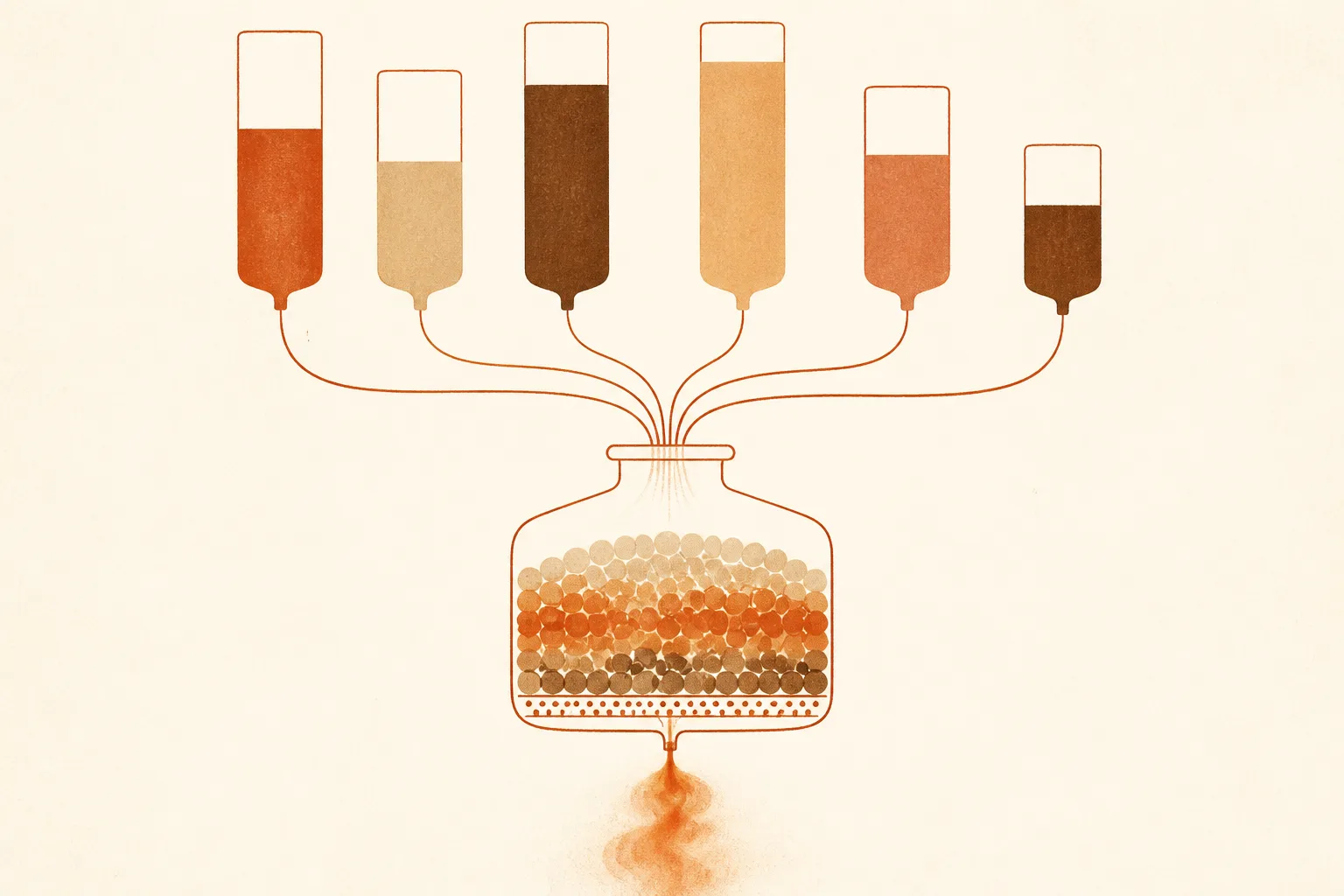
Choosing the bead
The first decision of the day is made before the synthesiser runs at all, and it concerns the far end of the molecule. A peptide is built backwards relative to the way a cell makes it: the last residue in the written sequence goes onto the bead first, and the chain grows towards the front. Whatever links that first residue to the bead will decide what the end of the finished molecule looks like when it is finally released.
Some resins carry a linker that lets go of the chain as a free carboxylic acid. Others release it as an amide, which matters because a great many natural peptide hormones end in an amide rather than an acid, and the difference can decide whether the molecule binds its receptor at all. A third family holds the chain so lightly that it can be released with dilute acid while its side-chain protection stays in place — useful when a protected fragment is wanted for joining to another one later. The bead itself is usually cross-linked polystyrene, the material of the original 1963 paper, or a polystyrene grafted with polyethylene glycol, which swells better in a wider range of solvents and tends to behave more kindly towards awkward sequences 14.
Loading matters too. A resin loaded densely with starting points gives more product per gram, but crowded chains on neighbouring sites can tangle as they grow. For a short, well-behaved sequence the dense resin is fine. For a long one the operator will often choose a lighter loading and accept less material in exchange for a chain that has room to be reached by the reagents.
Two kinds of armour
Every amino acid that goes into the synthesiser arrives from the supplier already dressed. Its amino end wears a temporary protecting group, and any reactive side chain — the extra acid on aspartate, the amine on lysine, the hydroxyl on serine — wears a permanent one. The logic, which an earlier generation of chemists would have recognised at once, is that only one bond may form at a time.
What made the modern method practical was finding a pair of protecting groups that come off under opposite conditions. The temporary group on almost every modern synthesiser is Fmoc, introduced in 1972 as an amino-protecting group removed by a mild organic base rather than by acid 2. The side-chain groups are acid-labile, typically based on the tert-butyl group, and they sit untouched through dozens of base treatments until the last day. Chemists call this orthogonality: two sets of locks, two different keys, and no risk that turning one opens the other. The older strategy relied on acids of different strengths for both jobs and needed extremely hazardous hydrogen fluoride at the end; the milder Fmoc route is a large part of why peptide synthesis became something a contract plant or a university core facility could run routinely 5.
What the operator watches
Once the program is loaded, the cycle looks, from the outside, like almost nothing. A solution of piperidine in solvent floods the vessel, sits for a few minutes, drains. That strips the Fmoc group from the growing end. The Fmoc fragment that comes away reacts with piperidine to form a compound that absorbs strongly in the ultraviolet, and many synthesisers pass the drained liquid through a detector for exactly that reason. The height of the signal is a live report on how many chain ends were just unmasked. If it falls steadily from one cycle to the next, fewer chains are being deprotected, and something on the resin is starting to go wrong.
Then the washes — several of them, each a flood and a drain — and then the coupling. The next protected amino acid arrives in excess, together with an activating reagent that turns its acid end into something reactive enough to bond with the free amine on the resin. Carbodiimides paired with an additive such as Oxyma, or aminium-type reagents, do most of this work today 5. The mixture sits, is agitated by nitrogen bubbling or gentle shaking, and drains. More washes. The vessel is ready for the next residue.
On a manual bench or when a step is suspected of being difficult, somebody takes out a few beads with a spatula and runs a colour test. The reagent is ninhydrin, and the test dates from 1970: free primary amines turn the beads a deep blue, so blue beads after a coupling mean the new residue did not attach everywhere it should have 3. Pale yellow means the step went through. It is a crude instrument by modern standards, qualitative and blind to certain residues, and it remains one of the most-used checks in the field because it takes a few minutes and needs a pinch of material.
The sequences that fight back
Most cycles are uneventful. Some are not, and experienced operators can often point to the stretch of a sequence that will cause trouble before the run begins. The problem is usually aggregation. As the chains lengthen, neighbouring chains on the same bead can hydrogen-bond to one another and fold into sheet-like structures, particularly through runs of water-averse residues. The resin bed visibly shrinks. Reagents can no longer reach the chain ends buried inside the tangle, deprotection slows, couplings stall, and the ultraviolet trace sags 4.
The remedies are a repertoire rather than a cure. Heat helps, and many modern instruments warm the vessel, some with microwave energy, to loosen the tangle and speed up slow steps. Special building blocks help more: pseudoproline dipeptides and backbone-protected residues put a deliberate kink in the chain that stops it lining up with its neighbours, and are removed at the end with the rest of the protection 45. A step can simply be run twice. None of these is free. Heat accelerates side reactions as well as couplings, the most notorious being the tendency of aspartate residues to curl back on themselves and form a ring called an aspartimide, which later reopens into by-products that are almost impossible to tell apart from the product.
The arithmetic of thirty couplings
All of this tending — the colour tests, the double couplings, the careful choice of resin — exists because of one piece of arithmetic that nobody on the shift can negotiate with. The fraction of chains that come out complete is the per-step success rate multiplied by itself once for every coupling. For a 30-residue peptide, a respectable length for a research sequence, the numbers run like this.
| Efficiency per coupling | Full-length after 30 couplings | Everything else in the vessel |
|---|---|---|
| 98% | about 55% | about 45% |
| 99% | about 74% | about 26% |
| 99.5% | about 86% | about 14% |
The shape of those figures is the point. A one-percentage-point improvement per step, invisible in any single cycle, is worth nearly twenty points of full-length product at the end. That is why a stalled coupling at residue twelve is treated as an event rather than a rounding error, and why a longer sequence is not merely more work but a different kind of project.
The missing fraction does not disappear. It stays on the resin as a crowd of near-relatives — chains missing a residue somewhere, chains capped short, chains carrying a side reaction — and it will all come off the beads together with the product on the last day.
The solvent nobody sees
Watch a synthesiser for an hour and the thing that registers most is not the chemistry but the liquid. Every step ends in a drain and every drain is followed by washes. The waste carboys under the bench fill steadily through the shift. An industry working group reviewing peptide production put the mass of material consumed per kilogram of finished peptide in the thousands of kilograms, the great majority of it solvent from synthesis and the purification that follows, and identified replacing the classic dipolar aprotic solvents as one of the field's central sustainability problems 6. For the operator that abstraction is concrete: it is the carboy that needs changing before the next run can start.
Cleavage day
When the last residue has gone on and its Fmoc group has come off, the resin is washed, shrunk with a volatile solvent and dried. It looks almost exactly as it did at the start of the run, a little heavier and a little more yellow. Everything that has been built is invisible.
Then comes the step the whole orthogonal scheme was designed around. The dried resin goes into a cocktail that is mostly trifluoroacetic acid, spiked with small amounts of water and scavengers such as triisopropylsilane — and, for sequences rich in cysteine or methionine, sulphur-containing thiols whose smell announces the day to everyone on the corridor. Over two or three hours the acid does two jobs at once: it snaps the chain off the linker, and it strips every permanent side-chain protecting group. The scavengers are there to catch the reactive fragments that those groups release before they can attach themselves to the peptide's own vulnerable residues 45.
The resin is filtered off and thrown away, its job finished. The acid solution, now carrying the peptide, is dripped into a large volume of ice-cold ether, and a white cloud forms at once as the chain, insoluble in ether, falls out of solution. A centrifuge packs it into a pellet at the bottom of the tube. The ether is poured off, the pellet washed and dried.
That pellet is the product of the shift, and it is where the popular picture of peptide making tends to end. It should not. The crude material is the target sequence mixed with every deletion, truncation and side-product the arithmetic predicted, and it still carries acid from the cocktail. For a well-behaved short sequence the main component might dominate; for a long or difficult one it might be a modest share. Nothing in it is ready for anyone's bench. The next stage — a preparative column, a fraction collector and a chemist deciding which fractions to keep — is where purity is actually made, and it is where the next story begins.
References
- Solid Phase Peptide Synthesis. I. The Synthesis of a Tetrapeptide
- 9-Fluorenylmethoxycarbonyl amino-protecting group
- Color test for detection of free terminal amino groups in the solid-phase synthesis of peptides
- Solid-phase peptide synthesis: from standard procedures to the synthesis of difficult sequences
- Advances in Fmoc solid-phase peptide synthesis
- Sustainability Challenges in Peptide Synthesis and Purification: From R&D to Production