The Machine That Read a Protein One Letter at a Time
A Swedish chemist devised a reaction in 1950 that peeled one amino acid at a time from a chain. Seventeen years later, in a Melbourne hospital laboratory, he and a colleague built a machine to do it unattended. It ruled protein chemistry for two decades, then was overtaken.
Pehr Edman, a Swedish chemist working in Melbourne, built the first automatic protein sequencer in the 1960s by turning a reaction he had devised in 1950 into a machine that stripped one amino acid after another from a protein and identified each as it came off 24. It then dominated protein chemistry for roughly two decades, until DNA sequencing and mass spectrometry made reading a protein letter by letter unnecessary for most purposes. The machine did not fail. It was overtaken by methods that did the same job faster and from different material.
Imagine the scene in a laboratory in a Melbourne hospital in the early 1960s: a chemist and a technician with no formal scientific qualifications begin to build, from glassware, tubing and a motor, a spinning cup that is meant to read a protein without a human hand touching it. Everything that follows is about whether that was a reasonable thing to attempt, and why it worked.
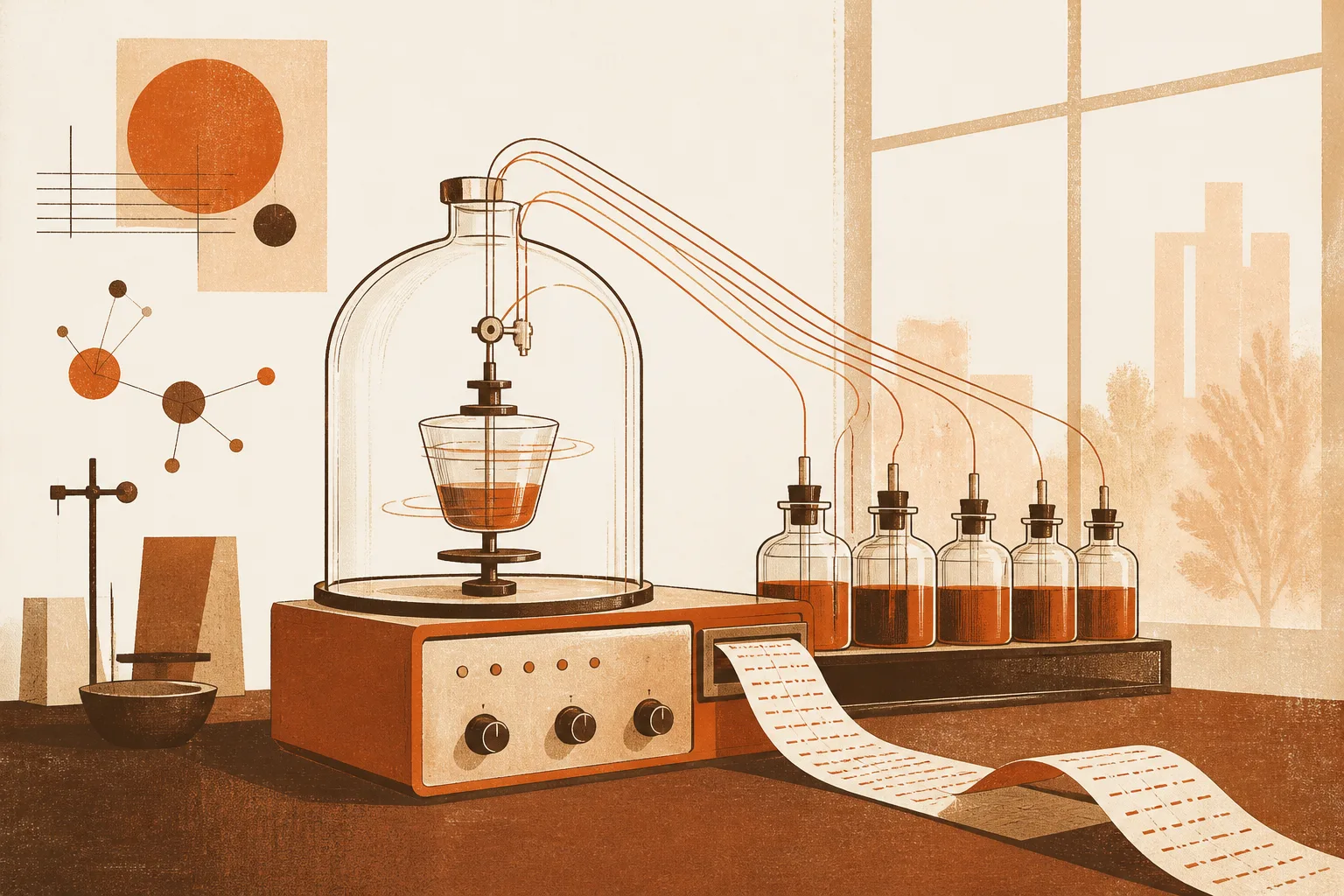
A reagent that takes one residue at a time
Before Edman, the standard way into a protein's sequence was chemically rough. Frederick Sanger's reagent, used for his work on insulin in the early 1950s, labelled the amino end of a chain, but once labelled the end was fixed: breaking the chain apart to read it destroyed the very order the chemist wanted. To learn a sequence Sanger had to cut insulin into many fragments, identify them and assemble the fragments like a jigsaw.
Edman's idea, which he described in Acta Chemica Scandinavica in 1950, was to find a reagent that would label the amino end and then allow that single residue to be cleaved off without breaking any other bond 4. Phenyl isothiocyanate does this. Under mildly alkaline conditions it couples to the amino end of the chain. When the chemist then changes to acid, the labelled residue is released as a derivative that can be identified, and the rest of the peptide, one residue shorter, is ready to begin again.
The elegance is in the repetition. The reaction is a cycle, and a cycle can in principle be run as many times as the chain is long. The human who runs it by hand, though, is the limit.
Why ten residues was the practical limit by hand
Each cycle is a sequence of extractions, evaporations and transfers, and at each stage a few per cent of the material is lost or damaged. The losses compound, which is the same arithmetic that governs a peptide synthesiser run in reverse. After a handful of cycles by hand the signal had faded and the background of mistakes had grown, so that reading much beyond the first ten or so residues was unreliable. A protein of several hundred residues had to be cut into pieces short enough for the method to cope.
| Problem | By hand | On a machine |
|---|---|---|
| Material lost at transfers | Several transfers per cycle | Reaction kept in one cup |
| Operator time | A working day for a few cycles | Cycles run unattended |
| Consistency | Varies with the operator | Same timing and volumes every cycle |
| Identification of each residue | Separate manual analysis | Collected for analysis in order |
St Vincent's, Melbourne: an unlikely workshop
Edman had trained in Sweden and worked at Lund before moving to Australia in the 1950s to take up a post at St Vincent's School of Medical Research in Melbourne, a research unit attached to a hospital 1. It is not the first place anyone would look for the birth of an instrument that changed biochemistry. The laboratory was small, the resources modest, and the people available were not the large teams of the major institutes.
His collaborator on the machine was Geoffrey Begg, an instrument maker and technician who is credited as co-author on the 1967 paper describing the sequenator 2. The pairing of a gifted chemist with a skilled maker of apparatus is the standard recipe for scientific instruments, and it recurs across this history, from the people who built the first ultracentrifuges to those who put synthesisers on a bench. The contribution of the person who could make a thing work in glass and metal is easily left out of the later telling.
The spinning cup
The design solved the loss problem by keeping the protein in one place. The sample was held in a glass cup that rotated at speed, spreading it as a thin film over the inner wall. Reagents and solvents were delivered in measured amounts from a bank of reservoirs, in a controlled atmosphere of inert gas, and removed again by the same route. Because the protein never left the cup during the reaction, none of the transfers that wore down the manual method took place. The liquids that carried away the released residues were collected and passed on for identification 2.
The 1967 paper in the European Journal of Biochemistry reported the machine working on real proteins. Accounts of the period describe a test on a protein from a whale, the sort of large, well-characterised molecule used to prove a method, and a run of several dozen residues in sequence, far beyond what could be done by hand. The exact figures are best read from the paper and from the later methods chapter that described the instrument in detail 23. What mattered historically was the demonstration that a sequence could be read mostly without a human being.
What the sequenator did to protein chemistry
Once the machine existed, it spread. Commercial versions appeared in the early 1970s, and by the middle of that decade protein sequences were accumulating in a way they never had before. Laboratories that could not have afforded years of fragment-by-fragment work could now put a purified protein into an instrument and have a sequence read overnight.
The effects were large and indirect. Sequences made it possible to compare proteins across species and to see families of related molecules. They allowed chemists to design synthetic peptides from known sequences, which links this story to the peptide-making articles on this site. And they gave molecular biologists the amino acid sequences from which short stretches of the corresponding gene could be guessed and then hunted. Much of what came to be called molecular biology in the 1970s and 1980s leaned on sequences produced by this instrument.
In the early 1980s a group at the California Institute of Technology described a more sensitive design that reacted the sample in the gas phase, which allowed sequences to be read from far smaller amounts of protein. The refinement kept the underlying chemistry and extended the method's life.
Munich, and an early death
Edman himself left Melbourne in the early 1970s to take a position in Germany, at a Max Planck institute near Munich, where he continued to work on instrumentation. He died in 1977, still in his early sixties, before the technology he had begun was displaced 1. His obituary in the Australian record places him among the figures whose work reshaped a field from a modest base.
Mass spectrometry and DNA: the eclipse
Two developments ended the sequenator's reign. The first was the maturing of DNA sequencing in the late 1970s. Reading a gene is faster and cheaper than reading the protein it encodes, and the protein's sequence follows from the genetic code. Once the methods for cloning and sequencing genes were routine, the question what is the sequence of this protein was often answered without touching the protein at all.
The second was mass spectrometry. New ways of getting large molecules into the gas phase intact, introduced in the late 1980s, allowed a spectrometer to read the sequence of a peptide from the masses of its fragments, from far less material and in far less time than a chemical cycle needed. The earlier article on the weighing machine tells that story. For a protein of unknown sequence, the instrument that had once been indispensable became an occasional tool.
Where the analytical articles take over
Edman chemistry did not vanish. It remains useful where a clear, direct reading of the first several residues of a purified protein is what is needed, as a check on identity or to establish whether the amino end is chemically blocked. It has limits that follow from its design: it reads from one end only, it cannot proceed past a blocked end, and its yield per cycle falls steadily with length.
The technical handbook on this network covers how sequence confirmation is done in the laboratory today. This piece has only tried to restore the instrument's biography: a reagent, a spinning cup, a hospital laboratory in Melbourne, and two men who built a machine to read the letters of life one at a time.