turning points
The Machine That Made Peptides Cheap
For a chemist in the 1950s, assembling a chain of nine amino acids was the work of years and worth a Nobel Prize. Then Bruce Merrifield fixed his molecule to a plastic bead, and the arithmetic of an entire field changed.
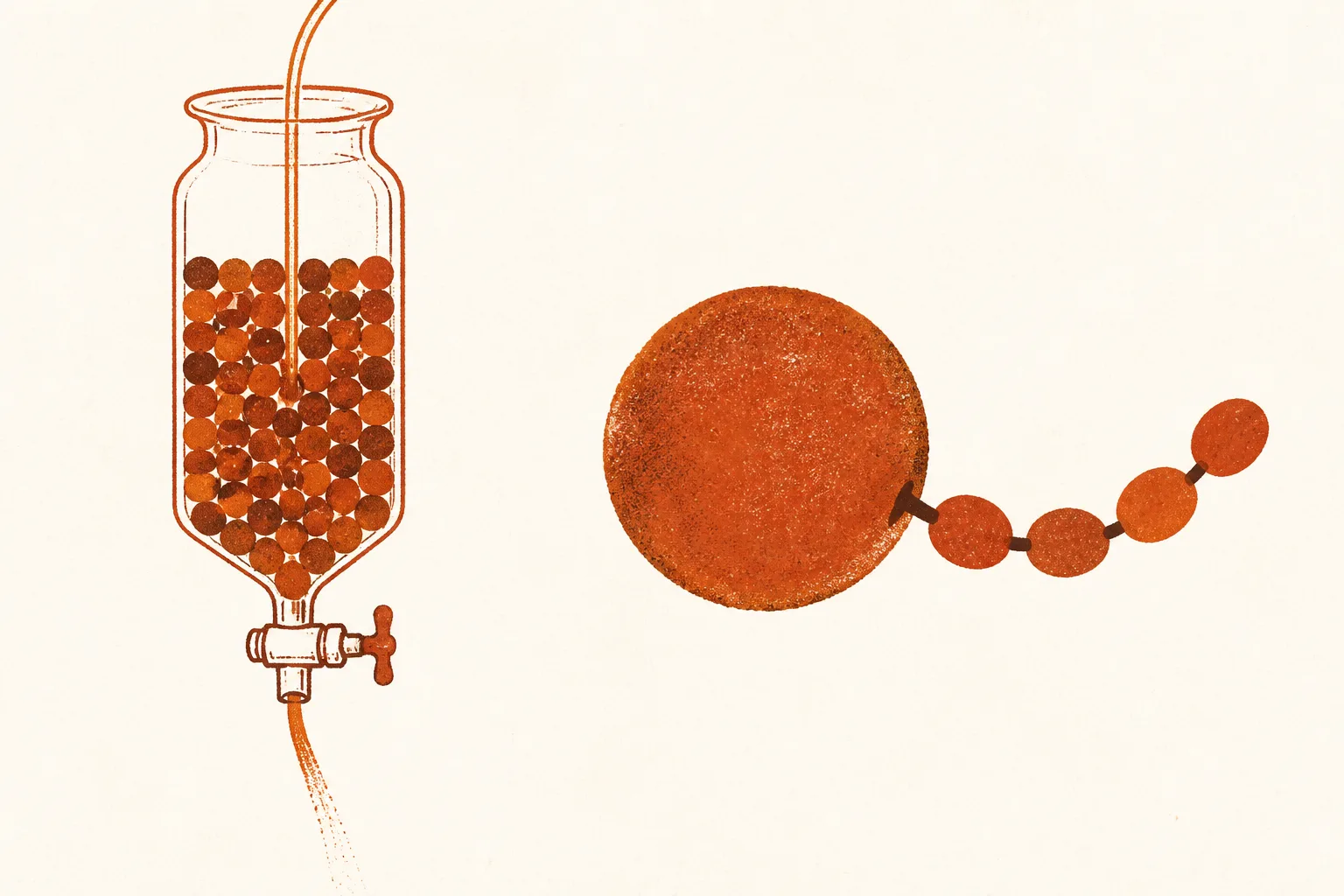
In a laboratory somewhere this morning, a squat machine is rocking a vessel of plastic beads in a bath of solvent. Every half hour or so it pumps in a fresh reagent, waits, then drains the vessel and rinses it out. Each rinse leaves the beads fractionally heavier, because one more amino acid has been fixed to a chain growing on their surface. That is how peptides are actually made: not extracted from tissue, not brewed in a fermenter, but assembled residue by residue on the outside of an insoluble bead, with every surplus reagent and by-product washed down the drain before the next addition. The technique is solid-phase peptide synthesis, it runs largely unsupervised, and it is why a short peptide is a routine reagent rather than the work of a career.
None of that was true seventy years ago. What separates the two states of affairs is one idea, published in 1963 by a chemist most people outside the field have never heard of — and it is simple enough that the hardest thing about it now is believing nobody had it sooner.
The years it used to take
To see why a bead mattered, sit with what preceded it. A peptide is a chain of amino acids joined by amide bonds, so in principle making one means forming those bonds in the right order. In practice an amino acid is awkward: it carries a reactive amine at one end and a reactive acid at the other, so mix two together and they join in whatever combinations they please, in either direction, and polymerise into a useless tar.
The classical answer was protection. Every reactive group not currently wanted got capped with a blocking group, so exactly one bond could form at a time. Couple the next residue, uncap the new end, couple the one after. That logic is sound and it is still the logic used today. The problem was never the coupling. It was everything that had to happen afterwards.
Because the reaction ran in solution, the product ended up dissolved among the leftovers: unreacted starting material, the reagent used to force the bond, the by-products it threw off, fragments that had coupled twice or not at all. All of it had to be separated from the growing chain before the next residue could go on — by crystallisation, by extraction, by column chromatography, by whatever the intermediate would tolerate. Each separation cost a day or more of skilled work, and each left product behind.
The losses compounded. Ten steps recovering eighty per cent apiece leaves about eleven per cent of what you started with; twenty steps leaves barely one. Anyone setting out to make a chain of real length was committing years to it and could expect to finish holding a few milligrams. Oxytocin, a hormone of nine residues, was synthesised in the early 1950s, and that was enough to be recognised with a Nobel Prize. Nine residues. Keep the number in view.
The molecule that could not run away
Merrifield's proposal ran to a few pages in the Journal of the American Chemical Society in 1963 and described the synthesis of a tetrapeptide — four residues, a deliberately unremarkable target, because nothing about the molecule was the point 1. The point was where it was standing.
Rather than build the chain in solution, he attached its first residue to a small bead of polystyrene, cross-linked so that it would swell generously in solvent but never dissolve. The chain then grew outward from the bead's surface, tethered at its carboxyl end, while the reactions went on around it in the surrounding liquid.
That single change is the whole invention. If the product is bolted to something you can catch on a filter, getting everything else away from it stops being a separation problem and becomes a rinsing problem. Pour in a large excess of the next protected amino acid, enough to drive the coupling nearly to completion however sluggish it is. Then open the tap. Solvent carries off the surplus, the by-products and the medium itself, and the peptide stays put, because it is nailed down.
The second consequence is less obvious and ultimately larger. Every step now ends in the same three operations — filter, wash, drain — so a craft has become a routine.
Deprotect, couple, wash, repeat
Stripped to its bones, the cycle runs like this.
- Deprotect: strip the temporary blocking group from the amine at the growing end of the chain.
- Wash: rinse away the deprotection reagent and what it removed.
- Couple: add the next protected amino acid in excess, with an activating agent that makes its acid group reactive enough to form the bond.
- Wash: rinse away whatever did not react.
- Repeat, once per residue, to the end of the sequence.
- Cleave: release the chain from the bead and strip the remaining side-chain protection, usually with strong acid.
Nothing in that list calls for a decision. The reagents differ from step to step only in which amino acid is delivered; the volumes, timings and valve openings are the same on the fortieth cycle as on the first. Merrifield saw this straight away and did the obvious thing — he built a machine to perform it. The first automated synthesisers were assemblies of pumps, valves, timers and a shaking vessel, and they turned a task measured in a chemist's years into one measured in the instrument's days 3.
Be precise about what automation achieved, because the popular version overstates it. The chemistry did not get easier; a difficult coupling remains difficult. What became trivial was the bookkeeping between reactions, and the bookkeeping was where the years had gone.
The enzyme that settled the argument
A method is not believed because it is elegant. It is believed when somebody uses it to do what the old method plainly could not, and in 1971 Merrifield and Bernd Gutte published the total chemical synthesis of ribonuclease A, an enzyme of 124 amino acids 2. Set against a nine-residue hormone that had consumed years, that was not an improvement in degree. The synthesis ran to several hundred chemical reactions and something on the order of twelve thousand automated steps, over weeks. No hand-run sequence of purifications could have been contemplated at that length.
But the result that mattered was not the chain. It was what the chain did. Released from the bead and allowed to fold, the synthetic material showed ribonuclease activity — it behaved as an enzyme. A protein assembled by a machine out of bottled reagents, with no cell and no ribosome anywhere in the process, had reached the same working three-dimensional structure as the natural article. That is a statement about biology as much as chemistry, and it closed any lingering question about whether synthesis was a serious route to biologically real molecules.
The arithmetic that sets the ceiling
The method carries one hard constraint, and it is arithmetic rather than chemistry. Because every residue goes on in a separate step, the overall yield is the yield of a single coupling multiplied by itself once for every residue in the chain. Small inefficiencies do not add up. They compound.
Take a coupling that succeeds 99 times out of 100, which is a good coupling rather than a routine one. A ten-residue peptide comes off the resin at about 90 per cent. A fifty-residue peptide finishes just under 61 per cent. A hundred residues falls to roughly 37 per cent. Nothing has gone wrong anywhere in that account — it is simply the yield when the chemistry behaves.
| Efficiency per coupling | 10 residues | 50 residues | 100 residues |
|---|---|---|---|
| 98% | 81.7% | 36.4% | 13.3% |
| 99% | 90.4% | 60.5% | 36.6% |
| 99.5% | 95.1% | 77.8% | 60.6% |
| 99.9% | 99.0% | 95.1% | 90.5% |
The missing fraction does not evaporate. It sits in the same vessel as chains that missed a coupling and carried on regardless, one residue short — deletion sequences, a term worth learning because it names the central purification headache of the field. A 49-residue chain missing one internal residue is very nearly the size, charge and polarity of the 50-residue chain you wanted, and telling the two apart is far harder than telling a peptide from a solvent.
That is why the practical ceiling for routine stepwise synthesis sits around fifty residues. Beyond it the wanted product becomes a minority component of an increasingly indistinguishable mixture. Longer molecules are generally grown in engineered cells rather than assembled chemically, or built by synthesising two shorter fragments and joining them at the end. The bead did not abolish the limit. It moved it, from roughly ten residues to roughly fifty, which covers most of what is biologically interesting in the peptide range 5.
A prize, and everything that came after it
Merrifield received the Nobel Prize in Chemistry in 1984, for developing a methodology of chemical synthesis on a solid matrix. By then the idea had escaped peptides altogether. The same logic — anchor the growing molecule, wash rather than purify, repeat one identical cycle — had been carried across to the automated synthesis of DNA, and from there into most of the technology that depends on making oligonucleotides to order. His own account of the method and its widening reach appeared in the middle of that decade 3.
The commercial consequence arrived quickly. Once a short peptide could be produced reliably, in days, by an instrument rather than an expert, it became possible to make a great many of them — to synthesise a hormone and forty variants, screen the lot, and keep whichever behaved interestingly. Peptide drug development as an industrial activity dates from that capability rather than from any discovery about peptides themselves. More than eighty peptide drugs have since reached the market worldwide, with a pipeline that has grown rather than contracted 4. Histories of the field divide it cleanly at 1963 for that reason 5.
What a bead is responsible for
Which brings the story to the present, and to a consequence Merrifield can hardly be held accountable for. Very nearly every research peptide in circulation today — the well-characterised ones, the thinly evidenced ones, and the ones whose marketing has comprehensively outrun their data — exists because his method made short peptides cheap. A compound with three mouse studies behind it and one with three decades of trials behind it cost roughly the same to make, because they come off the same kind of machine running the same cycle.
That is worth stating plainly, because it explains a shape the field has that is otherwise puzzling. The bottleneck in peptide research is not synthesis, and has not been since the 1960s. It is evidence — clinical evidence, in humans, at the scale that resolves a question — and evidence has not become cheaper at anything like the rate manufacture did. The gap between those two curves is where most of the confusion here lives 4.
The whole edifice — the industry, the catalogues, the long arguments about what any of it does — rests on a chemist deciding to stop chasing his product through one purification after another and bolt it to a bead instead, so the mess could be washed off. Everything after that is a rinse.