origins
How Insulin Changed What a Drug Could Be
A hundred years ago a protein went into a dying boy's arm and came out the other side as a medicine. Almost everything peptide science has done since walked through that door.
In the children's wards of 1920 there were beds nobody expected to need for long. A child admitted with what was then called sugar diabetes — thin, endlessly thirsty, breath faintly sweet like nail varnish — had a life expectancy measured in months, and the only treatment on offer was to eat almost nothing. Insulin mattered because it turned that sentence into a condition: within about two years of the first injections in a Toronto hospital, a disease reliably fatal in the young became one people lived with for decades. It mattered a second time, more quietly, for reasons with nothing to do with diabetes — insulin became the compound on which the whole idea of a protein as a medicine was built 4.
Almost everything peptide medicine has since become traces back through that one substance. And the parts of the story usually cut are the interesting ones.
What a diagnosis meant in 1920
Type 1 diabetes is, at bottom, a failure of admission. Glucose circulates in the blood; insulin is the hormone that tells cells to let it in. When the pancreatic beta cells that make insulin are destroyed — by the immune system, as we now understand it — sugar accumulates while the tissues that need it starve in the middle of plenty. The body then burns fat instead, and the ketones thrown off acidify the blood. Untreated, it ends in coma.
The one intervention that did anything was dietary, and it was brutal. From about 1915 the standard of care, associated above all with the American physician Frederick Allen, was severe caloric restriction — undernutrition imposed deliberately to cut the glucose load a failing pancreas could not handle. It bought months, occasionally a year or two, by making patients waste. Photographs from the period show children so emaciated it is hard to tell the disease from the treatment, and some on the regime died of starvation rather than diabetes. Their physicians knew. There was nothing else.
That the pancreas was implicated had been known since 1889, when removing the organ from a dog was found to produce diabetes, and attention had settled on the cell clusters scattered through it called the islets of Langerhans. That the islets might secrete something which could be taken out and given back had occurred to a great many people, and several got close; in Romania, Nicolae Paulescu published in 1921 on an extract that lowered blood glucose in dogs. The barrier was never the idea. It was that pancreatic tissue is loaded with digestive enzymes that destroy the very hormone you are trying to recover 4.
A summer in a borrowed laboratory
Frederick Banting was a young surgeon in London, Ontario, with a thin practice and no research background to speak of. Preparing a lecture in late 1920 he read a paper on the pancreas and had an idea: tie off the ducts carrying digestive enzymes out of the organ, wait for that tissue to wither, and whatever the islets secreted might survive to be recovered. He took it to John Macleod, professor of physiology at the University of Toronto, who knew how many had already failed. Macleod was unconvinced but not dismissive. He gave Banting bench space for the summer of 1921, a supply of dogs, and one student assistant — a post settled, by the account that has come down, by the toss of a coin. The winner was Charles Best.
Through that summer, with Macleod away in Scotland, the two worked their way to extracts that lowered blood glucose in dogs whose pancreases had been removed. Real proof of principle — and nowhere near a medicine. The material was crude and variable from batch to batch, injections raised sterile abscesses, and nobody could say what else was in the bottle.
The step that closed that gap is the one usually cut from the retelling. In December 1921 James Collip, a biochemist from Alberta on a sabbatical year in Toronto, joined the work and set about purification. Using fractional precipitation with alcohol — the active substance and the debris around it drop out of solution at different concentrations — he produced material clean enough to put into a person. An impure extract that works in a dog is a physiological finding; a purified one that can be injected repeatedly into a fourteen-year-old is a drug.
The fourteen-year-old was Leonard Thompson, at Toronto General, and the order of events is instructive. In January 1922 he received the earlier, cruder preparation; the effect was slight and he developed an abscess at the injection site. Weeks later he was given Collip's purified extract, his blood glucose fell, the ketones cleared, and he recovered. The group published their clinical results in the Canadian Medical Association Journal that year 1, and within roughly a year insulin was in industrial production and reaching patients across North America and Europe.
Four people, two medals
The Nobel Prize in Physiology or Medicine went, in 1923 and with unusual speed, to Banting and Macleod. Banting, incensed that Best had been passed over, announced he would divide his half of the money with him; Macleod divided his with Collip. A prize designed for two, stretched informally across four.
- Frederick Banting supplied the idea, the obstinacy to pursue it, and the surgery. His conception of why the method worked was wrong in its details.
- Charles Best did much of the bench work, as a student, and outlived the others by decades — a long career in which to shape the account.
- John Macleod provided the laboratory, the animals, the expertise and the judgement about what the results demonstrated. Accused then of taking another man's credit, he has been steadily rehabilitated since.
- James Collip made the extract usable in humans, and was written out of the popular story almost at once.
Add the outside claims — Paulescu's above all — and the honest position is that insulin has no single discoverer, and that the argument has run a century without resolving 4. That is not a defect in the record. It is what a laboratory result looks like described accurately: an idea from one person, hands from another, a place and a discipline from a third, the decisive chemistry from a fourth.
A patent that was meant not to pay
Then they patented it, which needs explaining, because the point was not to earn from it. The worry was that if they did not hold the patent someone else would, and that an unprotected preparation could be made badly by anyone who fancied a go. So it went to the University of Toronto for a nominal sum, on the stated principle that a discovery of this kind should not be exploited for private profit, and the university licensed manufacturers on its own conditions.
It is impossible to write that in this century without noting what came afterwards. The affordability of insulin became one of the most visible controversies in medicine roughly a hundred years after a patent was handed over specifically to stop it becoming one. The causes belong in another article.
The first protein anyone could spell
The second reason insulin matters begins in Cambridge in the late 1940s, with a question that sounds naive and was not: what exactly is a protein made of, and in what order?
It is hard now to recover how open that question was. Proteins were known to be built from amino acids, but whether any given protein had one exact sequence was undecided. A serious body of opinion held they were more like polymers than like sentences — regular, repeating, statistical, with amino acids recurring at fixed intervals rather than in some arbitrary order. On that view, asking for the sequence of a protein is a category error, like asking the exact length of a string cut at random.
Frederick Sanger chose insulin to settle it, partly because it was small and largely because it was one of very few proteins then obtainable pure and in quantity — a direct consequence of its being a manufactured medicine. He attacked the chain from its ends, using a reagent that latched onto the free amino group and survived the acid used to break the chain apart, so the labelled fragment could afterwards be picked out. Break the same protein up several different ways, identify the ends of every fragment, reassemble the whole from the overlaps. In 1951 he published the sequence of one of insulin's two chains 2, then the other, then the sulphur bridges holding them together.
The result was larger than the molecule. Insulin had a sequence: a specific, non-repeating, entirely unpredictable order of residues, identical in every copy. Proteins were exact objects, spelled out. That underwrote the idea that a gene specifies a protein letter by letter, and turned Sanger, eventually, towards reading nucleic acids the same way. He took a Nobel Prize for the insulin work in 1958, and a second later for sequencing DNA.
Teaching a bacterium a human word
For half a century after Toronto, insulin came out of abattoirs. It was extracted from the pancreases of pigs and cattle, which made the world's supply of a life-sustaining medicine a by-product of the meat trade. Animal insulin is also not human insulin: the pig molecule differs from ours by one amino acid, the ox molecule by three — enough to provoke immune responses in some patients. By the 1970s there were credible projections that demand would outrun the glands available.
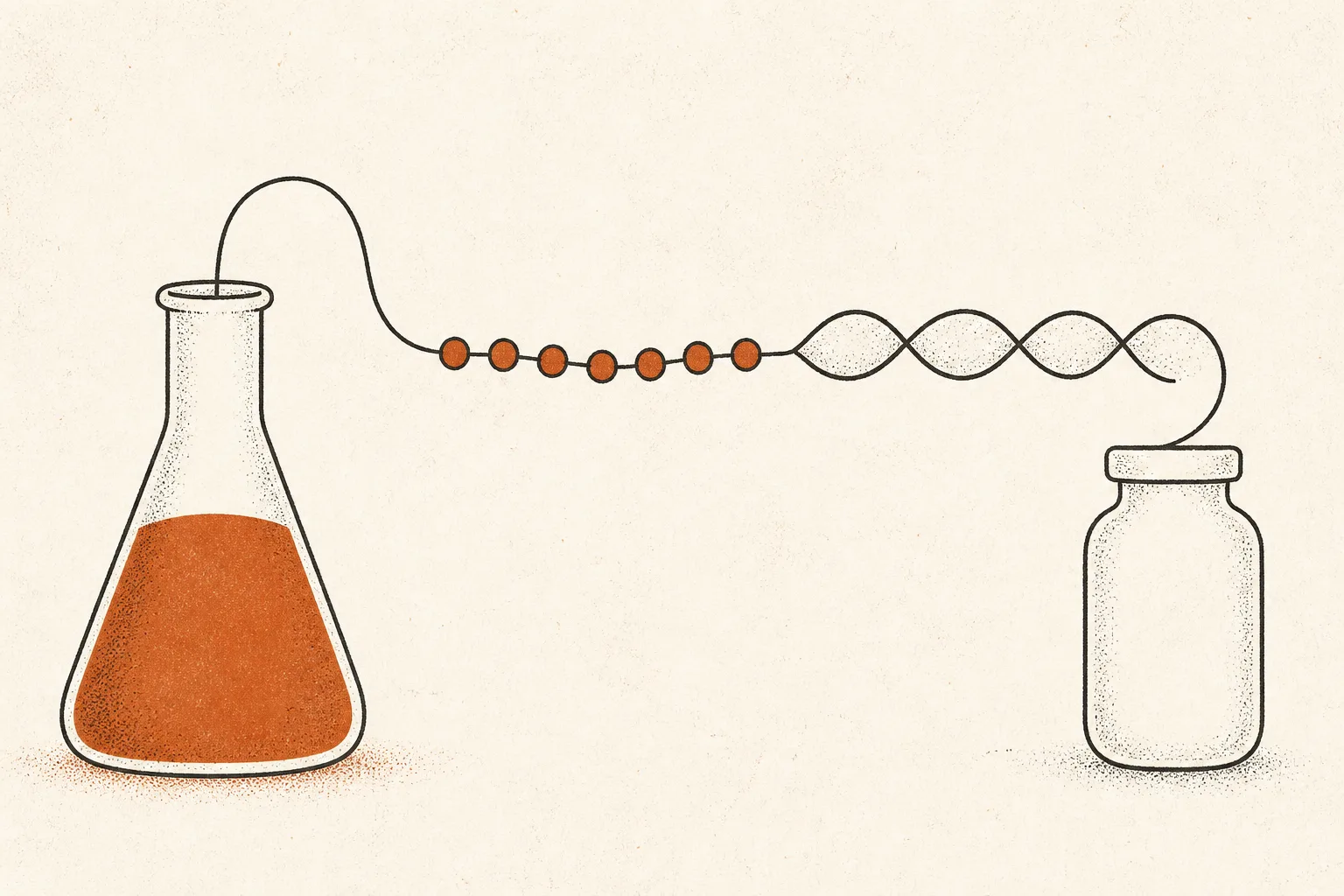
The answer came from the new recombinant DNA techniques, and insulin was the first target they were pointed at. In 1978 and 1979, chemists working between a young California company and a Californian research institute built genes for insulin's two chains — not copied out of human tissue but synthesised base by base, which was only conceivable because Sanger had established the sequence. The genes went into Escherichia coli, the gut bacterium that serves as molecular biology's workhorse; the bacteria expressed the chains, which were then purified and joined 3.
| Era | Source | Binding constraint |
|---|---|---|
| 1922 onward | Ox and pig pancreases | Slaughterhouse throughput; reactions to a nearly-human molecule |
| 1950s onward | The same, sequence now known | Supply unchanged; purity could at last be specified |
| 1980s onward | Bacteria and yeast with synthetic genes | Fermentation capacity, which can be built |
Recombinant human insulin reached the market in the early 1980s as the first medicine anywhere made by recombinant DNA. That is the moment biotechnology stops being a laboratory technique and becomes an industry: proof that a human protein could be manufactured to regulatory standard, at any volume, by organisms taught to make it.
Everything downstream
Three things had to be true before a peptide could be a drug in the way we now take for granted, and insulin established all three in order. First, that a protein could be a medicine at all — that a molecule far too large and fragile to swallow could be introduced from outside and do the work the body's own version does. Second, that its identity could be pinned down exactly. Third, that it could be made biologically at any scale wanted.
Run those forward and you arrive at the present. The GLP-1 receptor agonists now reshaping metabolic medicine are peptide analogues: hormone sequences altered on purpose — a residue swapped so an enzyme can no longer cut the chain, a fatty acid hung on so the molecule binds albumin and lingers for a week instead of minutes — made at industrial volume. Each move presupposes that you know the sequence you are modifying, that you can reproduce it identically, and that a peptide is a plausible thing to give a patient at all. None of that existed in 1920.
It is a long way from a Toronto dog kennel in the summer heat to a molecule designed on a screen, and the distance is made of things that had to be shown possible before anyone could stop thinking about them. Insulin showed all of them, one at a time. The child on the starvation diet and the peptide analogue in a modern pipeline sit on the same line — and the line has only the one origin.