turning points
From a Million Brains to a Usable Drug
Somatostatin was pulled out of the hypothalamus in 1973, did exactly what had been promised of it, and vanished from the bloodstream in about two minutes. Turning that result into a medicine meant throwing most of the molecule away.
Somatostatin was isolated in 1973, at the end of an effort that consumed years of two laboratories' working lives and animal brains in numbers most people would rather not picture 1. It did precisely what had been claimed for it: given to an animal, it shut down the pituitary's secretion of growth hormone, cleanly and reproducibly. Then it did something nobody had budgeted for. It disappeared. Injected into the circulation, somatostatin is cleared with a half-life on the order of two to three minutes — gone in less time than it takes to walk from the bench to the door. That is the answer to why the hormone itself never became a drug. A molecule that vanishes before it can hold anything in place is a magnificent scientific result and a therapeutic dead end at once, and the distance between those two descriptions is the subject of this article.
It is a distance almost nobody outside drug development ever sees, because none of it makes an announcement. The isolation gets the prize. The unglamorous chemistry that follows — the part that determines whether a discovery ends up in a pharmacy — gets a sentence, if that. Somatostatin is the cleanest case for looking at it directly, because the fix here was not tinkering at the edges. Someone had to take the molecule apart and keep about a quarter of it.
The molecule that would not stay
Start with half-life, because the term is doing most of the work here. Give a substance to an animal and its concentration in the blood falls as the body clears it; the half-life is the time taken for that concentration to halve. For native somatostatin the figure sits around two to three minutes — meaning a single injection produces a sharp suppression of growth hormone that is over before anyone has finished writing it down.
Two mechanisms do the clearing and both are ordinary. The first is enzymatic. Blood and the tissues it perfuses are full of peptidases — enzymes whose whole function is cutting peptide chains apart, some working inward from the ends, others cutting in the middle wherever a residue offers a grip. To a peptidase, a fourteen-residue hormone is not a message but a substrate. The second is filtration: small peptides fall below the size at which the kidney holds anything back, so what the enzymes miss is filtered out and lost.
Neither is a defect in somatostatin. They are the design. A molecule that modulates secretion minute by minute has to be disposable, because a signal persisting after the situation has changed is not a signal but noise. Which gives us the most under-appreciated fact about turning a hormone into a medicine: what makes a molecule a good hormone is very often exactly what makes it a bad drug.
Why an infusion is not a treatment
There is an obvious workaround, and it was tried. If the molecule is cleared in minutes, supply it continuously: a line into a vein, a pump, a steady infusion holding the blood concentration wherever you want it. This works, in the narrow sense that the physiology obligingly does as it is told. It does not work in any sense that matters. The condition somatostatin's effect points at most directly is acromegaly — growth hormone excess, usually driven by a pituitary tumour that will not stop secreting, and measured in decades. An infusion is a procedure; a medicine is something a person can be given at intervals and then get on with their life.
Worse, stopping the infusion did not simply return matters to where they started. Withdrawal produced rebound hypersecretion — the suppressed hormones overshooting once the brake was abruptly lifted 3. A drug whose discontinuation is itself an event carries a permanent asterisk.
And the native hormone is indiscriminate. Somatostatin acts not at one receptor but across a family of them, and it is not confined to the brain: it appears in the pancreas and along the gut, restraining insulin, glucagon, gastrin and much else 4. Suppressing all of that to reach one target is less a therapeutic strategy than a broad sedation of the endocrine system. Listed together, the shortfall between what had been discovered and what a medicine has to be stops looking like a detail.
- Survive long enough in the circulation to hold a receptor occupied for a clinically useful stretch of time.
- Be deliverable by a route a person can repeat indefinitely, rather than one requiring a vein and supervision.
- Act on the intended receptors more strongly than on the rest of the family.
- Behave predictably when stopped, without a rebound that undoes the benefit.
- Be manufacturable to a consistent standard and stable in a vial until used.
Native somatostatin failed the first four outright. Everything that follows is the work of meeting them.
Throwing most of the molecule away
The instinct when a molecule proves too fragile is to armour it — keep the structure and make it tougher. The programme that produced octreotide went the other way, and that inversion is the interesting part 2.
Somatostatin is fourteen amino acids arranged as a loop, closed by a disulphide bridge between two cysteines. Taking that loop apart systematically — shortening it, replacing residues one at a time, seeing what still worked — showed the receptor was not reading the whole thing. Most of the sequence was scaffolding, holding a short run of residues in a particular spatial arrangement, and it was that short run the receptor recognised. Chemists call it the pharmacophore: the minimum arrangement of atoms responsible for the binding.
So the brief inverted. Instead of defending fourteen residues against every enzyme in the blood, identify the handful that matter, build a far smaller molecule presenting them in the same geometry, and defend only that. What came out, reported in 1982 as SMS 201-995 and later named octreotide, is eight residues long — shorter than the hormone it stands in for, and more potent at the receptors that count 2.
Two ideas carry the defence, and between them they account for a large share of every long-acting peptide developed since. The first is stereochemistry. Amino acids come in two mirror-image forms, and life uses almost exclusively the left-handed one, written L. Proteases evolved in that world and are stereospecific: their active sites are shaped for L residues and cannot grip the mirror image. Substitute a D-amino acid where an enzyme habitually cuts and the cut does not happen — the bond is chemically unremarkable, it is simply not one the machinery was built to break. Octreotide carries D residues at the ends of its chain and at a key internal position, exactly where degradation was occurring.
The second is conformational constraint. A short linear peptide in solution is a floppy thing, flickering between an enormous number of shapes, only a fraction of which fit the receptor. Octreotide keeps a disulphide bridge closing it into a ring, and the ring holds the pharmacophore roughly in the shape the receptor wants. That buys affinity, since less of the molecule's time is wasted in useless conformations, and stability too, a compact ring offering fewer of the extended stretches peptidases prefer to grasp. Being small helps on its own account: eight residues present fewer bonds to cut than fourteen, and each was chosen rather than inherited.
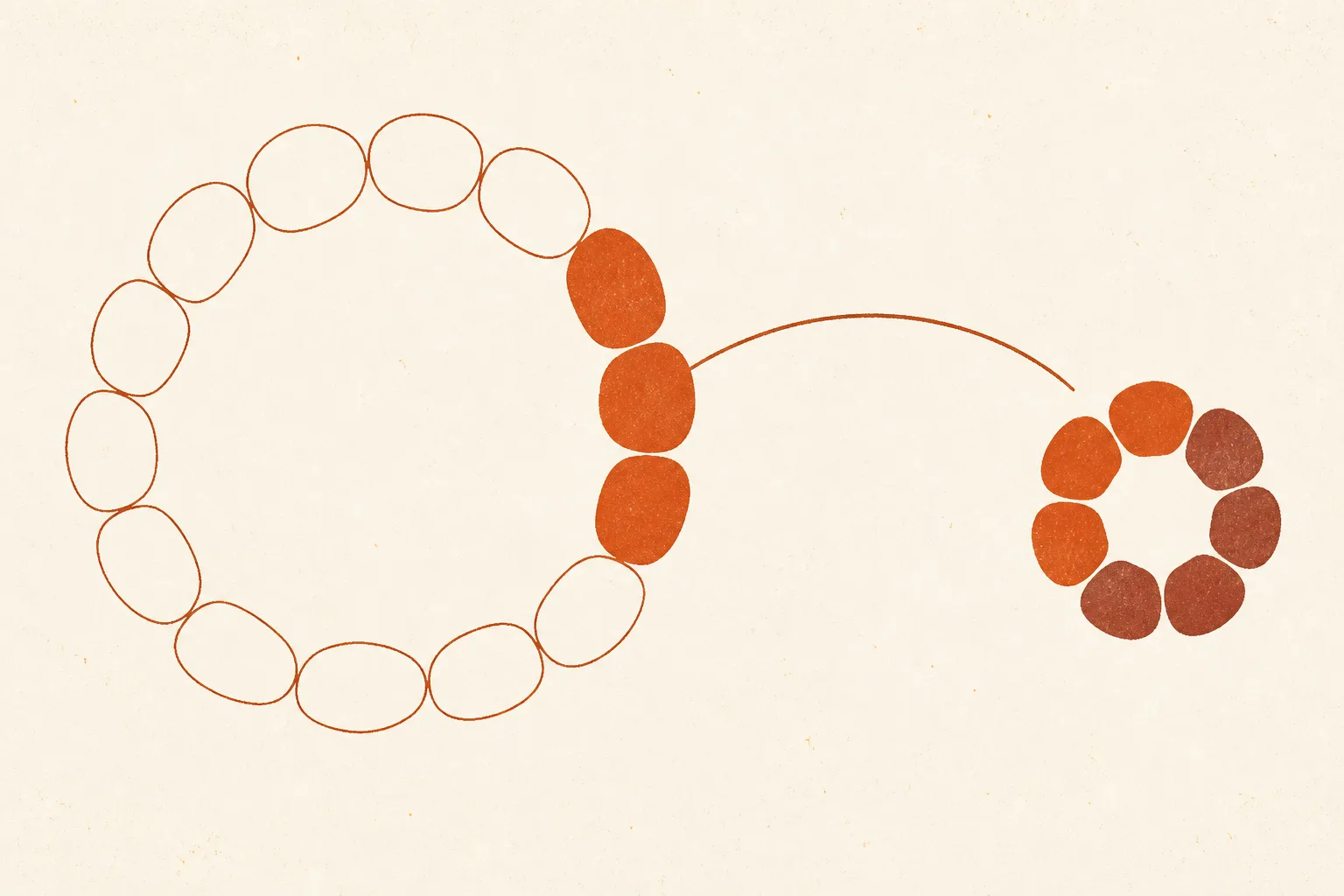
The result is the whole argument for working this way. Half-life measured in hours rather than minutes; potency at the relevant receptors exceeding the parent hormone's rather than merely approaching it; and enough resilience to be given under the skin instead of through a line into a vein 2. That last change is what converts a hospital procedure into something a person can manage alongside ordinary life, and it is a consequence of chemistry rather than of clinical practice.
| Native somatostatin | Octapeptide analogue | |
|---|---|---|
| Chain length | 14 residues | 8 residues |
| Circulating half-life | Roughly two to three minutes | Measured in hours |
| Practical route | Continuous intravenous infusion | Injection under the skin |
| Receptor coverage | Broad across the receptor family | Weighted toward a subset |
| Amino acid forms | Naturally occurring L residues | Includes mirror-image D residues |
| On withdrawal | Rebound hypersecretion reported | No comparable rebound |
What the analogue became
Octreotide reached clinical use during the 1980s, and by the mid-1990s had a review of its own in the New England Journal of Medicine, which is roughly the professional equivalent of being taken as read 3. Its established uses follow straight from the physiology. Acromegaly is the obvious one: where the hormone excess cannot be resolved by removing or irradiating the tumour producing it, a durable brake on secretion is what is needed. The other is the symptom burden of certain hormone-secreting neuroendocrine tumours, where the trouble is not the tumour's bulk but its output 3.
What happened afterwards makes the case for redesign more strongly than the original approval did. Octreotide was not an endpoint but a starting structure, and the field kept building on it 4. Depot formulations arrived, releasing the same molecule slowly from an injected carrier so the interval between administrations runs to weeks rather than hours. Further analogues followed with different preferences among the receptor subtypes, on the reasoning that if family members do different jobs, a drug distinguishing between them can be aimed more precisely.
Then came an idea of a genuinely different kind. These tumours are characterised by carrying somatostatin receptors on their surfaces, often in large numbers. A molecule that binds those receptors is therefore not only a drug; it is an address. Attach a chelating group to a somatostatin analogue, load it with a radioactive metal and inject it, and the analogue carries its cargo to whatever displays the receptor. With a diagnostic isotope the tumours light up on a scan, including deposits nobody knew were there. With a therapeutic one, the same targeting delivers radiation to receptor-bearing tissue rather than to the patient at large 4. The peptide has stopped being a signal and become a delivery vehicle — impossible for the native hormone, which would have been dismantled long before arriving.
Identical to what the body makes
Which is why this article sits on a site about peptides rather than in a history of endocrinology. A claim circulates permanently around research compounds, in a dozen phrasings: that a peptide is safe, or plausible, or promising, because it is identical to something the body already produces. The sentiment is intuitive and feels like reassurance. As a predictor of whether something will work as a medicine, it is close to backwards.
Somatostatin is the cleanest demonstration available anywhere. It is not merely similar to what the body makes; it is what the body makes, its effect unambiguous and characterised in detail, available in synthetic form for over fifty years. It never became a widely used medicine — while a deliberately unnatural version, eight residues instead of fourteen, carrying mirror-image amino acids terrestrial biology does not use, founded a drug class that is still expanding. The identity was not the asset. It was the obstacle.
The reason is structural rather than accidental. Endogenous signalling peptides are built to be cleared fast, because a message that will not stop being sent is useless as a message. The feature that makes a molecule a credible hormone disqualifies it as a drug, and one sequence cannot satisfy both demands. Look at the peptide medicines in use and every one has been altered away from its natural form somewhere: a residue swapped, a chain truncated, a fatty acid hung off the side so the molecule binds blood proteins and rides around instead of being filtered out, a ring closed to lock a shape.
So when a compound is recommended on the grounds that it is natural, or exactly what your own body uses, the honest reading is that this tells you something about provenance and nothing whatever about pharmacokinetics — how it is absorbed, where it distributes, how fast it is destroyed. Those are the questions that decide whether anything happens at all, and they are settled by experiment rather than by resemblance.
The template everything since has followed
The sequence of moves that produced octreotide has been repeated so often it now reads less like an invention than a recipe. Find the fragment that does the binding. Cut away everything that was only holding it. Substitute unnatural residues where enzymes attack. Lock the fragment into the conformation the receptor prefers, usually by closing a ring. Then, if more duration is wanted, attach something that slows clearance, or formulate it to release gradually.
That logic runs through most of the long-acting peptide drugs of the last four decades, in fields with no connection to growth hormone at all — reproductive medicine, metabolic disease, oncology. Different targets, different receptors, the same handful of defensive tricks in a different order. Somatostatin's contribution to that toolkit is out of all proportion to its own therapeutic career, and the field it founded has gone on generating new chemistry rather than settling into routine 4.
The discovery of a hormone tells you a lever exists. It does not hand you the lever. Between those two states lies a body of work with no natural constituency — too applied to be celebrated as science, too incremental to be sold as innovation — and it is where the overwhelming majority of interesting molecules quietly stop. Somatostatin got across because someone was willing to dismantle a fourteen-residue answer and keep only the few residues doing the work. Most compounds never find anyone prepared to do that, and the ones that fail there fail invisibly, which is exactly why the step is so easy to leave out of the story.