turning points
The Assay That Made Hormones Visible
Before 1959, a hormone in a living person was something you could reason about but never weigh. Then a physicist and a physician in a Bronx veterans' hospital turned an inconvenient antibody into the most sensitive measuring device biology had ever had.
A physician in 1955 could hold a tube of a patient's blood up to the light and know, with complete confidence, that there was insulin in it. What he could not do was find out how much. No colour reaction, no titration, no instrument on any bench in the world would return a number. The first method that could was radioimmunoassay, worked out at a veterans' hospital in the Bronx by Rosalyn Yalow, a physicist, and Solomon Berson, a physician, at the end of the 1950s. It measured the hormone by an indirection that beats any direct approach: let a known quantity of radioactively tagged insulin and an unknown quantity of the patient's own insulin compete for a deliberately insufficient supply of antibody, then count how much of the tagged material got squeezed out. Until that worked, the concentration of a hormone in a living human being was a quantity nobody had ever seen.
It is worth sitting with how odd a position that was. Hormones were not mysterious in 1955. They had names, sources, effects, in several cases known structures. They were simply, in the body, below the horizon of measurement — present and consequential and out of reach.
A science built on subtraction
Endocrinology grew up by taking things away. Remove a gland from an animal and catalogue what fails; grind the gland up, inject the extract, and see what recovers. Almost everything known about the thyroid, the adrenals, the pituitary and the pancreas before the middle of the twentieth century was established that way. It produced real knowledge, but notice what it is doing: reading the consequences of a signal in order to say something about the signal. Nobody was watching the messenger.
The obstacle was one of scale. Hormones are potent precisely because a very little goes a very long way, so a peptide hormone circulates at concentrations classical analysis could not approach — vanishing quantities dissolved in plasma already crowded with other proteins present in vastly greater amounts. Finding the hormone in that was not a matter of a more careful chemist. The chemistry had no purchase at all.
What existed instead was the bioassay: give the material to a living system and grade the response. How much did the animal's blood sugar fall, how much did the tissue contract, how much did the target gland grow. Bioassays are ingenious and they were all anyone had, but they answer a blurred version of the question — activity rather than amount, in units defined by the response itself, at a cost of days and a colony of animals. Studying a control system that way is like judging a conversation by watching the listener's face from across a room.
The antibody that was not supposed to exist
Yalow and Berson were not looking for an assay. They were asking a narrower question about how the body disposes of insulin, using the tool Yalow had brought from physics: radioactive tracers. Tag insulin with a radioactive iodine atom, inject a trace of it, and you can follow the labelled molecules through the circulation and watch how fast they vanish.
The labelled insulin did not behave as expected. In patients previously treated with insulin — which then meant insulin extracted from pigs and cattle, a molecule differing from the human one by a residue or three — the tracer hung about far longer than it should have. Something in their plasma was holding on to it, something that behaved like a globulin, and the interpretation that fitted was uncomfortable: these patients had made antibodies against the insulin they had been given.
That was not a welcome conclusion. The prevailing view held that a molecule as small as insulin could not provoke an immune response at all — antigens were supposed to be large. By the accounts that have come down, the report had a difficult passage into print, which is worth registering not as a grievance but as a measure of how firmly the assumption was held. The finding was correct.
The inversion that turned a nuisance into an instrument
Here is the move, and it is the reason this story is told at all. An antibody that grabs your labelled insulin is an obstruction if you are studying insulin metabolism. Turn it round and it is a detector — because a binding site that can be occupied is a binding site that can be competed for.
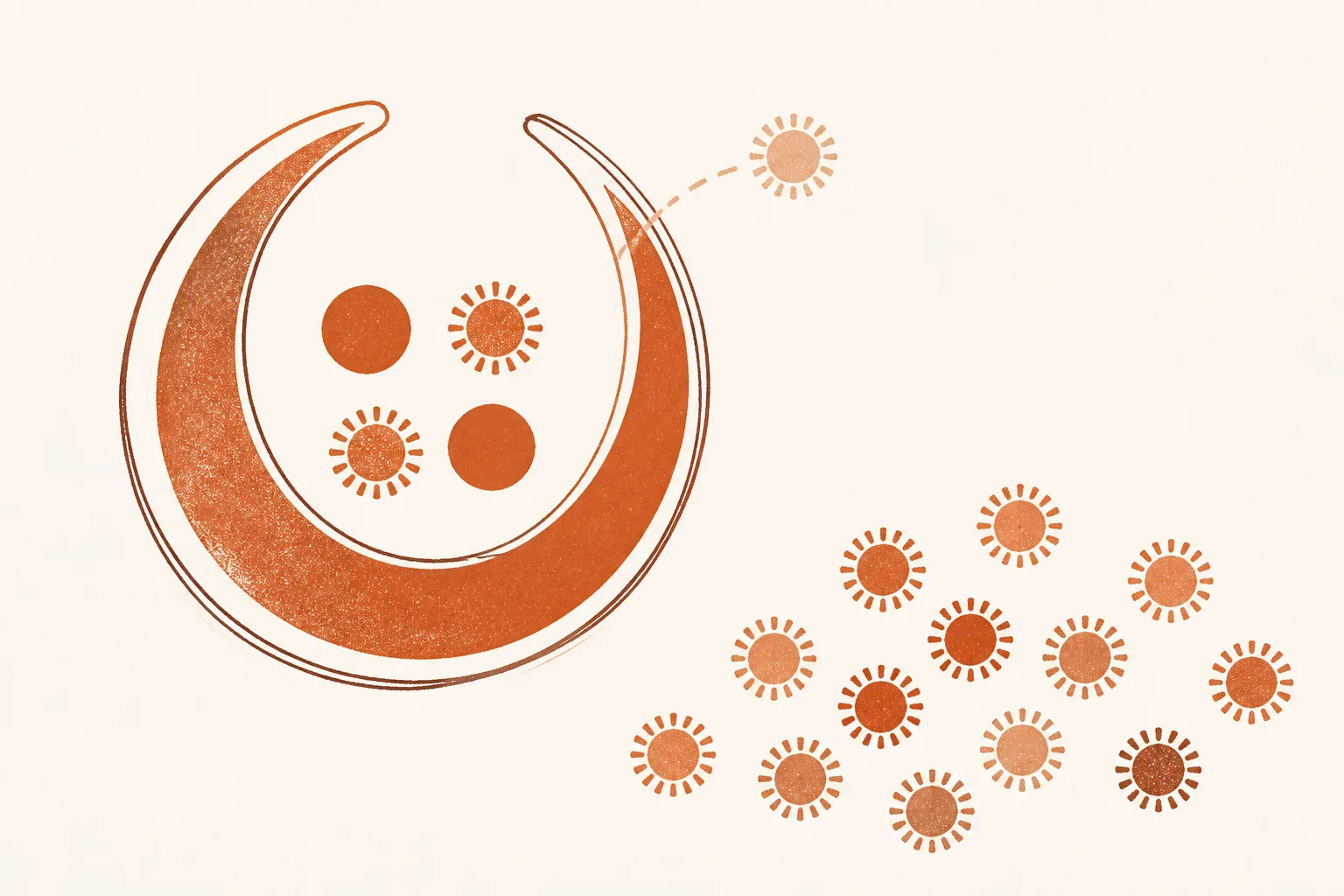
Set out a fixed and deliberately meagre quantity of antibody, too little to bind everything that will be offered to it. Add a fixed quantity of insulin carrying a radioactive tag, so every molecule of it can be counted by its emissions. On its own, a predictable share of that tagged insulin ends up stuck to the antibody. Now introduce the sample you want to measure. To the antibody, the patient's own insulin is indistinguishable from the tagged version, so the two compete for the same scarce sites, and tagged molecules are pushed off in proportion to how many untagged ones arrived with the sample. Separate bound from free, count the radioactivity in the bound fraction, and the number that comes back is low exactly to the degree that the patient's blood was rich in insulin.
The unknown is read backwards, from what is missing. In practice the run is calibrated against standards of known concentration, which trace out a curve the unknown can be read off — the binding arithmetic that makes this rigorous rather than merely suggestive was set out in 1959 2, and the following year the method was turned on ordinary human plasma, measuring the insulin circulating in people who had never been injected with anything 1. That paper is the hinge. A hormone in a living person had been weighed.
- Raise an antibody that binds the hormone you want to measure.
- Tag a batch of that hormone with a radioactive atom, so each molecule announces itself.
- Mix a small fixed amount of antibody with a fixed amount of tagged hormone, and add the sample.
- Let them compete, then separate what is bound from what is left free.
- Count the bound fraction, and read the concentration off a curve built from known standards.
Nothing in that logic is specific to insulin. Any substance you can raise an antibody against and label without wrecking it can in principle be measured this way, which is why the technique did not stay in one laboratory or one field. Yalow's own survey of what it became called it a probe for the fine structure of biological systems — less a test than a general way of interrogating anything that circulates 3.
The sensitivity was the whole point
Everything else follows from one order of magnitude. Radioimmunoassay opened measurement at picogram levels — a picogram being a millionth of a millionth of a gram — which is less an improvement on what came before than a different regime altogether 34. Quantities no previous method could approach became routine bench work, and the peptide hormones circulating in blood could be measured directly rather than inferred from what they did.
| Bioassay | Radioimmunoassay | |
|---|---|---|
| What is measured | A response in living tissue | Radioactivity displaced from binding sites |
| What comes back | Activity, in units of the response | A concentration, in mass per volume |
| What sets the limit | How small an effect can be read | How few counts can be told apart |
| What it takes | An animal colony, and days | A bench, a counter, known standards |
What became possible once you could see
Consider the great hormone hunt of the same era: the search for the hypothalamic factors that command the pituitary, pursued through mountains of animal tissue and years of fractionation. The chemistry was punishing, but the real bottleneck was epistemic. After each separation you hold a rack of tubes and must decide which still contains the thing you are chasing. Every wrong answer throws away the quarry or wastes a year purifying nothing. Putting a number on the pituitary hormone a fraction provoked turned that judgement from an art into a reading.
Clinical medicine changed more quietly and more pervasively. Endocrine diagnosis had been pattern recognition — the look of a patient, the constellation of complaints, a considered opinion. It became quantitative. A hormone concentration with a reference range beside it can be compared between two hospitals, or between the same person a year apart, and it can be abnormal before anyone looks ill. Disease became something you could detect rather than something you recognised once it had done its damage.
And then the consequence that matters most to anyone thinking about peptides as drugs. Pharmacology is arithmetic performed on measurements: how much reached the blood, how quickly it climbed, how long it persisted. Without an assay that can see a peptide at circulating concentrations, none of those quantities exist, and not one can be estimated from how a patient feels. Every claim about how long a peptide lasts, whether it is absorbed by one route or another, or what a modification did to its persistence, sits downstream of an assay of this kind — and where none has been run, such claims are not weak evidence but no evidence at all.
Stockholm, 1977
The Nobel Prize in Physiology or Medicine for 1977 was divided. Half went to Rosalyn Yalow for the development of radioimmunoassays of peptide hormones; the other half jointly to Roger Guillemin and Andrew Schally for the hypothalamic releasing hormones. There is something fitting in one award recognising both an instrument and a great finding that instrument helped make. Yalow was only the second woman to receive that prize.
Solomon Berson had died in 1972. Nobel Prizes are not awarded posthumously, so he could not share it, and Yalow spoke about this publicly rather than letting it pass — the work had been done by two people over more than two decades, and she said so. The research laboratory she led carried his name. The fact needs no decorating: the prize recognises individuals, the work was joint, and one of the two was not alive to be recognised.
The thing they chose not to do
They did not patent it. The method went out through the literature, without licences or royalties, and anyone with a counter and some patience could set it up. Within a few years it had been adapted to hormone after hormone, then to substances that were not hormones at all, in laboratories that had no connection to the Bronx and owed nobody anything for the privilege. The speed of that spread is a direct consequence of the absence of a toll booth.
The shape will be familiar, because it happened once before in the same field and to the same molecule. The Toronto group assigned the insulin patent to their university for a nominal sum, on the stated principle that a discovery of that kind should not be turned to private profit. Twice, then, in the short history of peptide science, the foundational tool was deliberately left unenclosed — and both times the effect was the same. Everything downstream moved faster than it otherwise would have, and the people who decided captured almost none of the value they created.
Instruments and the things found with them
There is a general pattern here worth stating in the open. The findings a field celebrates carry a name attached to a substance or a mechanism. But the events that reorganise a field are more often the arrival of a way of seeing: a lens, a diffraction pattern, a sequencing method, a competition between a labelled molecule and an unlabelled one. Those get a paragraph in the methods section, then disappear into the infrastructure — which is precisely the measure of how completely they succeeded.
Every reference range on a blood test, every graph of a peptide's concentration falling away over hours, rests on the same manoeuvre — something that could not be seen was measured by the shadow it cast on something that could. Before 1959 endocrinology was reasoning about a conversation it could not hear. Afterwards it could listen. That is a larger event than most of what has since been heard.