turning points
The Hundred-Year Problem of Swallowing a Peptide
From the moment insulin existed, someone asked whether it could be a tablet, and for the better part of a century the answer was a flat no. The story of how that no was finally, partially, expensively overturned.
Consider what it meant, in the 1920s, to be saved by insulin. A child in a diabetic coma, who a year earlier would have had months to live, sits up, eats, goes home. And goes home with a syringe, a needle to be boiled, and the expectation of doing this several times a day for the rest of a life just handed back. The molecule doing the saving is one the body makes itself, built from nothing more exotic than a chain of amino acids — and it cannot be swallowed. That is the difficulty in a sentence. Peptides have to be injected because the digestive tract is not an obstacle course they happen to fail; it is a dismantling system evolved specifically to reduce molecules of exactly this class to their components. Asking a peptide to survive it is asking it to be invisible to the one organ built to find it 14.
The obvious request followed immediately and never stopped. Could it not be a tablet? For the better part of a century the answer was not "not yet" but a flat no, with a mechanism attached. Tens of thousands of injections across a lifetime was the standing price of a molecule the pancreas had once released quietly and continuously into the bloodstream a few inches away, without ever passing through the stomach.
The oldest request in endocrinology
The constraint never stayed with insulin. As the field widened to something over eighty approved peptide medicines, the route of administration barely moved 45. Peptides went in through the skin, and a great deal of ingenuity went into making that bearable: finer needles, pen devices, weekly formulations, depots releasing their contents over a month.
What none of that could touch was the shape of the problem. An injectable needs a cold chain, a route for sharps, and a patient trained and willing to keep going — a hard proposition for a merely uncomfortable condition, and an outright barrier in prevention, where the person taking the drug does not feel ill. Whole categories of peptide never became medicines, not because the biology failed but because nobody was going to inject daily for the indication. The tablet was never about convenience. It was the difference between a molecule that reaches people and one that does not 1.
One organ, built to find it
So why is a tablet so hard? The instinct is to picture the digestive tract as an assault course: hazards a sufficiently tough molecule might, with luck and armour, get through. That picture is wrong in a way that matters. The gut is a dismantling plant, and its entire purpose is to take chains of amino acids arriving from outside the body and reduce them to their parts, because that is how an animal draws nourishment from the protein in its food. A therapeutic peptide is a chain of amino acids arriving from outside the body. It is not an unlucky bystander in that system. It is the substrate the system was specified for.
The specifics are almost a formality once you accept that, but they are worth naming once, quickly. Gastric acid begins hydrolysing the backbone before any enzyme is involved. Pepsin, one of the few enzymes that works at all in that acidity, starts cutting. In the duodenum the pH rises, pepsin switches off and the pancreatic proteases switch on — trypsin, chymotrypsin, elastase, the carboxypeptidases — which between them cleave beside essentially every residue in the natural alphabet. Surviving fragments meet the brush-border peptidases on the intestinal cell surface, whose job is to finish what the others started. Anything still intact must cross the epithelium: cells sealed by tight junctions that admit small hydrophilic molecules and little else, backed by a lipid membrane a large, charged, hydrogen-bond-rich molecule cannot dissolve into. Whatever manages that drains into the portal vein and passes through the liver before reaching the general circulation 14.
Five barriers in sequence, five different mechanisms, and no single countermeasure clearing more than one or two. That is the shape of the century.
The number that frames everything
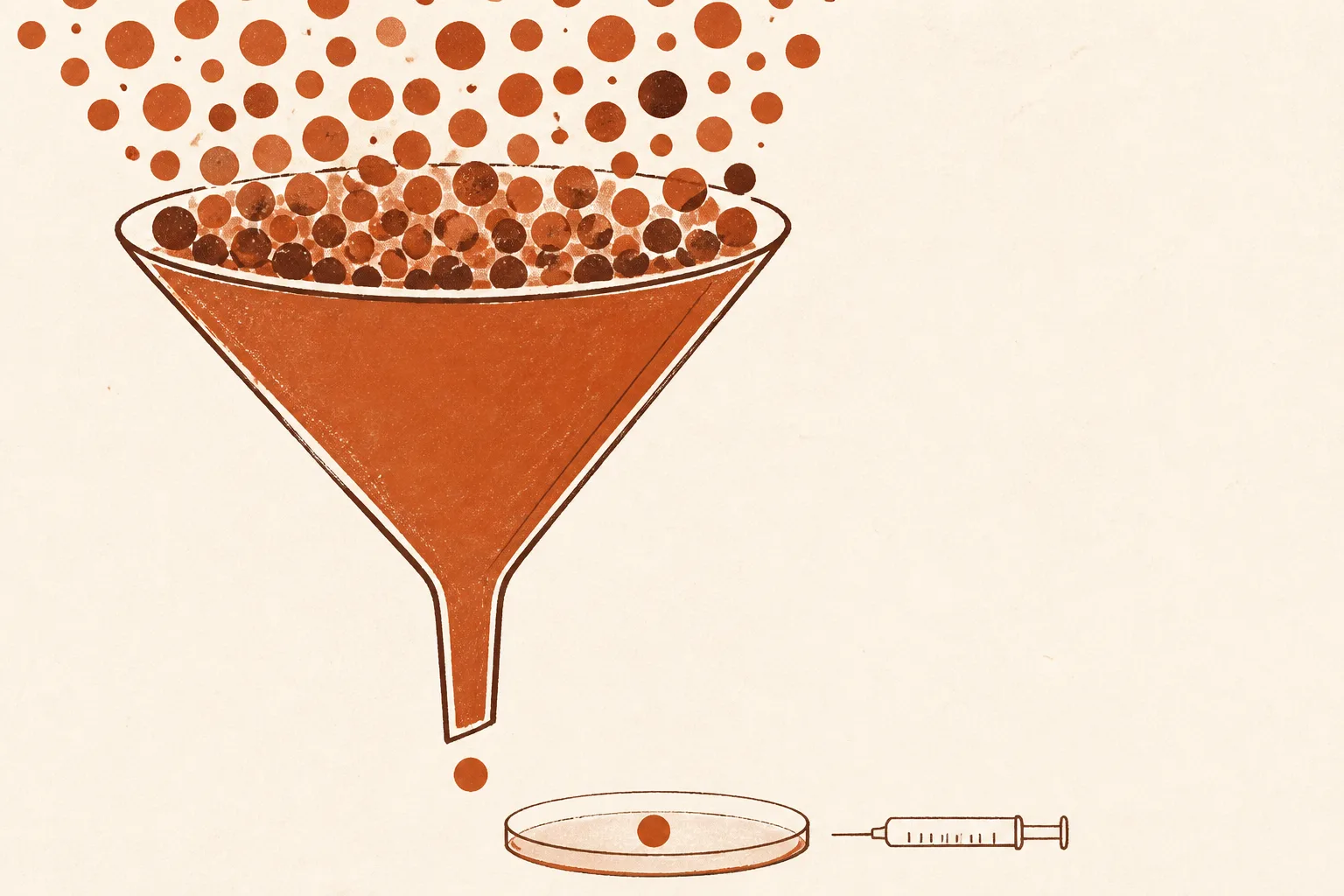
Everything else follows from one figure. For an unmodified peptide, oral bioavailability — the fraction of a swallowed dose reaching the bloodstream chemically intact — is typically well under 1 per cent, and frequently a tenth of that 15. It is worth pausing on how unusual that is. A conventional small-molecule tablet might deliver 50 to 90 per cent of what it contains. The peptide, in round terms, delivers nothing.
"Nothing" is not rhetoric. At well under one per cent, essentially the entire dose is destroyed in the lumen or never crosses the wall, and the sliver that does get through arrives in a quantity so small that ordinary variation — what the person ate, how much water they drank, how fast the stomach emptied — swings it by large proportions 1. A route that loses ninety-nine per cent of the drug and is unreliable about the remainder is barely a route at all. That is why the needle stayed.
The brute-force answer
And then, after all of it, one got through. Not by being redesigned to withstand the gut — decades of that had produced no marketed peptide of therapeutic size — but by being escorted.
Oral semaglutide is not semaglutide in a capsule. It is semaglutide co-formulated with SNAC, an absorption enhancer present in large molar excess, and the tablet works because of where and how SNAC behaves as it dissolves. The mechanistic work established something the field had not assumed: absorption happens in the stomach, not the intestine 2. As the tablet erodes against the gastric mucosa it creates a small, short-lived pocket of altered chemistry, and inside it SNAC does two things at once. It raises local pH, taking pepsin out of the picture — the enzyme simply stops working as the acidity falls away — and it promotes transport of the peptide across the gastric epithelium, through the cells rather than between them.
The elegance is in the constraints. That enhancement is concentration-dependent, operating only where SNAC is present in sufficient quantity; localised to the mucosa immediately against the eroding tablet; and reversible, the epithelium returning to baseline as the enhancer diffuses away 2. Something that threw the gut wall open durably and indiscriminately would be a far less welcome proposition. This opens a door the width of a tablet, for a few minutes, and shuts it again.
So much for the admirable half. The other half is that this is brute force, and the literature is candid about it. Bioavailability with SNAC still lands on the order of 1 per cent 12. The escort does not make the peptide good at crossing; it makes a tiny fraction cross reliably enough to be dosed. The oral product therefore carries very much more peptide than the injectable for comparable exposure, and absorption stays sensitive to the conditions under which the tablet is taken, which is why those conditions are specified unusually tightly. Both halves are the story. It works, and it wastes almost all of it.
The roads that did not get there
SNAC is one answer to part of one barrier, and it arrived at the end of a long queue of attempts on the others. The queue explains why so few products stand at the end of it 35.
- Enteric coatings. Wrap the peptide so it survives the stomach and releases further down. This clears acid and pepsin cleanly — then delivers the cargo straight into the pancreatic proteases, which are the harder problem. A useful component; never a solution alone.
- Protease inhibitors, co-formulated. Switch the digestive enzymes off. It works in animal models. Suppressing the enzymes that digest food, daily and indefinitely, has never appealed to clinicians or regulators, and the inhibition is incomplete anyway.
- Permeation enhancers. Make the wall itself more crossable. SNAC and sodium caprate have marketed products behind them; a long tail of candidates does not. The standing objection is selectivity — a more permeable epithelium is more permeable to everything present.
- Cyclisation. Join the chain head to tail so the trimming enzymes have no free ends to grip, and pre-organise its shape in the bargain. The most productive structural idea the field has, because it works on proteolysis and permeability at once.
- N-methylation. Methylate the backbone amides to strip out hydrogen-bond donors, the property most closely tied to whether a molecule this size can slip through a lipid membrane. Applied selectively, since those donors are often what holds the peptide onto its target.
The last two are not speculative, and the proof is a fungal peptide swallowed routinely for forty years. Cyclosporine is eleven residues long, cyclised head to tail so it has no termini at all, and N-methylated at seven of its eleven backbone amides. Its oral bioavailability runs around 30 per cent — two orders of magnitude above an unmodified peptide of comparable size — because on entering a lipid environment it folds its polar groups inwards and turns a greasy face to the membrane, hiding its own polarity for the crossing 14. Nature found it; nobody designed it, and four decades of trying to reproduce the trick on demand have yielded principles rather than a method 3. It settles the question of whether the gut can be crossed in principle. It can. The window is simply very narrow.
Acid stable is not orally active
Which brings this round to something with direct bearing on how research peptides get written about. "Orally active." "Acid stable." "Survives digestion." These phrases turn up constantly, and they almost always do far less work than they appear to.
Acid stability is a real property and a real result. A peptide goes into simulated gastric fluid — dilute acid with pepsin, at body temperature — and comes out largely intact. That is a genuine finding about one barrier. It says nothing about the trypsin, chymotrypsin and elastase waiting downstream, nothing about the brush-border peptidases, nothing about an epithelium that excludes almost everything of that size, and nothing about the liver behind it. A claim of acid stability addresses at most one barrier of five, and is routinely presented as though it had addressed all of them.
The second thing to notice is the difference between a measurement and an inference. Absorption is a pharmacokinetic claim: the compound was found in the blood, at a concentration, over time, ideally as a curve and against an intravenous comparison so the percentage has a denominator underneath it. An effect observed after an oral dose is not that. A peptide can act on the gut lining and never enter the circulation at all; approved medicines work in precisely that way. So when you read that something is orally active, the useful question is not whether the writer is honest. It is whether anybody measured the blood.
What the problem is worth
Return, finally, to the economics, because they explain the oddest fact here: a solution exists, it is impressive, and almost nothing has followed it.
Getting one peptide past the stomach took roughly a decade, a purpose-built excipient developed specifically for the job, mechanistic studies to establish where in the gut absorption was even occurring, and clinical programmes on a scale only a very large company can fund 2. The product delivers about one per cent of its active ingredient into the bloodstream and discards the rest. Every tablet carries a large multiple of the peptide an injection would have needed — material synthesised, purified and paid for in order to be destroyed on the way in.
That is the price of admission, and it says what the problem is worth to the people who solved it: enough to justify a decade and ninety-nine per cent waste, for one molecule, in a market of hundreds of millions. For anything smaller the sum does not work, which is why the injectable remains the default across the field, and why the peptides that have since made the same journey can still be counted without difficulty 35.
A hundred years on, the gut has not been defeated. It has been paid off — once, at an exorbitant rate, by the only kind of programme that could afford the fee. Everything else still arrives by needle.
References
- Advances in oral peptide therapeutics
- Transcellular stomach absorption of a derivatized glucagon-like peptide-1 receptor agonist
- Trends in peptide drug discovery
- Therapeutic peptides: Historical perspectives, current development trends, and future directions
- Peptide therapeutics: current status and future directions