how a peptide is made today
The Cell That Makes the Peptide Instead
Not every peptide comes off a bead. The longer ones are often grown in steel tanks by bacteria or yeast that have been handed a gene, and pulled out of the soup afterwards. The two routes can make the same molecule — and leave very different fingerprints behind.
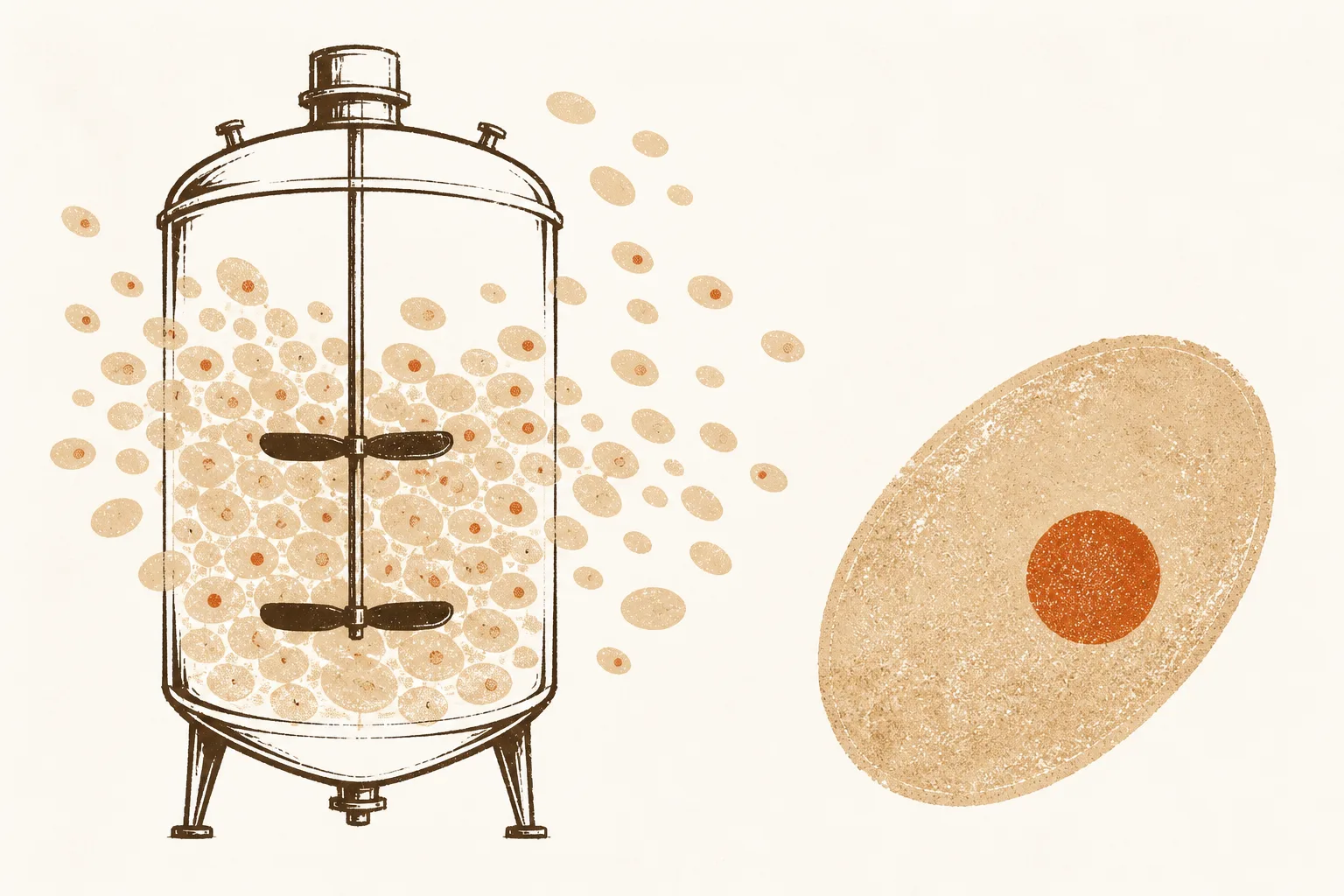
The tank is stainless steel, two storeys tall, and it hums. Inside, a broth the colour of weak tea is being stirred by paddles, fed with sugar and oxygen, and held at the temperature of a warm afternoon. It is full of bacteria — trillions of them, each carrying a short loop of DNA that tells it to make something it has no use for. At a chosen moment, when the culture is dense enough, an inducer is added to the feed and every cell switches on the borrowed gene at once. For the next several hours, a significant share of the bacteria's effort goes into making a foreign chain of amino acids. This is the recombinant route: instead of building a peptide residue by residue on a synthesiser, a manufacturer gives a gene to bacteria or yeast, lets the organism's own ribosomes assemble the chain, and then extracts and purifies it. It is usually chosen for longer peptides and small proteins, where chemical synthesis becomes inefficient, and it produces a molecule that can be identical to the synthetic one while carrying an entirely different set of impurities.
Insulin's own history — the first medicine made this way, in the late 1970s — has been told on this site. This piece is about the route as a working choice today: why a manufacturer picks a cell over a bead, how the cell is persuaded to cooperate, and what the words synthetic and recombinant actually tell anyone about the powder at the end.
Why length changes the answer
A synthesiser pays the same small tax on every residue. Each coupling misses a fraction of the chains, and those losses multiply along the sequence, so the proportion of complete product falls steadily with length while the crowd of near-identical failures grows. For a short peptide the tax is tolerable. For a chain of seventy or a hundred residues it becomes punishing, and the purification needed to rescue the product from its own debris can dominate the cost.
A ribosome does not work that way. It reads a messenger RNA and adds residues with an error rate low enough that a chain of a few hundred amino acids is routine, and the cell does it at no extra cost per residue in any sense a chemist would recognise. The organism supplies the amino acids, the energy and the machinery. What it will not do is make an arbitrary molecule on request, and the art of recombinant production lies in negotiating with it.
Persuading a bacterium
Escherichia coli is the workhorse. It grows fast on cheap media, its genetics are exhaustively understood, and a catalogue of engineered strains, plasmids and cultivation strategies exists to make it produce foreign proteins at high levels 1. For a small protein it is often the first choice. For a genuinely short peptide it presents two problems.
The first is that a bacterium is full of proteases, enzymes whose job is to find and destroy stray, unfolded chains. A short foreign peptide, floating free in the cell, is exactly what those enzymes are for. The second is that some peptides are actively harmful to their host: antimicrobial peptides, which kill bacteria by disrupting their membranes, are the clearest case 2. Ask E. coli to make a molecule designed to kill E. coli and the culture will not thrive.
The standard answer is disguise. The gene for the peptide is joined to the gene for a larger, well-behaved carrier protein, so the cell makes a single fusion protein with the peptide attached at one end. The carrier protects the peptide from proteases, masks its toxicity, and often drives the whole construct into dense, insoluble granules inside the cell called inclusion bodies 2. Inclusion bodies sound like a failure and are frequently a convenience: they are easy to collect by breaking the cells open and spinning out the heavy particles, and they concentrate the product away from most of the cell's own proteins.
What follows is downstream chemistry. The inclusion bodies are dissolved with strong denaturants, and the fusion protein is cut at a designed site between carrier and peptide — by a highly specific enzyme or by a chemical reagent that cleaves at a particular residue. If the product needs a folded structure, it must be coaxed into it by slowly removing the denaturant under carefully controlled conditions, which is where many processes lose much of their yield 1. Then the freed peptide has to be separated from the carrier, the cleavage agent and everything else the cell contributed.
The yeast alternative
Yeast offers a different bargain. Baker's yeast and its industrial relatives can be engineered to secrete a product into the surrounding broth, attaching a signal sequence that sends the chain through the cell's own export machinery. The product emerges outside the cell, often already folded and with its disulphide bonds formed, and far fewer host proteins come with it. Insulin is the textbook case: rather than making the two finished chains separately, yeast processes have been designed to secrete a single-chain precursor that is later converted into the mature molecule by enzymatic steps outside the cell 3.
Secretion is not free either. Yields can be lower, glycosylation — the attachment of sugar chains — can intrude, and designing a precursor that the cell will export efficiently is a molecular-engineering project in its own right 3. But the general pattern holds: bacteria tend to give more product with more downstream work; yeast tends to give cleaner product with more upstream design.
Two routes, two fingerprints
If the sequence is the same and the modifications are the same, the molecule is the same. A chain of amino acids does not remember whether a ribosome or a synthesiser assembled it. What differs is everything around the molecule — the impurities each route leaves behind, and therefore what has to be tested for.
| Chemical synthesis | Recombinant production | |
|---|---|---|
| Product-related impurities | Deletion and truncated sequences, incomplete deprotection, racemised residues | Mis-cleaved fusion products, misfolded forms, sequence variants from mistranslation |
| Process residues | Coupling reagents, scavengers, trifluoroacetate, organic solvents | Host-cell proteins, host DNA, cleavage enzymes, media components |
| Biological contaminants | Only from handling and water | Bacterial endotoxin from E. coli processes; must be actively removed |
| Where it scales well | Short and modified sequences | Long chains and small proteins built from natural residues |
That difference is not academic. A synthetic peptide can contain sequence-related impurities that a recombinant one would almost never carry, and a recombinant one can contain host-cell proteins that a synthetic one never could. A purity figure on its own does not say which kind of impurity it measured or missed.
When regulators compared them
Regulators have had to decide what the difference means. In 2021 the United States Food and Drug Administration finalised guidance allowing a synthetic peptide to be submitted as a generic copy of certain approved peptides of recombinant origin — glucagon, liraglutide, nesiritide, teriparatide and teduglutide — provided the applicant could show the same active ingredient and characterise its impurities rigorously against the reference product, including any new impurity the synthetic route introduced 4. In effect, the agency accepted that the same molecule could come from either route, and put the burden of proof on the impurity comparison.
In July 2026 the agency withdrew that guidance as no longer reflecting its current scientific thinking, publishing at the same time a set of revised draft product-specific guidances for generic peptides that address recombinantly, synthetically and semi-synthetically produced products as distinct cases, with a revision of the broader guidance planned 5. The details are still being written. The direction is clear enough: the route of manufacture has become a question in its own right, rather than a detail beneath the question of sequence.
What the label is telling you
So when a document says synthetic or recombinant, it is not making a claim about quality or about nature. Neither word means natural in any meaningful sense; both describe industrial processes, one run by chemistry and one by biology borrowed from a microbe. What the word does tell a careful reader is which family of impurities to expect, and therefore which tests ought to appear beside the purity figure: sequence confirmation and residual reagents for one, host-cell protein, DNA and endotoxin testing for the other.
The first recombinant medicine was grown in bacteria from genes built by chemists, which is a neat reminder that the two routes were never really rivals 6. The frontier today lies in the hybrids — a backbone grown in a tank and finished with a synthetic side chain, a long sequence assembled from chemically made fragments joined by enzymes. How those processes are designed and controlled, step by step, is a technical subject of its own, and it is where this story stops.
References
- Recombinant protein expression in Escherichia coli: advances and challenges
- Recombinant production of antimicrobial peptides in Escherichia coli: a review
- Yeast secretory expression of insulin precursors
- Abbreviated New Drug Applications for Certain Highly Purified Synthetic Peptide Drug Products That Refer to Listed Drugs of Recombinant Deoxyribonucleic Acid Origin; Guidance for Industry; Availability
- FDA Publishes Revised Draft Product-Specific Guidances for Certain Generic Peptide Products
- Expression in Escherichia coli of chemically synthesized genes for human insulin