origins
The Blood of Young Donors and a Tripeptide
Liver cells kept their character longer when the serum bathing them came from a young donor. Finding out why produced one of the smallest molecules in active research — and a fifty-year literature with one name running through it.
Two sets of liver cells in an incubator in the early 1970s, behaving differently — and the only thing separating them was whose blood they were sitting in. Cultures bathed in serum from young donors held on to their normal character longer than cultures given serum from old ones. GHK exists because somebody declined to leave that as a curiosity. Loren Pickart, then a graduate student, set out to find what in the serum was responsible, worked down through the fractions of human plasma until the activity was cornered in something very small, and in 1973 reported it in Nature New Biology: a tripeptide, glycine then histidine then lysine 1. Three amino acids. That is the entire molecule.
Two sera, one difference
The experiment sounds almost too plain to be interesting, which is part of why it is worth slowing down over. Cells grown outside the body need serum — the liquid left when blood has clotted, carrying hormones, growth factors, carrier proteins and a great deal else nobody had catalogued. Serum was, and largely still is, a necessary black box: you buy a batch, you use it, you do not ask it questions. This work asked one anyway, and the cells in young serum kept their normal appearance and behaviour longer than their counterparts in old 1. Same tissue, same incubator, same everything except the fluid.
Sit with what that implies. The thing making the difference was not inside the cells; it was dissolved in the medium around them. At least some of what we recognise as ageing is not sealed within a cell's own machinery but carried chemically in the fluid it lives in — and if it is carried chemically, it can in principle be caught.
The catching is called bioassay-guided fractionation, and it is elegant precisely because it requires you to know nothing. You split the serum by size, or charge, or solubility. You test each fraction in the same cell assay, keep whichever still works, discard the rest, split that one again. No hypothesis about the molecule ever has to be correct, because the assay does the choosing at every step. Whatever survives is, by construction, whatever the activity actually was.
Three amino acids, and a complication
What survived was strange chiefly for its smallness. A serum factor conferring something like youthful behaviour on tissue ought, by every expectation of the period, to have been a protein: a hormone or growth factor of several thousand daltons, folded into a shape, with a receptor waiting for it. What emerged weighed about 340 daltons and had three residues. A peptide that short barely has a structure to speak of. It is the size of thing a protease leaves behind on its way through something larger.
There is also a complication sitting in plain sight, in the title of the paper itself. The tripeptide was reported to prolong the survival of normal liver cells and to stimulate growth in neoplastic liver 1. Both. It was not presented as a youth factor but as something that changes how liver tissue behaves, in a direction welcome in one context and distinctly less welcome in another. Fifty years of summary have been kinder to the first half of that sentence than the second.
Why copper changed the question
The finding that made GHK chemically interesting rather than merely odd came afterwards. The tripeptide binds copper(II), and it binds it tightly. The N-terminal amine, the nitrogen of the intervening peptide bond and the imidazole ring of the histidine together present a coordination site of exactly the geometry copper(II) favours, and the complex holds together at the pH of blood 2. More to the point, that complex — GHK-Cu — turned out to be the active species. The peptide alone is not really the subject; it is the vehicle.
That matters because of copper's double character. It is essential — a set of enzymes cannot work without it, among them lysyl oxidase, which cross-links collagen and elastin into load-bearing fibres — and it is destructive when loose, because unbound copper catalyses free-radical chemistry indiscriminately. Biology's solution is not to store copper safely but to never let it travel alone: it is handed carrier to carrier, and the free concentration inside a cell is kept vanishingly low.
A small, diffusible, high-affinity copper ligand circulating in plasma therefore looked like part of that system: a chaperone, holding the ion in a form that can be moved and delivered rather than left to do damage 2. That converted an unexplained activity into a proposition you could argue about precisely. Whether GHK performs the role in a living human body is a separate question the literature has never closed — but the chemistry gave the compound a story with working parts, which a serum fraction does not have.
The decline curve, and why it persuades
The number that built GHK's popular reputation is not from the discovery work at all. It is the report that plasma GHK falls substantially over a lifetime: on the order of 200 ng/mL at around twenty years of age, down to roughly 80 ng/mL by sixty 4. One figure, easily remembered, pointing downwards.
It is seductive because it has the shape of an explanation rather than of an observation. Repair capacity declines with age; here is a repair-associated molecule declining with age; the second must therefore drive the first, and topping it back up ought to reverse the loss. Three sentences, and you have gone from a measurement to a therapy without anyone conducting an experiment in between.
What the finding establishes is that a concentration falls. It says nothing about which way the causal arrow points. A great many things fall with age downstream of ageing rather than upstream of it — declining because the tissue producing them is doing less, not causing the tissue to do less. A falling measure can be a cause, a consequence, a bystander marker or noise, and a graph cannot tell you which. Even if the arrow points the way people assume, restoration is a further claim again: bodies accumulate damage that does not undo itself simply because a signal comes back.
There is a quieter problem too, which is measurement. Separating free GHK in plasma from its copper complex, from GHK bound up with albumin, from fragments of larger proteins ending in the same three residues, is not straightforward. The 200-to-80 figures are repeated very widely; the number of independent determinations behind them is not large. The gap between how often a number is quoted and how often it has been measured is a reliable warning sign in any literature.
The result with the fewest fingerprints
If you had to keep one experiment from the whole GHK literature and discard the rest, the case for keeping the 1988 one is strong. Working with a French matrix biology group, the collaboration reported that the tripeptide-copper complex stimulates collagen synthesis in cultured fibroblasts, at low concentrations, with the complex rather than the free peptide as the active form 3.
It is not the most spectacular result attached to this compound — it is a cell-culture measurement of one protein's synthesis, nothing more. What makes it load-bearing is who else was in the room: a group with its own culture systems, its own assays, its own long-standing arguments about collagen, and no investment in whether a tripeptide's reputation survives. It also fits the chemistry, since lysyl oxidase is a copper enzyme that cross-links collagen 2. The mechanism predicted the observation rather than being retrofitted to it.
The habit this should encourage is slightly unnatural: when you meet a claim about GHK-Cu, follow the citations backwards until they stop moving. What you find, repeatedly, is a long chain of reviews converging on a small number of primary experiments 45. The reviews are numerous. The independent primary work is not — and a claim does not become better supported by being restated in more places.
| Claim | Primary evidence behind it | How independent |
|---|---|---|
| Present in human serum | Isolation, early 1970s | Original laboratory |
| Binds copper(II) tightly | Coordination chemistry | Broad — general chemistry |
| Raises collagen synthesis in fibroblasts | Fibroblast culture, 1988 | Independent matrix biology group |
| Falls markedly with age in plasma | Plasma concentration measurements | Few determinations, associated authorship |
| Shifts expression across many genes | In vitro transcriptomic screening | Associated authorship |
| Improves the appearance of skin | Small topical cosmetic studies | Often commercially connected |
Fifty years, one name
Here is the structural fact about this literature, stated plainly because it changes how the whole body of work should be read. An unusually large share of GHK research across five decades — the foundational characterisation, the tissue-remodelling reviews, the later gene-expression analyses — involves the same investigator, who also built commercial interests in copper-peptide skincare 25.
That is not an accusation and should not be read as one. Nothing about it implies anything improper, and a scientist who devotes fifty years to one molecule is almost always doing so because they think the molecule is real. The point concerns the shape of an evidence base, not anybody's motives — and the honest version of it cuts both ways, with edges of equal width.
Research attention is scarce and fiercely contested. A small molecule with no patentable novelty, no pharmaceutical sponsor and no disease constituency lobbying for it does not sustain a field by merit alone; somebody has to keep publishing on it, keep the name in circulation through the decades when nobody else will touch it. Several findings now regarded as important survived exactly that way, carried by one stubborn person through a long stretch of indifference. Sustained single-investigator advocacy is one of the mechanisms by which real discoveries stay alive long enough to be taken seriously.
It is also, precisely, how a weak finding avoids the scrutiny that would have settled it. A literature growing mainly by self-citation and internal review accumulates volume without accumulating tests. Every new review cites the last; the bibliography lengthens; the story becomes more consistent rather than more challenged. From outside, the two situations are indistinguishable. Both look like a long publication record, a coherent mechanism and a healthy citation count. You cannot tell them apart by reading more carefully, or by reading more.
The only thing that separates them is independent replication — groups with no stake in the answer running the experiment and reporting whatever comes out. That is why the 1988 fibroblast work is worth more than its modest scope suggests 3. It is also why the right posture towards the remaining claims is provisional rather than dismissive. Unreplicated is not the same as untrue. It means the experiment that would settle the matter has not been run by anyone with nothing to lose.
Where that leaves the compound
Sorting the tiers is not difficult once you insist on doing it. There is real chemistry, and it is the strongest part. There is a cell-culture effect on collagen produced with an independent group, fitting that chemistry. There is a human evidence base confined almost entirely to topical application with cosmetic endpoints, in studies typically small and often commercially connected. And there is a popular account that outruns all three by a considerable distance.
- Established: the tripeptide exists in human plasma and binds copper(II) with high affinity in a well-characterised geometry.
- Reasonably supported: the copper complex increases collagen synthesis in cultured fibroblasts.
- Reported but thinly replicated: the age-related fall in plasma concentration, and the scale of the gene-expression changes attributed to the peptide.
- Human data: topical, cosmetic in endpoint, small. Systemic human pharmacology is essentially unstudied.
- Not established: that GHK delivers copper in living human tissue, that its decline causes any loss of function, or that restoring it would reverse one.
What a fifty-year literature buys, in the end, is durability rather than certainty. GHK has not been forgotten, which is more than can be said for most compounds isolated in 1973, and that is largely one person's achievement. But persistence and evidence are different currencies, and this field holds rather more of the first than the second. What the compound needs is not another review restating the mechanism.
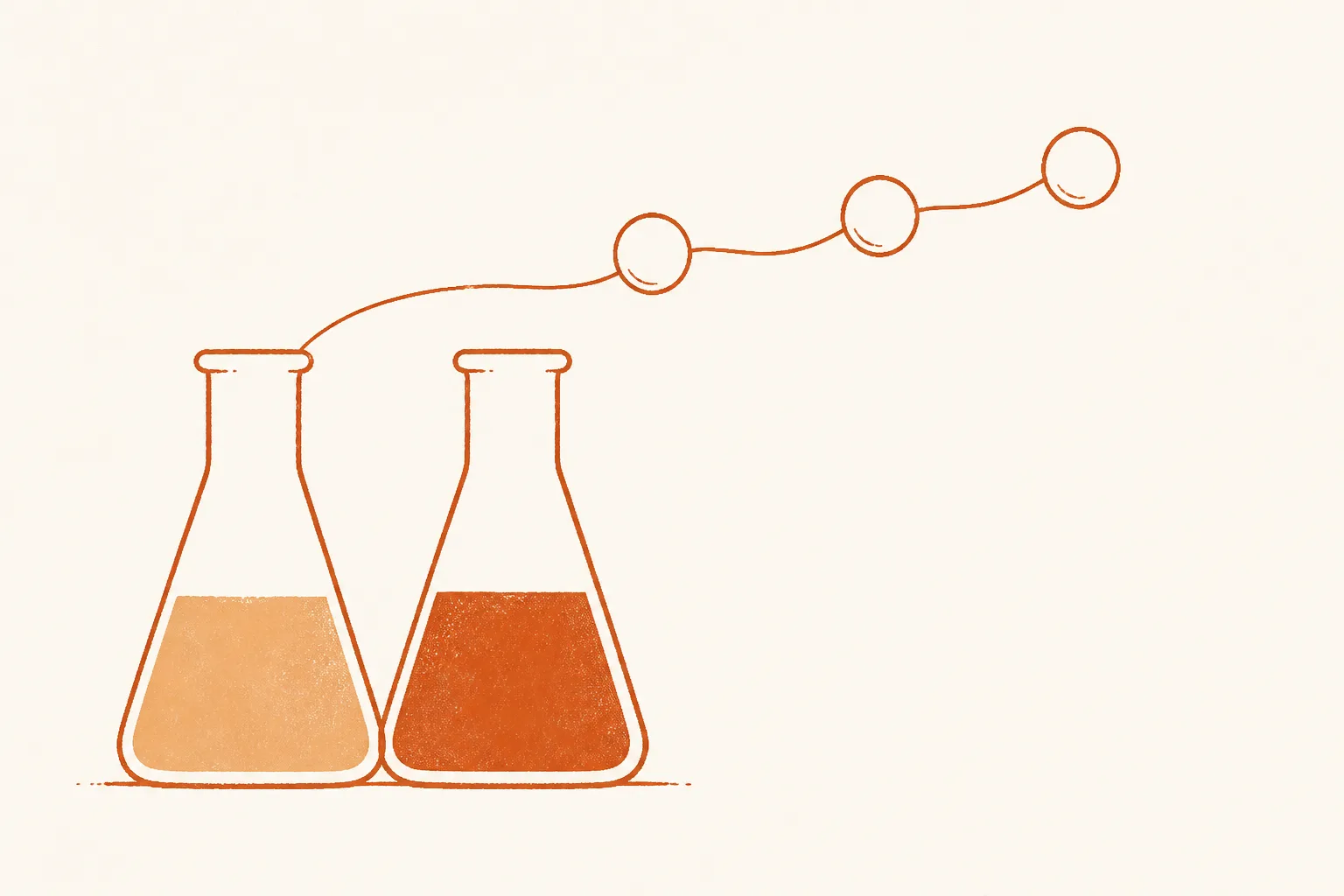
It is worth ending on the experiment that started it, though, because it has aged better than almost anything built on top of it. Two flasks, the same cells, serum from a young donor and serum from an old one, and a visible difference between them. Whatever becomes of the tripeptide, that was a good question well asked — and the method used to chase it down remains one of the honest ways to find something you were not looking for.
References
- Tripeptide in human serum which prolongs survival of normal liver cells and stimulates growth in neoplastic liver
- The human tri-peptide GHK and tissue remodeling
- Stimulation of collagen synthesis in fibroblast cultures by the tripeptide-copper complex glycyl-L-histidyl-L-lysine-Cu2+
- Regenerative and Protective Actions of the GHK-Cu Peptide in the Light of the New Gene Data
- GHK Peptide as a Natural Modulator of Multiple Cellular Pathways in Skin Regeneration