origins
The Hunt for the Hormones That Command the Pituitary
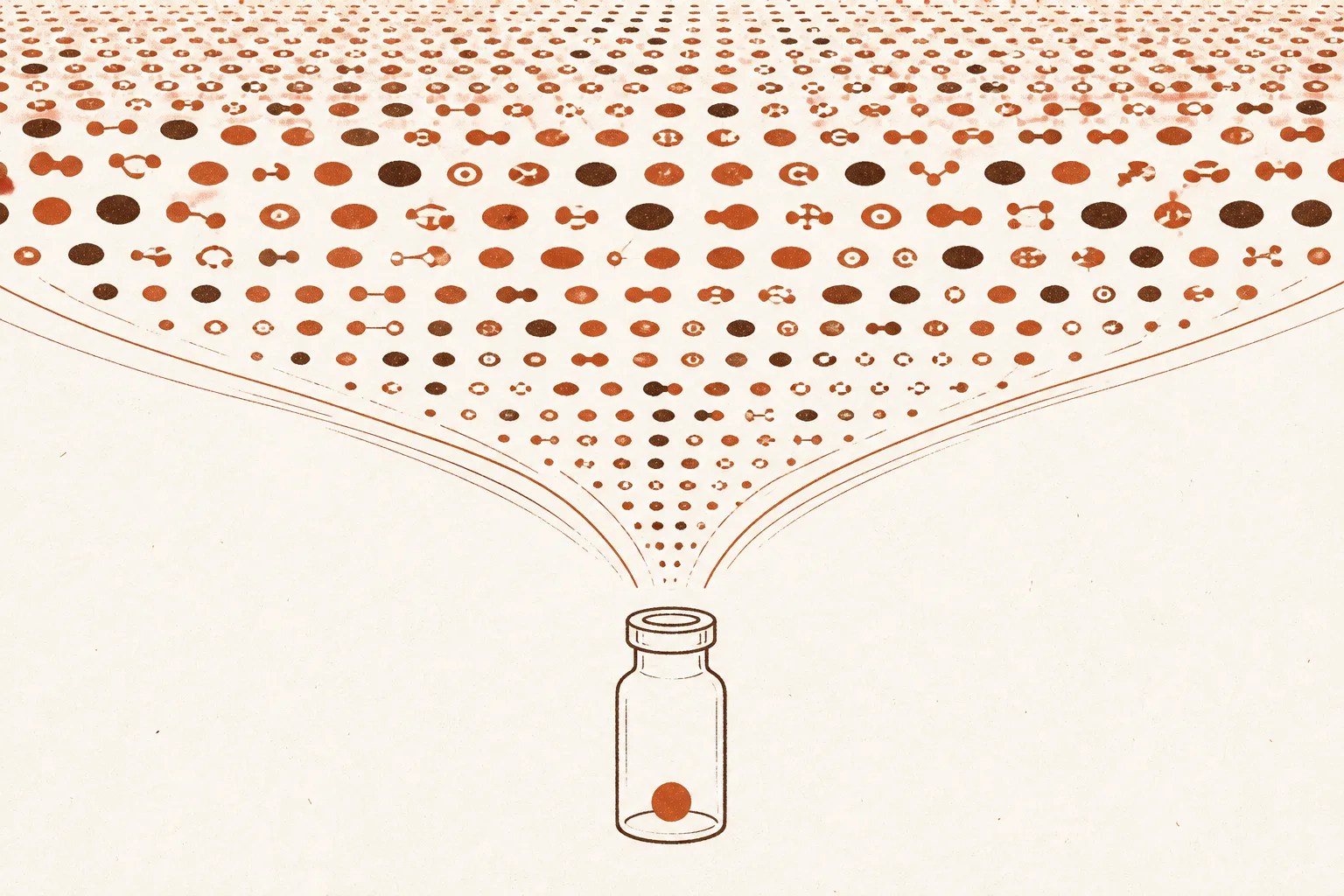
To find the molecules by which the brain gives orders to the endocrine system, two rival laboratories spent twenty years reducing animal brains by the tonne to a residue you could barely see. The first answer they got back was three amino acids long.
Picture a refrigerated lorry somewhere in the American Midwest in the middle of the 1960s, loaded with frozen brains by the tonne. Its cargo is bound not for a rendering plant but for a laboratory, where technicians will thaw each brain, cut out the hypothalamus — a structure at the base of the brain about the size of a sugar lump — and drop it into a tank with the others. That was the method, and there was no other. The hypothalamic releasing hormones were discovered by collecting animal hypothalami in numbers reported in the hundreds of thousands, and on some accounts into the millions, extracting the pooled tissue, fractionating it again and again, testing every fraction for biological activity, and chasing that activity down until a few milligrams of pure material remained — enough, at last, to determine a structure. Two laboratories did this in parallel for twenty years.
The first structure that came back was three amino acids long. That detail is the one that tends to stop people, and we will come to it. Begin instead with the tonnage, because the material problem is the story. Nothing here was limited by imagination: the hypothesis had been clearly stated a decade before anyone held a molecule. What stood in the way was that these molecules sit in tissue at concentrations so faint that the only road to an answer ran through an abattoir.
A hypothesis with no molecule
The anterior pituitary is a gland the size of a pea, slung beneath the brain, and it issues the orders that run much of the endocrine system: hormones driving the thyroid, the adrenal cortex, the gonads, growth, lactation. Something has to tell it when to act, and the obvious candidate was the hypothalamus directly above. The awkwardness was anatomical. The anterior lobe has essentially no nerve supply running into it, so the brain cannot wire instructions to it the way it wires a muscle. What it does have is a private circulation: vessels collecting blood at the base of the hypothalamus and carrying it down the pituitary stalk.
By the 1940s and 1950s, work most closely associated with the British anatomist Geoffrey Harris had turned that plumbing into a proposition. Certain hypothalamic neurons, the argument went, were not firing at the pituitary but secreting into it — releasing chemical factors into the portal blood, which then instructed the gland. The brain, in this account, contained cells that behaved like glands.
The hypothesis stayed unproven for a very long time. Crude hypothalamic extracts would indeed provoke a pituitary response, but crude brain extracts do a great many things when injected into an animal, and physiology that looks like evidence of a specific messenger can be produced by all sorts of unspecific insults. A serious body of opinion held that the releasing factors were an artefact of the extract rather than a real class of molecule. This was no mopping-up exercise — it was a contested claim, in a corner of endocrinology where ten years of work had produced not one characterised substance.
The arithmetic of a milligram
To settle the argument you had to hold the molecule, and that meant a supply problem with few parallels in biochemistry. The fragment worth dissecting out of a sheep weighs a fraction of a gram, and the releasing factor within it is present not as a component of that tissue but as a trace contaminant — the amount in any single gland measured in billionths of a gram. Determining a structure, by the methods of the 1960s, meant assembling milligrams. The ratio between those two numbers is the logistical history of the field.
So the laboratories became small industrial concerns, with standing arrangements at meat-packing houses. Brains arrived frozen, in bulk, on a schedule; technicians worked dissection lines; the tissue accumulated in cold rooms for years until there was enough to justify starting. Then extraction into solvent, and the long reduction after it — countercurrent distribution, gel filtration, ion-exchange, chromatography of every kind available — each stage discarding the bulk of the material to concentrate whatever still worked.
A second problem consumed as much labour as the chemistry: knowing where the activity had gone. Every fractionation splits one flask into many, and unless you can tell which of them still holds the thing you are chasing, you have merely made a mess in higher resolution. For years the only answer was a bioassay — inject a fraction into a live animal, measure what its pituitary does — noisy enough that a weak signal could be argued over for months.
Two laboratories, two species
The work was carried by two groups, and by the 1960s they were unmistakably racing. Roger Guillemin, French-born and trained partly in Montreal, ran his programme first at Baylor in Houston and later at the Salk Institute, working principally with sheep hypothalami. Andrew Schally, born in Poland and also trained in Montreal — for a period a member of Guillemin's own laboratory before founding his — built his operation in New Orleans, working principally with pig. The difference of species was not incidental: it meant two independent supply chains and two bodies of data that could not be compared line by line.
The rivalry is well documented and needs no embroidery: two laboratories pursuing the same targets, competing for the same finite funding, publishing in the same journals within months of one another. The popular retelling has hardened over the decades into something more theatrical than the published record supports. What the record shows is a long, expensive, mutually watchful contest between serious groups — enough to explain how fast the field moved once the first structure fell.
Three residues, both ends blocked
The first target to give way was the factor that makes the pituitary release thyrotropin, the hormone that drives the thyroid. By 1969 both groups had enough purified material to attack its structure, and the answer, published that year, was pyroglutamyl-histidyl-proline amide 3. Three amino acids — glutamic acid, histidine, proline, none of them rare — in the shortest chain that can meaningfully be called a peptide.
It is difficult now to convey how odd that looked. The pituitary hormones being commanded are large, dozens to hundreds of residues long, and the assumption had been that a factor capable of instructing an entire endocrine axis would itself be a substantial polypeptide, because size was where specificity was thought to live. A tripeptide of common amino acids looked less like a hormone than like a scrap of one.
The chemistry had been misleading too. Both ends of the molecule are modified: the glutamic acid at the front is cyclised into a ring, called pyroglutamate, and the proline at the back carries an amide cap rather than a free acid group. The molecule therefore presents no ordinary beginning and no ordinary end, so classical methods for reading a chain inward from its termini returned nothing, and enzymes that normally chew peptides from either end could get no purchase. That resistance had been read for years as evidence of something exotic. It was evidence of something tiny and sealed.
The point was settled the only way it could be. The three residues were synthesised in the plain form and did nothing. Cyclise the front end, cap the back, and the synthetic material behaved identically to the substance extracted from tissue — same chemistry, same hormonal activity 3. Two decades of doubt ended with a molecule a competent chemist could make in an afternoon.
A decapeptide, and then an inhibitor
Once one structure was in hand the rest came faster, because the field now knew what it was looking for: something small, probably capped, present in trace amounts. Next to fall was the factor controlling the gonadotropins — luteinising hormone and follicle-stimulating hormone, the pituitary signals governing reproduction. Isolated by Schally's group and reported in 1971, it proved to be ten residues long and, like its predecessor, sealed at both ends 4. One factor governed both gonadotropins rather than one each, which simplified the map.
Then in 1973 came the result that reframed the subject. Guillemin's group had been hunting the factor that ought to make the pituitary release growth hormone. What they pulled out of the extract instead was a polypeptide that did the opposite: it suppressed growth hormone secretion 5. They named it somatostatin. It runs to fourteen residues and closes on itself through a disulphide bridge, a loop rather than a straight chain.
An inhibitor had not been the object of the search, and finding one changed the model. The hypothalamus was not simply issuing start commands; it was holding the pituitary between opposing signals, pushing and restraining, which describes far better how endocrine output behaves over a day. Somatostatin also refused to stay in the brain, turning up in the pancreas and along the gut — the first hint that the peptides being fished out of the hypothalamus were not exclusively hypothalamic.
| Molecule | Reported | Chain length | Effect at the pituitary |
|---|---|---|---|
| Thyrotropin-releasing hormone | 1969 | 3 residues, capped both ends | Releases thyrotropin |
| Gonadotropin-releasing hormone | 1971 | 10 residues, capped both ends | Releases both gonadotropins |
| Somatostatin | 1973 | 14 residues, disulphide loop | Suppresses growth hormone |
The prize, and the instrument behind it
In 1977 the Nobel Prize in Physiology or Medicine went in part to Guillemin and Schally, for the peptide hormone production of the brain, and in part to Rosalyn Yalow, for developing radioimmunoassay. Those two halves are usually reported as separate achievements sharing a year. They are better read as one.
Radioimmunoassay works by competition: an antibody that binds the hormone is offered a fixed quantity of radioactively labelled hormone alongside the unlabelled sample, and how much label the antibody ends up holding reveals how much unlabelled hormone was there to displace it. It reaches concentrations far below anything chemistry alone could then detect, and its relevance here is direct. Purification is only possible if, at every step, you can tell which tube holds the activity; without a sensitive answer to that question you are not purifying anything, merely dividing it.
What a million brains bought
The immediate result was confirmation of Harris's hypothesis, which would have been enough. The larger result was a new category. These were the first peptides shown to function as chemical messengers of the brain, and once investigators began looking they were found everywhere — in regions with no connection to the pituitary, doing work unrelated to endocrine control. By the late 1970s both principals were writing surveys framing the neuron itself as a secretory, endocrine-like cell 12. Neuroendocrinology dates from this moment.
The therapeutic consequences are not modest either. Somatostatin's discovery founded a drug class — the long-acting somatostatin analogues, developed because the natural molecule is cleared far too quickly to be useful, and still in use in conditions of hormone excess and in certain neuroendocrine tumours 5. Analogues of the gonadotropin-releasing decapeptide became central to reproductive medicine and to hormone-sensitive cancer treatment. Both classes exist because somebody first established the parent sequence, and that sequence came out of a tank of hypothalami.
The one that got away was the original quarry. Growth-hormone-releasing hormone — the factor Guillemin's group had been chasing when somatostatin turned up instead — resisted another decade, and was finally characterised in the early 1980s not from hypothalamic tissue but from tumour tissue that happened to produce it in unnatural abundance. That sequence is the parent of the growth-hormone-releasing analogues discussed elsewhere on this site.
The kind of effort this was
What is worth carrying away is not the structures, which any database will give you in a second, but the shape of the effort that produced them. The rate-limiting factor was never insight. The hypothesis was decades old and clearly framed; the chemistry, once enough material existed, took months rather than years. What the field lacked was substance — literal, weighable substance — and there was no clever route around that. The answer cost twenty years and brains in numbers most people would rather not picture because arithmetic said it had to.
The same problem would be approached quite differently today. You would find the gene, express the peptide in a cell line, and read the sequence from micrograms by mass spectrometry. That is progress, and nobody should wish the abattoirs back. But a large share of what is now foundational knowledge was bought by people who spent the productive decades of their careers dissecting frozen tissue on a line and running columns, on a hypothesis many of their colleagues thought was wrong.
That kind of grind is rare now, and rarer still to fund. It is the reason there is a class of medicines to talk about at all.
References
- Peptides in the brain: the new endocrinology of the neuron
- Aspects of hypothalamic regulation of the pituitary gland
- The identity of chemical and hormonal properties of the thyrotropin releasing hormone and pyroglutamyl-histidyl-proline amide
- Isolation and properties of the FSH and LH-releasing hormone
- Hypothalamic polypeptide that inhibits the secretion of immunoreactive pituitary growth hormone