people and places
The Zagreb School and a Literature With One Centre
Several hundred papers report that one short peptide accelerates repair in almost every tissue it has been tested on. Nearly all of them trace back to a single university programme — which is the most interesting thing about the whole affair.
There is a peptide, fifteen amino acids long, that has been reported to help almost everything. Go looking for BPC-157 in the biomedical literature and you will turn up several hundred papers describing accelerated repair in the stomach lining, in tendon, in ligament, in skeletal muscle, in bone, in peripheral nerve, in the brain. What you will not turn up is a randomised controlled trial in humans. The reason the count is so lopsided is not that a trial was attempted and went badly; it is that nobody has ever been in a position to pay for one. The compound is a short, unpatentable sequence described openly in the literature decades ago, so there is no commercial sponsor with a route to recovering the eight-figure cost of a clinical programme — and the sustained body of work that produced most of those papers came out of an academic laboratory pursuing a research question, not a company assembling a dossier for a regulator. The volume came from the lab. Trials require somebody else entirely, and that somebody has never appeared.
That combination — an enormous preclinical literature sitting beside an empty clinical one — is more interesting than any single finding inside it. And it raises a question that is not really about peptides at all: what is a body of evidence worth when almost all of it comes from one place?
A fragment from an unlikely place
The starting material was gastric juice. Somewhere in that famously corrosive soup sits a protein given the plain functional name body protection compound, and BPC-157 is a partial sequence of it — fifteen residues lifted out of the whole and made synthetically. The peptide was developed and characterised principally at the University of Zagreb, in Croatia, by Predrag Sikirić and a long roster of colleagues, and the earliest work went where the origin pointed: the gut. Ulcers, chemically induced lesions, models of inflammatory bowel disease, damage from anti-inflammatory drugs 1.
It is worth sitting with what that programme actually involved before deciding what to make of it. This was not a paper or two. It was decades of continuous work across dozens of injury models, in a single research culture, following one compound wherever the logic of the previous experiment suggested it should go next. Sustained programmes of that kind have become genuinely rare. The modern funding cycle rewards novelty in three-year instalments and punishes the researcher who spends twenty years on one molecule; the Zagreb group did the unfashionable thing and stayed. Whatever conclusion the evidence eventually supports, the undertaking itself deserves to be described as what it is — a serious, systematic, long-horizon piece of science.
The claim that would explain the breadth
The list of tissues is the first thing anybody notices, and usually the first thing they hold against it. A compound that helps the gut and the tendon and the bone and the brain sounds less like a finding than like a sales pitch. But the group has never presented it as a list of separate claims. Their framing is that there is one claim, tested in many places.
The proposed mechanism sits upstream of any particular tissue. It concerns angiogenesis — the growth of new blood vessels into an injured area — and the nitric oxide system, the signalling arrangement that governs how blood vessels dilate and constrict and therefore how much perfusion a damaged region receives. In a 2018 paper the group set their compound explicitly alongside the standard angiogenic growth factors and argued that the lessons learned in gastrointestinal healing carried straight across into tendon, ligament, muscle and bone 5.
Read that way, the breadth stops being suspicious and starts being a prediction. Tendon and ligament are notoriously slow to heal, and a large part of why is that they are poorly supplied with blood to begin with. Bone repair depends on vascular ingrowth. Gastric mucosa is perfusion-dependent in the most immediate way imaginable. If a molecule acts on the process by which injured tissue gets its blood supply back, then it should show an effect in every tissue where blood supply is the bottleneck — and the tissues where blood supply is the bottleneck are, more or less, the list. The organ inventory is not evidence of overreach. It is what the hypothesis says you should find.
The account was later extended further, into a brain-gut axis framework: the idea that the peptide's gastrointestinal effects and its reported effects on the central nervous system are two faces of the same two-way signalling relationship between gut and brain, rather than two unrelated properties that happen to belong to the same molecule 2. This is, again, a unifying move — an attempt to explain more of the data with less machinery, which is what a theory is supposed to do.
Why breadth cuts in both directions
Here is the difficulty, and it needs stating precisely, because it is very easy to state badly and it is usually stated badly.
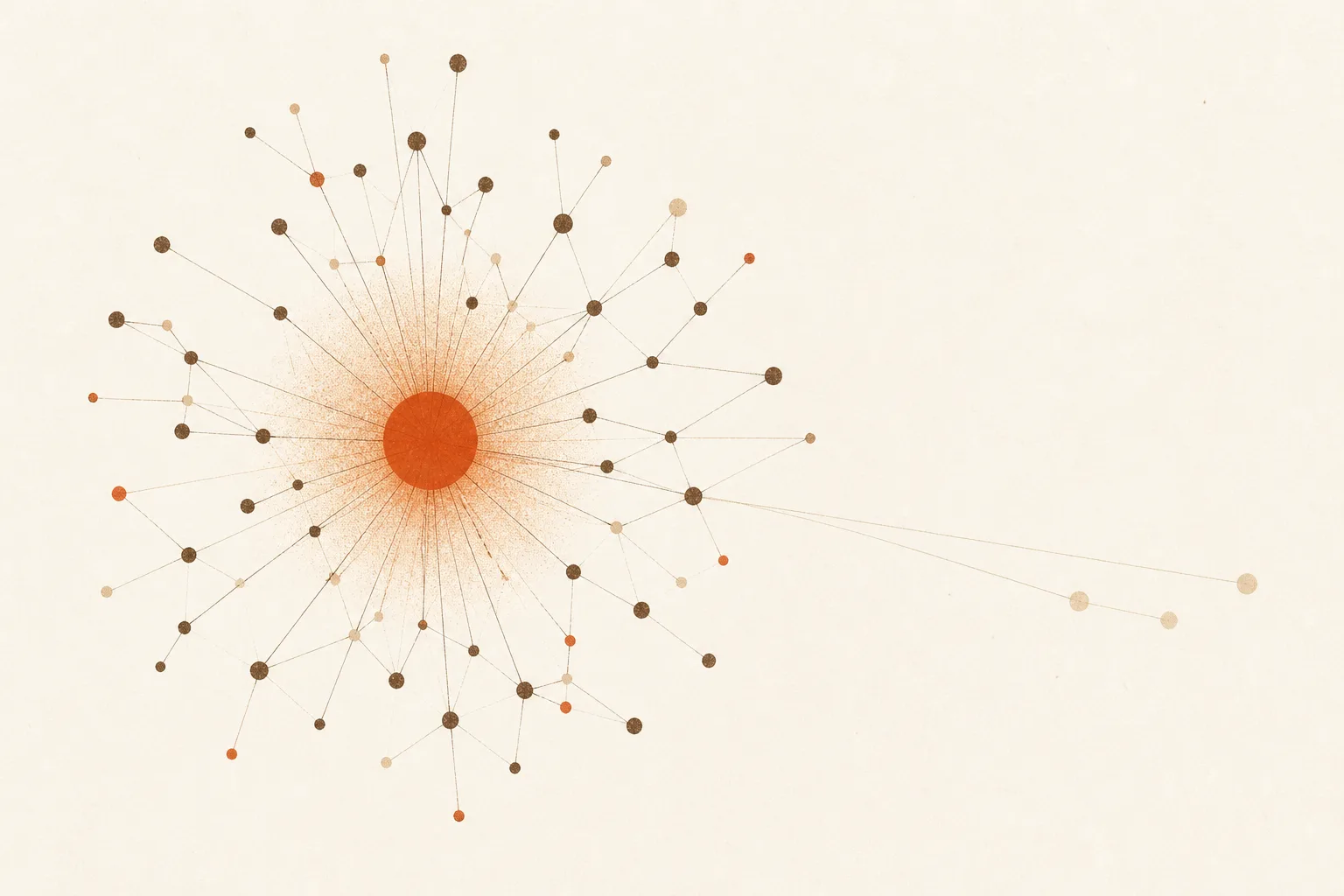
Wide-ranging benefit is exactly what a real upstream mechanism predicts. It is also exactly what you would expect to see in a body of work that has never been checked from outside. Not because anyone has done anything wrong — this has nothing to do with honesty — but because every laboratory on earth has house methods. A house way of inducing the injury. A house strain of animal, a house supplier, a house colony with its own microbiome. A house scoring rubric for what counts as healed, applied by people trained by the same person. A house sense of which pilot experiments were worth writing up. None of that is misconduct; it is what a research culture is. But systematic features travel with the group that has them, and if any of them nudges results in a consistent direction, that nudge appears in every study the group runs, in every tissue, for twenty years — and looks from the outside exactly like a general effect.
So: two explanations, one observation. They cannot be told apart by reading more papers from the same source, because both of them predict more papers from the same source saying the same thing. They come apart in exactly one place — when somebody in a different building, with different animals and different habits and no stake in the answer, runs the experiment and reports what happened.
| Observation | If a single upstream mechanism is real | If the pattern belongs to one research culture |
|---|---|---|
| Benefit reported across many unrelated tissues | Expected — the mechanism sits above tissue type | Expected — a systematic feature travels with every study the group runs |
| Effects consistent in direction across decades | Expected — a real effect is reproducible | Expected — the methods that produced it did not change either |
| Effects seen over a wide range of quantities | Possible for a signalling modulator with a flat response | Possible if the measurement is sensitive to something other than the compound |
| Result obtained by an unconnected group | Expected | Not expected — this is the observation the two accounts disagree about |
Where the work has been checked from outside
It has been, in places — and this is where fairness requires precision, because the sceptical version of this story habitually overstates itself. It is not true that no one outside Zagreb has ever looked.
The clearest example is a set of tendon experiments published in 2011 by a group working in Taiwan, using explants — small pieces of living tendon kept alive outside the body, where the surrounding physiology cannot confuse the picture. They reported that the peptide increased the outgrowth of tendon fibroblasts from the explant, improved those cells' survival under stress, and accelerated their migration, and they linked the effect to changes in growth factor receptor expression on the cells themselves 3. That is a different laboratory, a different country, a different experimental system and a different proposed handle on the mechanism, arriving at a result pointing the same way. It counts for something, and it counts for more than a dozen further papers from the original group would have.
Beyond that, the musculoskeletal strand has attracted review attention — surveys gathering the soft tissue healing work together and assessing what it collectively shows 4. Reviews are useful and they are not replications: a review inherits whatever evidence base it summarises, and cannot manufacture independence that the underlying studies lack. A careful survey of a concentrated literature is still a survey of a concentrated literature.
The honest summary, then, is not none but not much. External work exists. Set against a total literature of several hundred papers, it is a thin outer ring around a very dense centre.
A hundred papers from one group, ten from ten
This is the part that outlives the compound, and it is the actual argument of this piece. Science does not self-correct by accumulating publications. It self-corrects by having findings tested by people who did not produce them.
The reason is unglamorous. A methods section is a summary, not a specification. It cannot contain everything, because nobody knows everything that mattered — the ambient temperature of the animal house, the particular way a technician holds an instrument, the unrecorded judgement about which measurements were spoiled and dropped. When a second group repeats an experiment, they inevitably vary all of that, because they cannot help it. If the effect survives being handled by strangers, it is probably attached to the compound. If it does not, it was probably attached to the circumstances. Running the same protocol a hundred more times in the room where it was invented cannot perform that test, however scrupulous the people in the room are, because the room is the variable that never changes.
- A replication is worth more the less it has in common with the original — different institution, different animals, different technicians, different assay, different incentives.
- Ten studies from ten unconnected groups sample ten sets of unrecorded conditions. A hundred from one group sample one, a hundred times.
- Citation counts measure attention, not confirmation. A heavily cited finding from a single source is a well-known unreplicated finding.
- Reviews and meta-analyses cannot create independence. They aggregate whatever independence the primary literature already had.
- A failed independent replication is informative. So is a successful one. The absence of either is the situation that tells you nothing.
None of this is an accusation, and it should not be read as one. There is no implication here about anybody's integrity, competence or motives, and nothing in the published record invites one. The point is structural, and it applies with equal force to the most careful laboratory imaginable: no research group, however rigorous, can supply its own external check. That is not a criticism of any particular scientist. It is what the word external means.
Neither debunked nor established
Readers tend to want a verdict, and the two available verdicts are both wrong here. BPC-157 has not been debunked: there is no body of failed replications, no retracted foundation, no trial that came back negative. Nor is it established: it has never faced the test that would establish it. It occupies the awkward middle that most compounds occupy for most of their existence, made conspicuous in this case only because the preclinical literature is so unusually large that people assume something must have been settled by now.
What would settle it is not exotic. A defined injury with an objective endpoint, randomisation against placebo, blinded assessment, a pre-registered primary outcome, enough participants to detect an effect of the size the animal work implies. Orthopaedic surgery runs trials like that routinely. The obstacles are not scientific and never have been: no agreed manufacturing standard, no established human quantity to test, no pharmacokinetic groundwork, and — the one that decides it — no sponsor. A fifteen-residue sequence described in the open literature decades ago cannot be protected, and a trial nobody can profit from is a trial nobody runs.
That is worth being clear about, because it is routinely misread in both directions. The absence of human trials is not a hidden verdict against the compound, and the presence of several hundred preclinical papers is not a verdict for it. Both facts are mostly about money and institutions. What remains is a large, coherent, decades-long body of work with one centre of gravity, a mechanistic story that would make sense of all of it, and — still, after all this time — almost nobody else who has gone and looked.
References
- Stable gastric pentadecapeptide BPC 157: novel therapy in gastrointestinal tract
- Brain-gut Axis and Pentadecapeptide BPC 157: Theoretical and Practical Implications
- The promoting effect of pentadecapeptide BPC 157 on tendon healing involves tendon outgrowth, cell survival, and cell migration
- Gastric pentadecapeptide body protection compound BPC 157 and its role in accelerating musculoskeletal soft tissue healing
- BPC 157 and Standard Angiogenic Growth Factors. Gastrointestinal Tract Healing, Lessons from Tendon, Ligament, Muscle and Bone Healing