origins
Why So Many Drugs Come Out of Venom
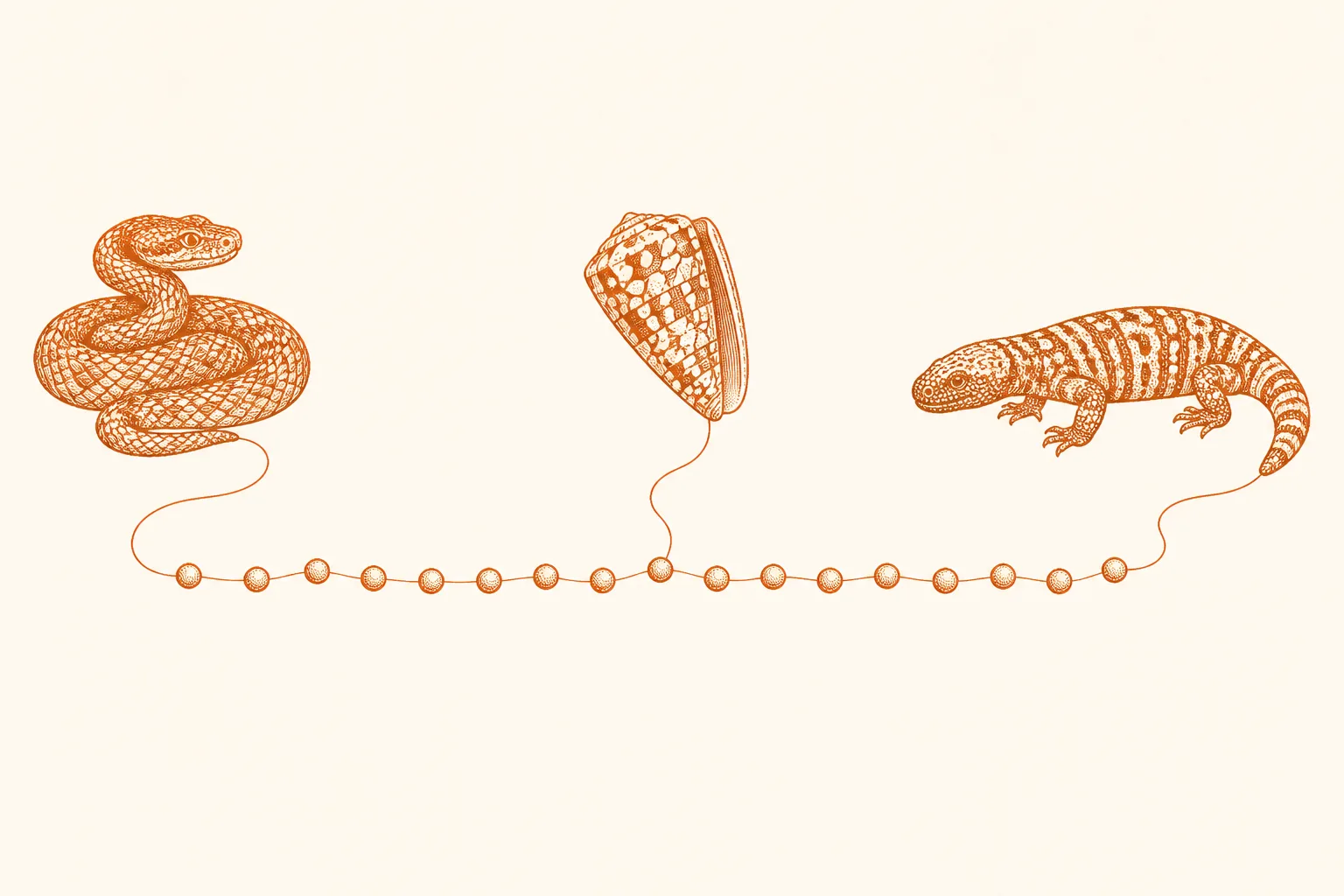
A snake, a sea snail and a desert lizard have each handed medicine a drug class. That is not a run of luck — it is what happens when you raid a chemistry programme that has been running for tens of millions of years.
Open a pharmacology textbook at the cardiovascular chapter, then at the chronic pain chapter, then at the metabolic one, and the same strange footnote keeps appearing: a snake, a sea snail, a lizard. It reads like a run of coincidences and it is nothing of the sort. Venom is the product of an extremely long optimisation run. An animal that hunts or defends itself chemically survives only if its molecules act fast, act at vanishingly small doses, and act on one specific piece of another animal's physiology — which is, very nearly word for word, the specification a pharmacologist writes before starting work. Evolution has been running the medicinal chemistry programme for millions of years, against live targets, with lethal consequences for failure. So many drugs come out of venom because venom is where that specification has already been met.
The specification nobody had to write
Consider what a venom actually has to achieve. The animal carrying it is usually smaller than the thing it wants to subdue, or the thing that wants to eat it. It cannot win by volume: it has a gland holding a few microlitres and, often, one chance to deliver them. Whatever is in that gland must work within seconds, at quantities measured in millionths of a gram, on a body that is actively resisting. There is no room for a molecule that binds loosely, or needs an hour to accumulate, or spreads its effect thinly across a dozen tissues and does nothing decisive in any of them.
Now write down what a drug developer asks of a candidate: high affinity for a defined target, activity at low concentration, a fast and unambiguous effect, enough stability to survive the journey. The two lists are close to identical. The difference is scale. The pharmacologist's version has been pursued for about a century, by a few thousand people, a few hundred compounds at a time. The animal's version has been pursued across tens of millions of years and an enormous number of lineages in parallel, with every unsuccessful variant deleted from the record by starvation or by being eaten.
And the two programmes keep arriving at the same addresses. Venoms converge on voltage-gated ion channels, on cell-surface receptors, on the clotting cascade, on the proteases that set blood pressure 5. That convergence is not a coincidence either. Those are the control points where a small intervention produces a large physiological swing — which is precisely what makes them worth attacking, and precisely what makes them worth treating.
The snake that lowered blood pressure
The founding case is a Brazilian pit viper, Bothrops jararaca, and it deserves telling properly because nothing since has improved on it as an illustration. The clinical fact came first, long before anyone could explain it: among the effects of the venom was a dramatic fall in blood pressure. In the 1960s the Brazilian pharmacologist Sérgio Ferreira described what was doing it — not a molecule that lowered pressure by itself, but one that made another molecule work harder. He called it a bradykinin-potentiating factor 1.
Bradykinin is a peptide the human body makes for itself: nine amino acids that widen blood vessels and are then destroyed, briskly, by an enzyme circulating in the blood. Ferreira's venom factor did not imitate bradykinin. It obstructed the enzyme that clears it. The body's own vasodilator, allowed to linger, did the rest. That is a more interesting mechanism than a straightforward poison, and it pointed somewhere useful: at the enzyme.
The enzyme turned out to be holding down a second job. Angiotensin-converting enzyme — ACE — is also the step that turns angiotensin I into angiotensin II, one of the most powerful constrictors of blood vessels the body possesses. So a single enzyme sat at the junction of two opposing systems, destroying a dilator with one hand and manufacturing a constrictor with the other. Block it and both effects run in the same direction: pressure falls twice over. The snake had, in effect, marked the spot.
What followed was chemistry rather than zoology. The venom peptides themselves made unpromising medicines — they were peptides, digestion destroyed them, and they had to be injected. What they supplied was a template: the shape of something that fits the enzyme's active site. Working from that lead, chemists designed a small molecule that did the same job and could be swallowed 2. The class that grew out of it — the drugs whose names end in -pril — became one of the most consequential in all of cardiovascular medicine, used across high blood pressure, heart failure and kidney disease, taken by enormous numbers of people over decades. It began with the observation that a snake's venom lowered blood pressure by potentiating a peptide the body already made.
There is an honest wrinkle here, and it is worth naming because it recurs. The eventual drug was not the venom peptide. It was a small molecule designed from the peptide lead — same target, different chemistry, better behaviour in a human being. Venom often works this way: it supplies the insight that a particular enzyme matters, that a particular pocket can be occupied, that a particular shape will fit, and the medicine is then built from scratch to be small, stable, cheap and swallowable. The animal's molecule is the map, not the destination.
When the peptide stays a peptide
Cone snails are slow animals with beautiful shells and an unlikely hunting method: a modified tooth fired like a harpoon, loaded with a venom that has to stop a fish in open water before it swims out of reach. Speed is not optional for a predator that cannot chase anything. The venom of a single species may hold a hundred or more distinct short peptides, most of them stapled into rigid shapes by disulphide bridges, each aimed at some component of a fish's nervous system.
One of them blocks the N-type voltage-gated calcium channel — a gate on the nerve endings that carry pain signals into the spinal cord. Close the gate and the message is not passed along. The synthetic version of that toxin, ziconotide, was licensed for severe chronic pain 3, and this time the peptide stayed a peptide. The drug is the toxin's own sequence, not a small-molecule impression of it. As a demonstration that a venom component can become a medicine more or less unaltered, it is the cleanest example there is.
The catch is how it has to be given. Ziconotide does not survive the gut and does not cross from the bloodstream into the central nervous system in useful quantities, so it is delivered directly into the cerebrospinal fluid around the spinal cord, by pump, under specialist care 3. That is a demanding way to take a medicine, and it shows the recurring problem with unusual clarity: a molecule optimised by evolution for one delivery route — injected through a harpoon straight into a fish's tissue — is not thereby suited to any other. Nothing in its history obliges it to be absorbable, or to cross a barrier it never had to meet.
And then the lizard
The third case is the one most people have now heard of, and it is told in full elsewhere on this site, so it can be brief here. In the early 1990s a peptide called exendin-4 was isolated from the venom of the Gila monster 4. It resembled a human gut hormone closely enough to switch on the same receptor, and differed from it in exactly the way needed to escape the enzyme that clears the human version within a minute or two. That resistance was the thing a well-funded pharmaceutical effort had spent most of a decade failing to design. The metabolic drug class that followed is the most commercially significant thing ever to come out of a venom gland, and its founding compound was, once again, not invented but found.
A screening library nobody had to synthesise
Set the three cases side by side and the general pattern comes into view. Venomous animals number well over a hundred thousand species — snakes, scorpions, spiders, cone snails, sea anemones, centipedes, some fish, a few mammals and lizards — and every venom is a mixture rather than a substance, frequently running to hundreds of distinct components 5. Multiply the two figures and the arithmetic becomes absurd: millions of bioactive peptides, of which only a sliver has ever been characterised. It is a compound library on a scale no company could afford to synthesise, and nobody had to.
And yet the yield is a handful of drugs rather than a torrent, which tells you the library is hard to read. The obstacles are practical and stubborn.
| Obstacle | What it means in practice |
|---|---|
| Supply | A single milking may yield microlitres. Many of the most interesting animals are small, rare, awkward to keep, or live somewhere difficult to reach — and synthesis only becomes an option once you know the sequence and the fold. |
| Complexity | A venom is a mixture, not a compound. Hundreds of components, some present in traces, some active only in combination with others. |
| Isolation | Establishing which component causes an observed effect means fractionating the mixture and testing the pieces, over and over, with the real risk that the activity belonged to the mixture and vanishes on purification. |
| Structure | Many toxins depend on precisely folded disulphide bridges. Knowing the sequence is not the same as having the molecule. |
| The translation gap | Potent at a target is not the same as usable as a medicine. Selectivity, safety margin, half-life, immune response and route of administration are each a separate problem. |
Each of those is solvable given money and time, and together they explain why venom-derived drugs arrive in ones and twos. They also explain where the successes cluster. Ferreira's factor mattered because somebody recognised which enzyme was being inhibited. Exendin-4 mattered because the receptor it hit was already the object of an expensive, stalled programme. Venom rewards people who already know what they are looking at; it is a poor place to go fishing without a hypothesis.
What evolution was not optimising for
This is the point at which the story usually gets over-told, so it is worth being plain. Evolutionary optimisation produces molecules that are extremely good at doing something to an organism. It does not produce molecules that are safe. It does not produce molecules selective for the one effect a clinician wants rather than the several others that arrive with it. And it does not produce molecules that can be given by any route more convenient than the one the animal happens to use.
Look at what selection was actually rewarding in each case. In the snake, a collapse in blood pressure fast enough to disable — where the therapeutic version is a carefully graded, chronically maintained reduction in an outpatient over decades. In the snail, a total and immediate block of neuronal signalling — where the therapeutic version has to relieve pain without abolishing everything else those channels do. The direction of the effect is right. The magnitude, the duration and the breadth are all wrong, and correcting them is not a formality: it is most of the work, and most of it fails.
So the accurate summary is a modest one. Venom supplies the starting point rather than the answer. It tells you a target is worth attacking, hands you a molecule that proves it, and then leaves behind years of chemistry, formulation, toxicology and clinical testing. The animal did the discovery. It did not do the development, and it had no reason to.
A library being lost faster than it is read
One consequence follows without needing to be dressed up. The library is finite, it is not sitting in a freezer, and it is not indexed. It is held inside living animals in particular habitats — reefs where the cone snails hunt, forests, arid systems, rivers — and a good many of those habitats are under pressure. Species are being lost faster than anyone is screening them, and a venom never collected leaves no record of what was in it.
There is no need to make this sentimental; it is an inventory problem. About a century of pharmacology has drawn three drug classes of genuine consequence, plus a long tail of research tools and candidates, from a fraction of what exists 5. The reasonable inference is that the remainder is worth something, and that the cost of finding out rises as the sample shrinks. Whether the rest of it gets read before it closes is a question about funding and protection — not about whether the molecules are there.
References
- A bradykinin-potentiating factor (BPF) present in the venom of Bothrops jararaca
- Design of specific inhibitors of angiotensin-converting enzyme: new class of orally active antihypertensive agents
- Ziconotide: neuronal calcium channel blocker for treating severe chronic pain
- Isolation and characterization of exendin-4, an exendin-3 analogue, from Heloderma suspectum venom. Further evidence for an exendin receptor on dispersed acini from guinea pig pancreas
- Venoms as a platform for human drugs: translating toxins into therapeutics