origins
The Gila Monster and the GLP-1 Drugs
A venomous lizard in the deserts of the American Southwest had already solved the problem that stalled a decade of pharmaceutical chemistry. It took an endocrinologist working on a side interest to notice.
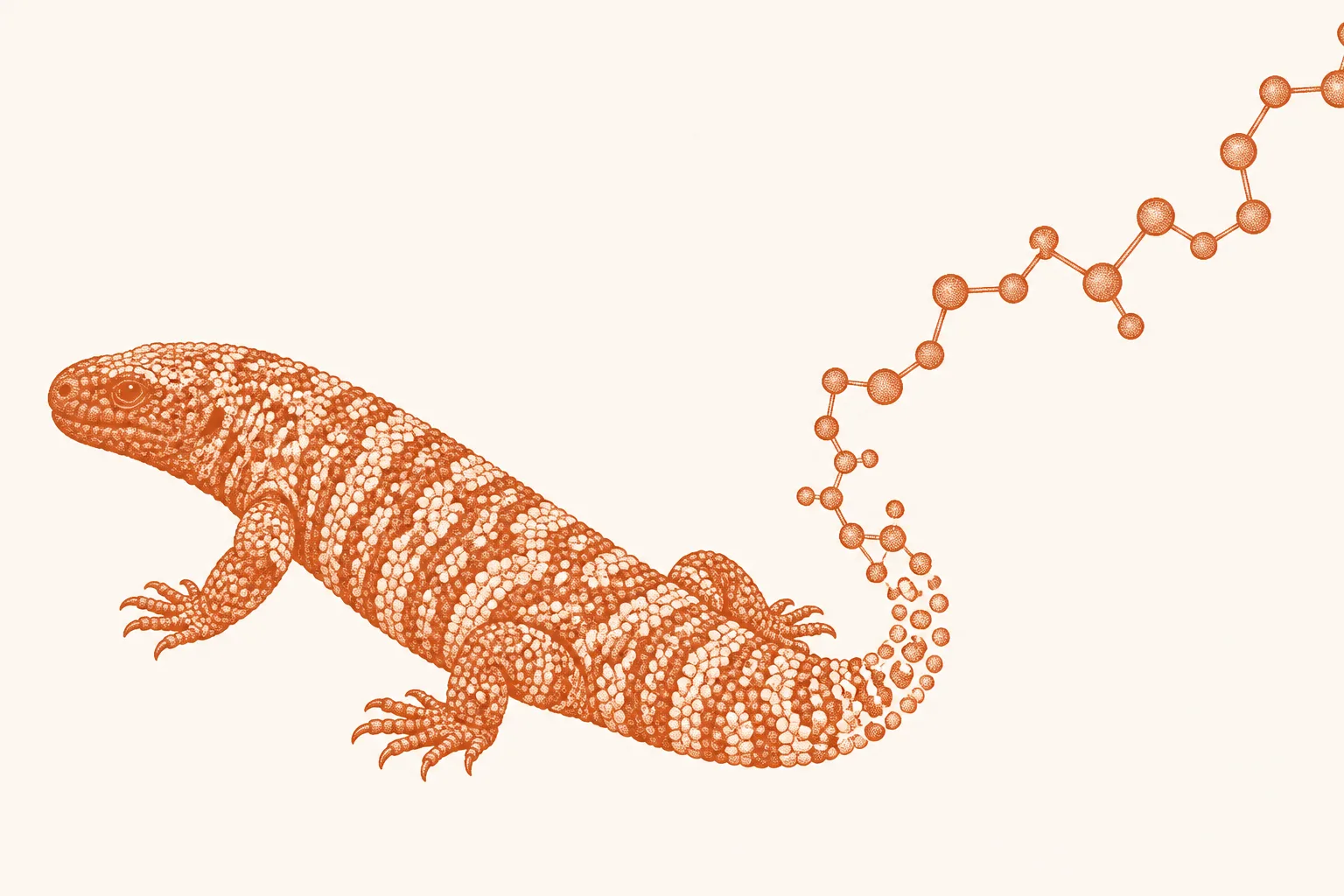
The Gila monster is a slow, heavy, beadwork-skinned lizard that lives in the deserts of Arizona and northern Mexico, eats perhaps five or six enormous meals in a year, and spends most of its life underground doing very little. It is also, improbably, where the largest class of metabolic drugs in the world comes from. The line runs through its venom: in the early 1990s an endocrinologist at a Veterans Affairs hospital in the Bronx isolated a peptide he called exendin-4 from the venom of Heloderma suspectum 1, found that it switched on the human GLP-1 receptor, and — the part that mattered — found that it survived in the bloodstream for hours where the human hormone survived barely a couple of minutes. That peptide became exenatide, the first GLP-1 receptor agonist licensed for type 2 diabetes 4, and every drug in the class since descends from the proof it supplied.
A hormone the body destroys on purpose
By the middle of the 1980s the picture was clear and slightly maddening. Physiologists had known for decades that glucose swallowed provokes far more insulin than the same glucose delivered by vein — the incretin effect, the body's way of hearing that food has arrived before the sugar itself turns up. When the hormone behind much of that signal was characterised as glucagon-like peptide-1, it looked like an answer to type 2 diabetes handed over intact. It prompted insulin release only when glucose was already raised, so it did not push blood sugar dangerously low. It suppressed glucagon. Infused into patients, it did what the physiology promised 3.
And then it stopped, almost immediately. An enzyme called dipeptidyl peptidase-4 — a protease that sits on cell surfaces and drifts in plasma — clips two amino acids off the front of the hormone and leaves it inert. Native GLP-1 has a circulating half-life on the order of one to two minutes 5. A treatment that must be dripped continuously into someone otherwise well enough to walk about is not a drug. It is a demonstration.
So the field had a target it believed in and no molecule that could reach it. Two routes suggested themselves. You could inhibit the enzyme and let the body's own hormone last longer, the logic that eventually produced the gliptins. Or you could build a version of the hormone the enzyme would not recognise — alter the sequence enough to defeat the protease while keeping enough of it to activate the receptor. That second problem is harder than it sounds. Peptides are not modular; a substitution that saves a molecule from being cut very often ruins its fit at the receptor. The chemistry ground on through the late 1980s without a clean answer.
The endocrinologist who went looking in venom
The answer, when it came, arrived from outside the programme entirely. John Eng was an endocrinologist at a Veterans Affairs hospital in the Bronx. He had trained in the laboratory of Rosalyn Yalow, who shared a Nobel Prize for the radioimmunoassay — a technique using antibodies and radioactive labels to pick out vanishingly small quantities of one particular peptide from a messy biological sample. It finds a needle in a haystack, provided you have some idea of the needle's shape.
Eng turned it on venom, which is less eccentric than it sounds. Venom is not poison in the blunt sense. It is a concentrated pharmacological library, often dozens of peptides deep, each one shaped by selection to seize hold of a receptor in another animal and do something drastic within seconds. Evolution has already done the medicinal chemistry, and it has optimised for precisely the properties a drug developer wants: potency, selectivity and stability in a hostile environment. Pharmacology has raided venom repeatedly for this reason — an entire family of blood-pressure drugs traces back to a Brazilian pit viper.
What Eng was hunting for were venom peptides that acted on the pancreas — a question nobody had commissioned him to ask. From the venom of the Mexican beaded lizard, Heloderma horridum, came a peptide he named exendin-3 2. From that of its close relative, the Gila monster, Heloderma suspectum, came exendin-4 1.
What the lizard had already solved
Exendin-4 is thirty-nine amino acids long. Roughly 53% of its sequence is shared with human GLP-1 — enough resemblance that it binds and fully activates our receptor, nowhere near enough that anyone would call it the same molecule. It is not the lizard's edition of our hormone. It is its own peptide, made in a gland in the animal's lower jaw, which has converged on a shape that happens to fit us.
The detail that decided everything sits at the second position of the chain. Human GLP-1 carries an alanine there, and that alanine is exactly what dipeptidyl peptidase-4 reads before it cuts. Exendin-4 does not have it. The protease arrives, finds nothing it recognises, and moves on. The result is a peptide that activates the same receptor with comparable potency and then stays in circulation for hours rather than minutes 4.
Put plainly: the problem that had stalled a well-funded pharmaceutical effort for most of a decade was already solved, and the solution was sitting in the venom gland of a desert reptile. Nobody designed it. It was simply there, waiting for someone who thought to look.
| Human GLP-1 | Exendin-4 | |
|---|---|---|
| Origin | Intestinal L-cells, after a meal | Venom of Heloderma suspectum |
| Length | Thirty amino acids, active form | Thirty-nine amino acids |
| Second residue | Alanine | Glycine |
| Cleaved by dipeptidyl peptidase-4 | Yes, rapidly | No |
| Persistence in blood | One to two minutes | Hours |
| At the human GLP-1 receptor | Native agonist | Potent agonist |
Why a lizard would need such a molecule
The obvious next question is what the animal is doing with it, and here the honest position is that the pharmacology is far better established than the natural history. The usual explanation runs as follows, and it should be read as a reasonable inference rather than a settled fact.
A Gila monster does not eat the way a mammal does. It takes a handful of enormous meals in a year — eggs, nestlings, the young of small mammals — and can put away a substantial fraction of its own body weight at a sitting. Between those meals the digestive system is essentially stood down. An active gut is metabolically expensive, and an animal that may not eat again for months has little reason to pay for one. When food finally arrives, the whole apparatus has to be brought back up at speed: enzyme secretion, motility, the handling of a sudden flood of nutrients. A long-lasting peptide that rouses the pancreas is a plausible part of that machinery, and on this reading the very persistence that makes exendin-4 attractive as a drug would be the point of it for the lizard too.
The complication is where the peptide was actually found. Exendin-4 came out of venom, and venom is equipment for subduing prey rather than for digesting lunch. Whether the molecule has a genuine endocrine role in the animal's own gut, whether it acts chiefly as a venom component that deranges a bitten animal's physiology, or whether it does both, is not resolved by the isolation work — those studies characterised what the peptides did to pancreatic tissue in a dish, not what they do inside a lizard 12. Treat the digestive account as the leading hypothesis, not the moral of the story. The pharmacology holds either way.
The patent nobody else wanted
What happened next is worth telling carefully, because it has been retold often enough to acquire a polish it may not deserve. The documented shape is this. Eng had a peptide with obvious therapeutic implications and an employer with no appetite for pursuing them. Institutions are poorly built to act on a finding that arrives sideways, out of a clinician's own curiosity. He pursued the patent himself, and it took time and persistence before a company took the compound up and carried it into development. Beyond that outline, the specifics that circulate — the conversations, the sums, the precise sequence of refusals — are not reliably sourced, and the story does not need them.
The synthetic form of exendin-4 was named exenatide, and it became the first GLP-1 receptor agonist approved for type 2 diabetes, reaching patients in the middle of the 2000s 4. By the standards of what came after it was a modest product: injection twice a day, and an effect on body weight that was real but small beside later compounds. What it did mattered more than what it sold. It demonstrated in human beings, over years rather than hours, that continuous agonism at the GLP-1 receptor lowers glucose, is tolerable, and does not produce the disasters a chronically switched-on hormone receptor might reasonably have been expected to produce 3.
The line from venom to pharmacy
That proof was the expensive part, and everything since has been engineering laid on top of it. What is easy to miss is that the engineering promptly abandoned the lizard. The drugs that followed went back to the human sequence and made it durable by other means: swapping the vulnerable residue for an unnatural amino acid the protease cannot process, and hanging a fatty acid chain off the peptide so that it clings reversibly to albumin and is ferried around shielded from filtration and degradation. Liraglutide made that work daily; semaglutide stretched it to weekly; tirzepatide brought a second gut-hormone receptor into the same strategy 5. None of them is a lizard peptide. All of them exist because a lizard peptide showed the receptor was worth the money.
- GLP-1 is identified as a potent, glucose-dependent driver of insulin release — and far too short-lived to give as a medicine.
- Exendin-3 is isolated from Mexican beaded lizard venom, exendin-4 from the Gila monster's; both act on pancreatic tissue.
- Exendin-4 proves a potent agonist at the human receptor and, lacking the residue the clearing enzyme reads, lasts hours.
- Its synthetic form, exenatide, is approved for type 2 diabetes, establishing the receptor as a viable long-term target.
- The target validated, the field returns to the human sequence and engineers durability into it directly.
Where molecular novelty actually comes from
It is tempting to file all this under luck. The anecdote has the right shape for it: the overlooked researcher, the strange animal, the discovery nobody would back. But luck is the wrong frame, and it flatters the industry rather more than it deserves.
Consider what was running in parallel. On one side, a well-resourced field was trying to design a protease-resistant GLP-1 analogue from first principles — a genuinely difficult combinatorial problem, tackled a few hundred candidates at a time. On the other, a lineage of desert lizards had been running an incomparably larger experiment for tens of millions of years, under selection that kills whatever does not work, and had arrived at a peptide with precisely the properties being sought. The asymmetry is not close. No screening programme, however well funded, tests a number of molecules that is anything other than negligible beside what biology has already tested and kept.
That is the durable lesson here, and it travels well beyond one drug class. Molecular novelty is overwhelmingly biological in origin. The pharmacopoeia is full of things found rather than invented — in soil bacteria, in moulds, in bark, in marine snails, in venom — and the human contribution is usually the second act: recognising what a molecule is for, making it manufacturable, proving it safe, then improving on it. Semaglutide is a superb piece of protein engineering. It is also, unmistakably, downstream of a lizard.
There is a version of this story that ends in sentiment about biodiversity, and that version is not wrong. But the sharper point is about where knowledge sits. The reason the answer was in the Gila monster is not that the Gila monster is special. It is that the answer is nearly always already out there, in some organism with no interest whatsoever in our problems, and the limiting factor is whether anyone thinks to look — and then, having looked, whether anyone will back what they find.
References
- Isolation and characterization of exendin-4, an exendin-3 analogue, from Heloderma suspectum venom. Further evidence for an exendin receptor on dispersed acini from guinea pig pancreas
- Exendin-3, a novel peptide from Heloderma horridum venom, interacts with vasoactive intestinal peptide receptors and a newly described receptor on dispersed acini from guinea pig pancreas
- The incretin system: glucagon-like peptide-1 receptor agonists and dipeptidyl peptidase-4 inhibitors in type 2 diabetes
- Pharmacology of exenatide (synthetic exendin-4): a potential therapeutic for improved glycemic control of type 2 diabetes
- Mechanisms of Action and Therapeutic Application of Glucagon-like Peptide-1