The Experiment That Named the Hormone
In January 1902 two physiologists at University College London cut every nerve to a dog's gut and still watched the pancreas respond. What they concluded forced a new word into the language, and a libel trial, a riot and a statue followed.
The question the experiment answered was simple: how does the pancreas know that food has left the stomach? In January 1902, in a physiology laboratory at University College London, Ernest Starling and William Bayliss showed that it does not know through the nerves. Two physiologists cut every nerve they could find to a short loop of a dog's small intestine, poured dilute acid into the loop, and watched the pancreas, some distance away, begin to secrete anyway. Something had travelled from the gut to the gland by another road 1.
The road was the bloodstream, the substance was later named secretin, and the idea it proved was strange enough that the language had no word for it. Within three years Starling would supply one. This is the story of an animal experiment, the ideas it overturned, the controversy that followed it into a courtroom, and the word that outlived all of it.
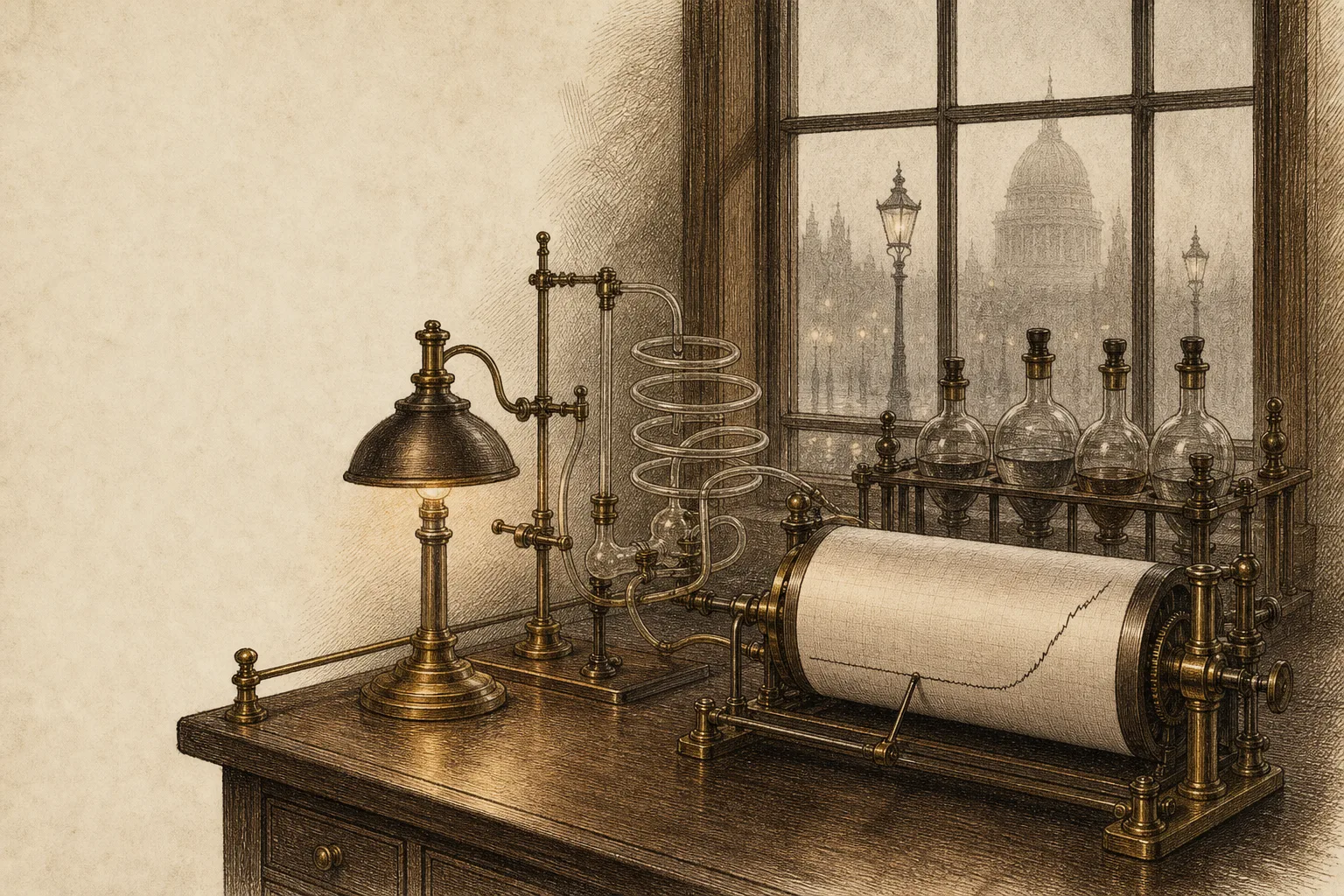
University College London, January 1902
Bayliss and Starling worked in the physiology department at University College London, and they were more than colleagues: Bayliss had married Starling's sister, so the two men were brothers-in-law who argued across a laboratory bench and a dinner table in the same week. Both were interested in the same practical puzzle. After a meal, the stomach passes its acidic contents into the first part of the small intestine, and within moments the pancreas starts to pour alkaline digestive juice into the same place. The timing is tight. How does the gland know?
The accepted answer was a reflex. Acid touches the intestinal wall, sensory nerves carry the signal to the nervous system, and motor nerves carry an instruction to the pancreas. It was a satisfying explanation because it fitted the dominant picture of the body as a machine wired with nerves. The laboratory of Ivan Pavlov in St Petersburg had built its reputation on exactly this kind of nervous control of digestion, and had reported that the acid effect depended on nerve pathways 23.
The experiment that undid the theory was a test of the wiring, and the date usually given is mid-January 1902. The animal, a dog under anaesthesia, had a loop of upper small intestine isolated. Every nerve that could be identified running to the loop was severed, so that the segment was connected to the rest of the animal by little more than its blood supply. Acid was introduced into the loop. If the reflex theory were right, the pancreas should have stayed silent. It did not. Juice flowed 1.
The reflex theory that had to be wrong
A single result in a single animal is not yet a discovery. Defenders of the reflex theory could argue that some small nerve fibres had been missed, or that nerve connections within the gut wall itself might carry the signal. Bayliss and Starling anticipated the objection and went for a cleaner test. If a chemical was released into the blood when acid touched the gut lining, that chemical should be extractable.
They scraped the lining of the same stretch of intestine from another animal, ground it with dilute hydrochloric acid, boiled and filtered the mixture, neutralised it, and injected the clear liquid into a vein of a third animal. Within a short time the pancreas of the recipient responded with a marked flow of juice. No acid had touched its gut. No nerve connected the extract to the gland. The liquid in the syringe contained a substance that the pancreas obeyed 1.
The commentaries written on the centenary of the work stress how complete the logic was. A nerve reflex was ruled out by section, and a chemical messenger was demonstrated by extraction and injection, in the same series of animal experiments 23. The evidence was an animal one throughout: dogs, under anaesthesia, with the findings read from the volume of secreted juice. Nothing in it tested a human being, and nothing in it identified a molecule. What it established was the existence of a pathway.
| Question | Nerve-reflex account | Bayliss and Starling's account |
|---|---|---|
| How does the signal travel? | Along nerves from gut wall to gland | Through the blood, as a chemical carried from gut to gland |
| Prediction if the gut nerves are cut | No pancreatic response to acid | Response continues |
| Prediction for an extract of gut lining injected into a vein | No effect, since no nerve is involved | Pancreatic juice flows |
| What the 1902 experiments found | Prediction failed on both counts | Prediction held on both counts |
A messenger carried in the blood
They named the substance secretin, because it stirred up secretion, and they were careful about what they claimed. The 1902 paper described the effect and the method of getting it, and it left the chemistry open. They could not purify the active material and had no way of saying how large it was or what it was made of. What they could say was that a lining cell in the intestine released something into the blood when acid arrived, and that the something was soluble, survived boiling in acid, and worked at a distance 1.
That last property, action at a distance through the blood, is what mattered conceptually. Physiology at the time knew two ways for one organ to influence another: a nerve, or a nutrient or waste product reaching tissues in passing. Secretin was neither. It was an item made for the purpose of carrying an instruction. The physiologists suggested, and Starling developed over the following years, that the body might be run in part by a family of such substances, each made in one place and acting in another.
The libel trial and the brown dog
The work depended on live animals, and in Edwardian London that was a public matter. Animal experiments were legal only under licence, and a vigorous anti-vivisection movement watched the university laboratories closely. In 1903 two Swedish women who had enrolled as students at the medical school published a diary of what they said they had seen, and it included an account of a small brown terrier dog operated on in a demonstration in the physiology department. The campaigner Stephen Coleridge repeated the allegation in public and named Bayliss as the man responsible for an operation conducted, he claimed, without proper anaesthesia.
Bayliss sued for libel. The case was heard in November 1903, and the jury found for Bayliss, who was awarded damages of £2,000. The animal-protection movement did not accept the verdict. A memorial to the dog, with an inscription accusing the university of cruelty, was unveiled in Battersea in 1906. Medical students, who regarded the statue as an insult, attacked it and clashed with police and supporters across several nights in what became known as the Brown Dog riots. The borough council removed the statue in 1910.
1905: a word from the Greek
By 1905 Starling had been invited to give the Croonian Lectures to the Royal College of Physicians, one of the senior lecture series in British medicine, and he used the platform to generalise. His subject was what he called the chemical correlation of the functions of the body. Secretin was his lead example of a substance that carries a message in the blood from one organ to another, and he needed a name for the class. He used the word hormone, from a Greek verb meaning to excite or arouse 5.
The word fits secretin well, because secretin excites, and it later proved flexible enough to cover substances that inhibit. Its coinage in a lecture hall in 1905 is why secretin is called the first hormone in textbooks: not because it was the first such substance whose effect was observed, but because it was the first to be understood as an instance of a general principle and given a collective name.
Why adrenaline has a competing claim
Priority disputes in the history of science rarely end cleanly, and this one has a good second candidate. In 1895 George Oliver and Edward Schäfer, working in the same Gower Street department, reported that extracts of the adrenal gland, injected into animals, produced a sharp rise in blood pressure 4. By about 1901 the active material had been isolated in crystalline form from the adrenal gland, and it was given the name adrenaline. In the narrow sense of a chemical made by a gland and acting at a distance, adrenaline was recognised earlier than secretin, and it was purified first.
What adrenaline lacked, on the usual reading, was the framing. A pressure-raising extract could be understood as a curiosity of one organ. Secretin, by contrast, appeared at precisely the moment when a nerve explanation of coordination had been tested and failed, so it carried a general conclusion with it. A third strand is older still: experiments in the mid-nineteenth century had shown that testes transplanted into castrated birds restored male characteristics, which implied a blood-borne influence that nobody then had a name for. Historians therefore tend to give credit in layers. Others saw earlier effects. Bayliss and Starling proved a mechanism, and Starling named the idea.
What became of secretin as a molecule
For several decades secretin was a physiological activity rather than a substance. Preparations existed and could be used in the laboratory, but the active principle could not be separated from everything else in the extract. The work of purification was done in the 1960s, notably at the Karolinska Institute in Stockholm, and showed secretin to be a chain of 27 amino acids. That placed it in the same structural family as glucagon and other gut and pancreatic peptides, and it meant that the first hormone ever named was, in chemical terms, a peptide.
The sequence made synthesis possible, and chemical synthesis followed in the late 1960s. A later chapter in secretin's history, in which the peptide was proposed for an unrelated condition on the strength of a few case reports and then tested in controlled trials, belongs to the story of how claims about peptides outrun the evidence. It is a reminder that the 1902 experiment established a physiological pathway in dogs, and that every later use of the molecule needed its own evidence.
Where the definitional and pharmacology articles take over
Starling's 1905 definition has been stretched, narrowed and argued over for a century, and a modern account would add receptors, feedback loops and signalling inside tissues that do not involve the bloodstream at all. Those are the subjects of the fundamentals and pharmacology articles elsewhere on this network. What belongs here is narrower: the experiment, the people, and the habit of mind it created.
For a reader approaching the literature, the useful lesson is about evidence tiers. The secretin result was convincing because it was tested two ways in the same animals, once by removing the proposed pathway and once by supplying the proposed messenger directly. It was nevertheless an anaesthetised-dog experiment, and the paper claimed no more than that. Much of what later became confused about hormones and peptides came from forgetting where such a result stops.