The Brown Liquid They Called Mississippi Mud
A parcel of soil from a Borneo forest reached a pharmaceutical laboratory in Indiana in the early 1950s. Within a few years it had become the antibiotic hospitals still keep for when almost everything else fails. The path between the two was stranger than the drug.
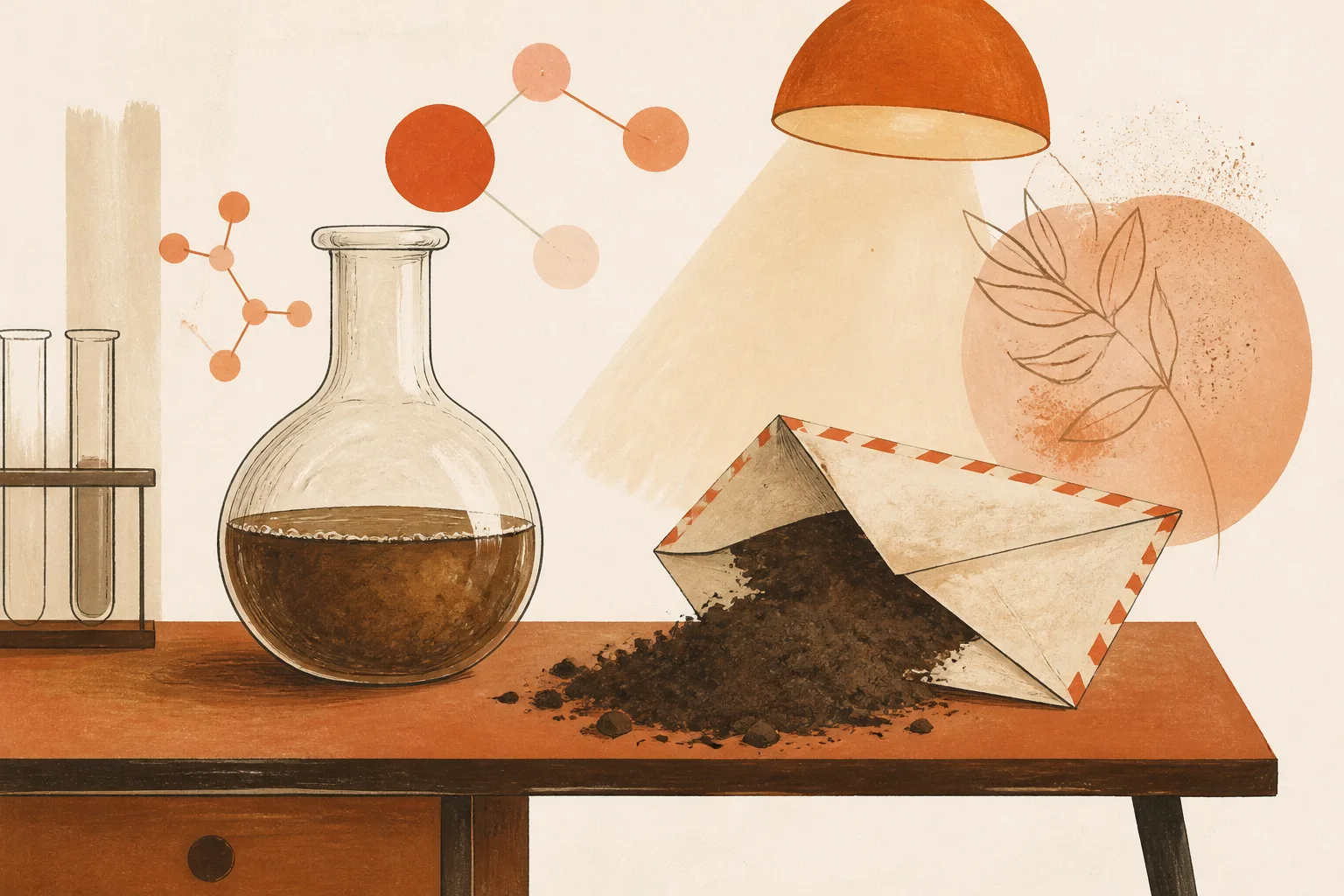
Vancomycin began as a handful of soil. According to the histories, the sample was collected in 1952 in a forest in Borneo and passed to the Eli Lilly laboratories in Indianapolis by a missionary, William M. Bouw. A team led by the chemist Edmund Kornfeld found in it a bacterium that made an antibiotic, which the company isolated in 1953 and had on the market by 1958 12. Today it is a drug that hospitals keep in reserve for serious infections by resistant Gram-positive bacteria, and it is a peptide, though a decorated one.
The interesting parts of the story are the ones around the molecule: a company that collected dirt by post, a preparation so impure it earned a nickname, a regulator that moved unusually fast, and thirty years in which the drug was overshadowed before the arrival of resistant bacteria made it indispensable.
A pharmaceutical company that collected dirt by post
In the 1940s and 1950s the search for new antibiotics was a collecting business. Streptomycin had come from a soil actinomycete in 1943, and a successful drug in the 1940s could change the fortunes of a company. Several firms responded by asking travellers, missionaries and employees abroad to send back soil from forests, deserts and riverbanks, and by screening what arrived for organisms that stopped bacteria growing. Eli Lilly was among them.
The logic was statistical rather than scientific. Most samples yielded nothing. A few produced a compound that was either already known or too toxic to use. The occasional one produced something new, and the cost of the programme was the postage, the technicians and the patience. The Borneo sample was one of a great many, and a single organism from it was to be the notable exception 1.
The method had a long pedigree and a short half-life. Within two decades the easy finds had been made, and the screening of soil gave way to chemical modification of existing molecules and, later, to genomics. The Borneo sample belongs to the last stretch of the period in which an envelope of dirt could still change the course of medicine, and it is easy to see why it is remembered with affection by the people who tell the story 1.
Streptomyces orientalis and the 1953 isolation
The organism that came out of the Borneo soil was a filamentous soil bacterium, then called Streptomyces orientalis and later moved to a different genus as Amycolatopsis orientalis. Its culture fluid held an agent that stopped the growth of Gram-positive bacteria, including staphylococci that had become resistant to penicillin, which at that time was an increasingly worrying problem in hospitals 12.
The agent carried an internal catalogue number, compound 05865, and by June 1953 the Lilly team had established that it was distinct from the antibiotics already known. In the account usually given, the decisive evidence was a paper chromatogram, in which the new substance moved to a position unlike any of the known compounds 1. Paper chromatography was a recent and unglamorous tool, and it is a reminder that much of the antibiotic era was settled by technicians reading smudges on filter paper.
A brown liquid and a nickname
Getting the compound out of the culture was harder than finding it. The earliest isolation used picric acid, a reagent that is potentially explosive when dry, which was not an arrangement a manufacturer could comfortably scale. A replacement process was developed that avoided it, but the product was a brown preparation that was far from pure. Its colour and consistency gave it a nickname in the laboratory: Mississippi mud 1.
Sources differ on exactly how impure the early material was, and this piece does not rely on a figure. What matters for the later story is the consequence. A preparation containing large amounts of other material is unpredictable, and the reputation vancomycin acquired in its early decades for causing harm to the ear and kidney is generally attributed in the histories at least partly to those impurities, before purification improved 14.
| Date | Event |
|---|---|
| 1952 | Soil collected in a Borneo forest and sent to Eli Lilly by a missionary |
| 1953 | The producing organism isolated; the agent shown to be distinct from known antibiotics |
| 1958 | Approved for medical use in the United States and marketed as Vancocin |
| 1980s | Use rises as methicillin-resistant staphylococci spread through hospitals |
The patient whose foot was saved
The first reported use of the drug was against penicillin-resistant Staphylococcus aureus. In the story usually told, a patient with a post-surgical foot infection that had not responded to other antibiotics recovered and went home two months later with the foot intact 1. It is a single case report from the 1950s, which is the weakest kind of clinical evidence, and the right way to read it is as an anecdote that helped the drug's reputation, not as a measure of its performance.
1958: a fast approval and a name that means 'to vanquish'
The regulator fast-tracked the application, and the drug was approved in 1958, which in the standards of the time was brisk. The reason was the threat it addressed: hospital staphylococci resistant to penicillin had become a pressing problem, and few alternatives existed 12.
The name is traditionally explained as derived from the verb to vanquish, a fitting piece of corporate optimism. Sources differ, and one account derives it from a Latin verb meaning to vanish. The story with the better claim to be remembered is the more modest one: the compound began life as a number, and it was given a name only when it was ready to be sold.
Approval did not mean the problem of purity was behind the company. The histories describe continuing efforts through the following years to refine the preparation, and the reputation of the early product for causing harm was one of the reasons the drug was not used more widely 14.
Thirty years in the cupboard
Vancomycin did not become the first choice it might have been. It was given by injection because very little of it is absorbed from the gut, which limited its convenience. Its early preparations were linked to toxicity. And within a few years of its approval, semi-synthetic penicillins that resisted the staphylococcal enzyme appeared, with methicillin among the first, offering clinicians a more familiar alternative 14.
The result was a long period in which the drug was available but peripheral. Its patent expired in the early 1980s, according to the usual account, and generic versions followed. A molecule that a company had put years into was, for much of the 1960s and 1970s, a specialist's drug, kept for infections that other agents had failed to clear 12.
There is a quiet lesson in this stretch of the history. A drug can be good and still be overlooked, simply because the circumstances that make it valuable have not yet arrived. Vancomycin was approved in 1958 as a response to one resistant bacterium and was kept for decades as an insurance policy against the next. When the next one came, the insurance was there, which is a different story from the one in which a drug is withdrawn and has to be rediscovered 2.
Why it came back: Clostridioides difficile and MRSA
The reversal came from the bacteria. Through the 1970s and 1980s, staphylococci resistant to methicillin and its relatives spread through hospitals, and the drug that had been displaced in the 1960s became one of the few reliable options against them. The same property that made it clumsy, that it is not absorbed from the gut, also proved useful: taken by mouth, it stays where the bacteria of a severe intestinal infection with Clostridioides difficile are found 13.
The comeback was not an unqualified success. As use rose, resistance did too, and the later history of the drug includes enterococci resistant to it and staphylococci with reduced susceptibility. The pharmaceutical industry responded with a second generation of related molecules, including teicoplanin and, later, semi-synthetic derivatives that were built to overcome the new defences 3.
What a glycopeptide is, and the articles that explain it
Vancomycin is a glycopeptide: a short chain of seven amino acids, several of them unusual, cross-linked into a rigid basket and decorated with sugar units. It acts on the construction of the bacterial cell wall by binding to a particular two-residue terminus on the wall's building blocks, which prevents them being joined together 3. That is the whole of the chemistry this piece will offer.
The structural reasons why cross-linking and cyclisation matter to peptide stability, and the methods used to confirm what is in a sample of any such molecule, belong to the technical and analytical articles. What the story of vancomycin adds is the human side: a drug found by postal collection, nearly lost to fashion, and recovered when the environment around it changed.
In one sentence
A parcel of Borneo soil, an impure brown preparation and a fast approval in 1958 gave medicine a glycopeptide that spent decades on the margins and then, as resistant bacteria spread, moved to the centre 13.