The Soil That Was Fed Bacteria: Gramicidin, 1939
Two years before penicillin was purified, a French-born microbiologist at the Rockefeller Institute set out to find an antibiotic on purpose, by feeding dirt. What came out of the soil was the first antibiotic to reach a clinic, and it was a peptide.
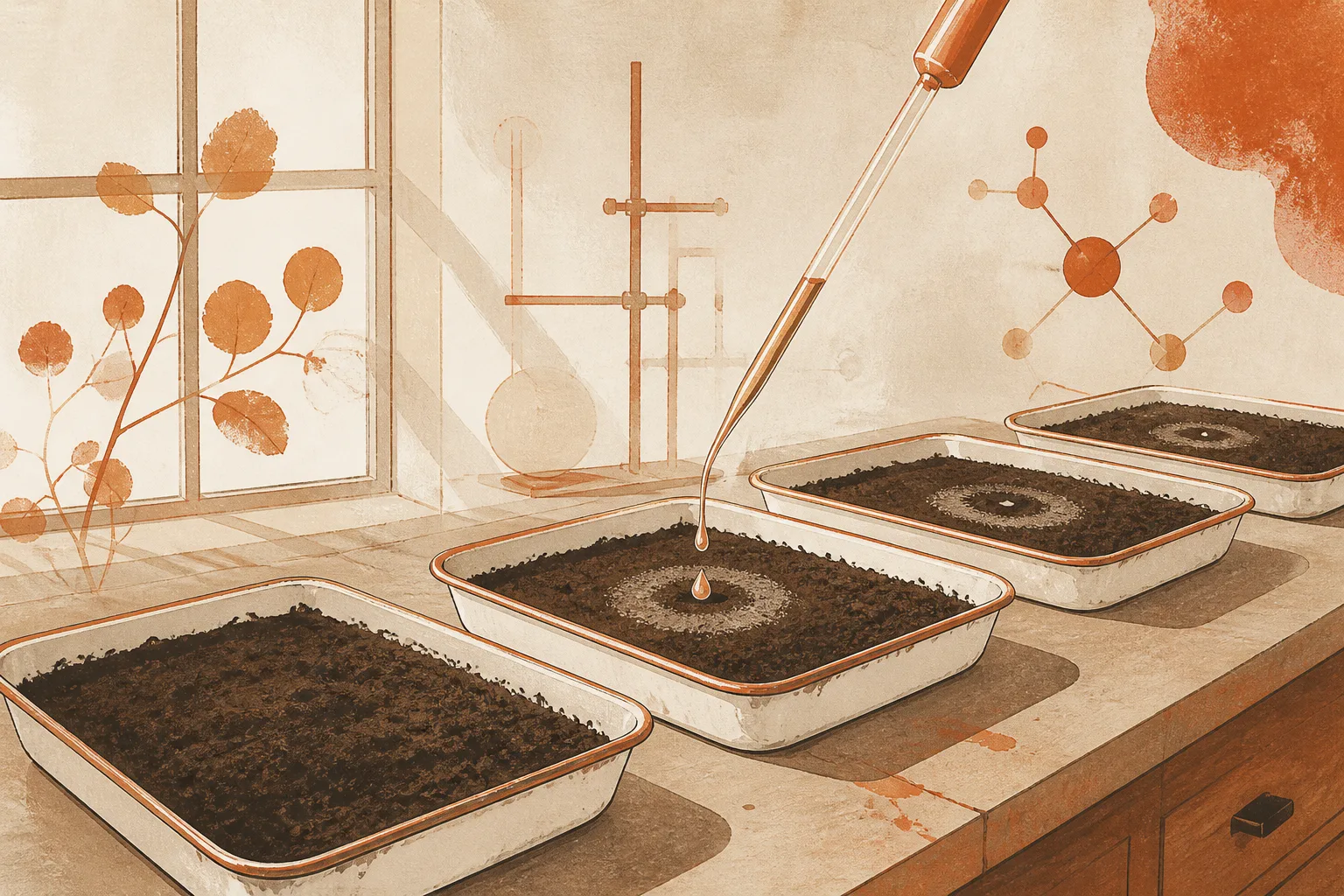
The first antibiotic to reach a clinic was a peptide, and it was found on purpose. In the late 1930s René Dubos, a French-born soil microbiologist at the Rockefeller Institute in New York, kept soil in his laboratory and fed it, over about two years, a mixture of the very bacteria he wanted something to destroy: staphylococci, pneumococci and haemolytic streptococci. Out of that soil, in 1939, came a spore-forming rod called Bacillus brevis, and out of the rod came a substance that killed most Gram-positive bacteria 12. It is a peptide because, chemically, that is what it is: a short chain of amino acids, assembled by a bacterium rather than by a gland.
The story is usually told as a prelude to penicillin, and it does have a place in that sequence. But it is better read as a story in its own right: a hypothesis about dirt, an old idea that had sat unused for decades, a quarrel inside the molecule itself between a gentle fraction and a violent one, and a scientist who, having found what he was looking for, stepped away from it.
A hypothesis about dirt
Dubos had been at the Rockefeller Institute since 1927, recruited by the bacteriologist Oswald Avery, who handed him a problem that sounds like a riddle. The capsule of type III pneumococcus, the sugary coat that protects the bacterium from the body's defences, is a polysaccharide that does not decay in nature as readily as it ought to. If it does not pile up forever, Avery reasoned, something in the soil must be eating it. Find the something, and you might have a tool for stripping the capsule from a living infection 2.
Dubos found it. By enriching soil with the purified capsular polysaccharide and waiting for an organism that could live on it, he isolated an enzyme that dissolved the capsule. It was announced in Science in 1930 and described in two papers in the Journal of Experimental Medicine in 1931 and 1932, and it protected mice against a type III infection 2. It never became a medicine. But it left Dubos with a method, and the method was the discovery: if the soil can be taught to produce an enzyme against a bacterial coat, it can be taught to produce something against the bacterium itself.
The reasoning behind the later experiment was ecological. Soil is crowded and competitive, and a population of microbes that has survived there for a very long time has presumably acquired weapons. Dubos put it to work. Over roughly two years he fed soil a mixture of bacteria of the kinds that cause human disease, and screened it for organisms that flourished while the mixture shrank 12.
An old idea, sixty years unused
Dubos was not the first person to notice that microbes fight one another. In 1877 Louis Pasteur and his colleague Jules Joubert observed that the anthrax bacillus, which flourished in sterile urine, grew poorly when the urine was contaminated with common bacteria, and Pasteur remarked that the observation might have therapeutic promise. In the following decades there were scattered reports of bacterial extracts that checked other bacteria, and none of them led anywhere durable. The ideas were present; the infrastructure to pursue them, and the motive, were not.
What changed by the 1930s was a shift in expectation. The sulphonamide drugs had shown that an infection inside the body could be attacked chemically. Fleming had published his observation of the mould that cleared a staphylococcal plate in 1929, and then left it largely where it was; Florey would later say that the penicillin work had been shelved for nearly a decade 2. A scientist who set out in 1937 to find a bacterial killer in soil was working in the gap between a known precedent and a missing programme.
Bacillus brevis and the two fractions
The organism that survived the feeding was a spore-forming rod, Bacillus brevis, a name that has since been changed to Brevibacillus brevis. Cultures of it contained something that killed most Gram-positive bacteria and, in the laboratory, did so at low concentrations. Dubos reported the preparation and its activity in the Journal of Experimental Medicine in 1939, in a paper whose title speaks of 'a bactericidal agent extracted from a soil bacillus' 1. The crude substance was named tyrothricin.
Dubos was a microbiologist, not a chemist, and the next step needed one. He teamed with the biochemist Rollin Hotchkiss, and in 1940 their fractionation of the crude material appeared in the Journal of Biological Chemistry 4. Tyrothricin was not a single compound. It was a mixture of two polypeptides, and they behaved so differently that Hotchkiss is recalled as giving them nicknames: tyrocidine the 'roughneck' and gramicidin the 'gentle protector' 2.
| Component | Chemical class | Action on bacteria | Reach |
|---|---|---|---|
| Tyrocidine | Cyclic polypeptide | A lysin that attacks the bacterial membrane | Gram-positive and Gram-negative organisms |
| Gramicidin | Linear peptide of 15 amino acids, alternating L and D forms | Inhibits growth, described as bacteriostatic | Selective for Gram-positive organisms |
The table compresses a distinction that matters. The 'roughneck' did not discriminate between a bacterial cell and a mammalian one, and was the more dangerous of the two. The gentler fraction was easier to live with. Its commonest later form is still named gramicidin D, the letter standing for Dubos.
Why gramicidin could only be used on the surface
In mice, a single injection of gramicidin protected against fatal bacterial infection. That is the sentence that made the discovery famous, and it needs its qualifier: it was an animal result, in a laboratory model, and the very next finding was that the substance was too toxic to be given into the bloodstream of a person 2. Whatever the molecule did to bacterial membranes, it also did harm to the cells of the animal receiving it, notably the red blood cells.
So gramicidin's clinical life was confined to places a drug could be applied directly: wounds, ulcers, and mucous surfaces. Accounts of its use through the Second World War describe topical preparations of exactly that kind 23. Tyrothricin and gramicidin were among the first antibiotics to be manufactured commercially. They were also, in a sense, the first antibiotic to reveal what would be a recurring bargain: a molecule that kills bacteria well enough to matter often hurts something in the host as well, and the clinical story is the story of narrowing that gap.
Wartime wounds, and the revival of a stalled penicillin
The significance of Dubos's result was larger than the substance he found. A reliable example that a soil organism could produce a bactericidal agent which protected an animal from infection changed what was worth trying. Howard Florey, whose Oxford group would take penicillin through purification and into the first patients, credited Dubos with reviving the penicillin research that had been shelved after Fleming's 1929 observation 2.
That is how the story is usually told, and the order of events is part of what is notable. Gramicidin, and not penicillin, was the first antibiotic to be taken through a clinical programme. It was a modest first. It could not be injected, and its applications were narrow. But it demonstrated that the pipeline from soil to bottle was real, and a generation of researchers followed it. The retrospective accounts collected in Launching the Antibiotic Era give a sense of how recent and improvised the field felt to the people who were inside it 3.
The man who walked away from his own discovery
Having launched the field, Dubos did not stay in it. Biographical accounts describe him as stepping back from antibiotic research, and give as his reason a conviction that such agents would encourage resistance in the organisms they were meant to remove. His intellectual interests moved to the relationships between organisms and their environments, a subject on which he would later write widely for general readers.
The detail of this departure is less well documented than its outline. The retrospectives on which this piece relies do not give a date or a single document for the moment of withdrawal, and the account of a warning issued in 1942, before antibiotics were in general use, rests on biographical summaries rather than a primary paper this piece was able to check. It is reported here as that: a recorded view, attributed to Dubos in later biographical writing, that resistance should be expected.
The warning about resistance
What can be said with confidence is that the concern was shared by the field's pioneers. Fleming warned of it in his Nobel address in 1945, and the first reports of drug-resistant staphylococci followed the introduction of penicillin within a few years. The 1939 paper itself belongs to the earlier moment, when the existence of an antibiotic was still the surprise and its failure was still hypothetical 1.
Read from the present, Dubos's wariness looks less like pessimism than like the first sketch of a problem that now organises the whole subject. Every later story in this cluster, the glycopeptide kept in reserve, the lipopeptide abandoned and revived, the preservative that bacteria seem slow to resist, is partly a story about how long a molecule stays useful.
What a peptide antibiotic is, and where the chemistry articles take over
A peptide antibiotic is a short chain of amino acids made by a microbe, and used by it as a weapon. Many of them are cyclic, many contain unusual residues, and several act on the bacterial membrane or cell wall, not on the genetic machinery inside. Gramicidin is a small and unusual member of the family: its alternating L and D residues allow it to coil into a structure that, in laboratory studies, forms pores in membranes.
The mechanisms, the structures and the modern pharmacology of antimicrobial peptides are covered elsewhere on the sister sites of this network; this article stops at the point where a historical question becomes a chemical one. What belongs here is the human sequence: a man, a theory about dirt, an experiment that took two years, and a molecule that proved a point larger than itself.
In one sentence
In 1939 a Rockefeller microbiologist demonstrated that an antibiotic could be hunted rather than stumbled upon, found it in a soil bacterium, and showed that it was a pair of peptides, one too violent for the body and one too toxic to inject, which together proved that the idea worked 124.
References
- Studies on a bactericidal agent extracted from a soil bacillus: I. Preparation of the agent. Its activity in vitro
- René Dubos: unearthing antibiotics
- Launching the Antibiotic Era: Personal Accounts of the Discovery and Use of the First Antibiotics (Moberg & Cohn, eds)
- Fractionation of the bactericidal agent from cultures of a soil bacillus