The Receptor That Waited Twenty Years for Its Hormone
Most drugs are built to imitate something nature already made. In this case the imitation came first: a laboratory peptide, then its receptor, then, more than two decades after the first clue, the hormone the receptor had been waiting for. A discovery story told back to front.
In the late 1970s, a chemist at Tulane University in New Orleans, Cyril Bowers, was testing altered fragments of an opioid peptide on pituitary cells in culture, and found that some of them made the cells release growth hormone. The release did not follow the pattern of opioid action, and nobody could say what it was acting on. The answer took about twenty-two years: first a hexapeptide built in a laboratory, then a receptor cloned by a drug company, and only in 1999 the natural hormone, found not in the brain but in the stomach and named ghrelin 123.
Nearly every drug-discovery story is told forwards. A hormone is found, its receptor is worked out, and chemists copy or improve the hormone. This one ran in reverse, and that inversion is why it is still taught as the clearest case of what the field came to call reverse pharmacology. This is strictly a history of how the pieces were found and in what order. It says nothing about what ghrelin or any compound in this lineage does in an animal or a person, and that omission is deliberate.
A molecule that worked and should not have
Bowers came to the problem from the opposite direction to most endocrinologists. In the 1970s the enkephalins, short peptides made in the brain that act on the same receptors as morphine, were a fashionable subject, and chemists were making altered versions to see which changes mattered. Bowers tested enkephalin analogues on pituitary cells. Some of them made those cells release growth hormone, and the release followed no opioid logic 1.
What made this strange was timing. In the late 1970s no one had yet identified the brain's own signal for growth hormone release; that molecule, growth hormone-releasing hormone, would be characterised in 1982, isolated from tumours of the pancreas that had caused excess growth hormone in patients. The enkephalin-derived compounds could not be explained as imitations of any known hormone, and chemists who work by imitation are uncomfortable when there is nothing to imitate. The honest description was a result with no mechanism.
It would have been easy to drop it. Instead the Tulane group did what medicinal chemists do with an active compound of unknown purpose: they kept altering it, testing each variant, and following whatever got stronger. The record from this phase is a series of structure-activity studies in the early 1980s, all conducted in cell culture and in laboratory animals. None of it tells us anything about people, and none of it is the subject here. What matters for the story is that the activity could be improved by design while its target stayed completely hidden.
GHRP-6, 1984: a hexapeptide with no known receptor
By 1984 the group had a six-residue peptide that was far more potent in the laboratory than the enkephalin fragments it came from. Its title in the journal Endocrinology described it as a new synthetic hexapeptide acting on the pituitary, and reported both in vitro and in vivo activity, meaning in cultured pituitary cells and in animals 1. It was later known as GHRP-6, short for growth hormone-releasing peptide. Two of its six residues were D-amino acids, the mirror-image forms that the body does not use when it builds proteins, which made it unlike anything a cell would make for itself.
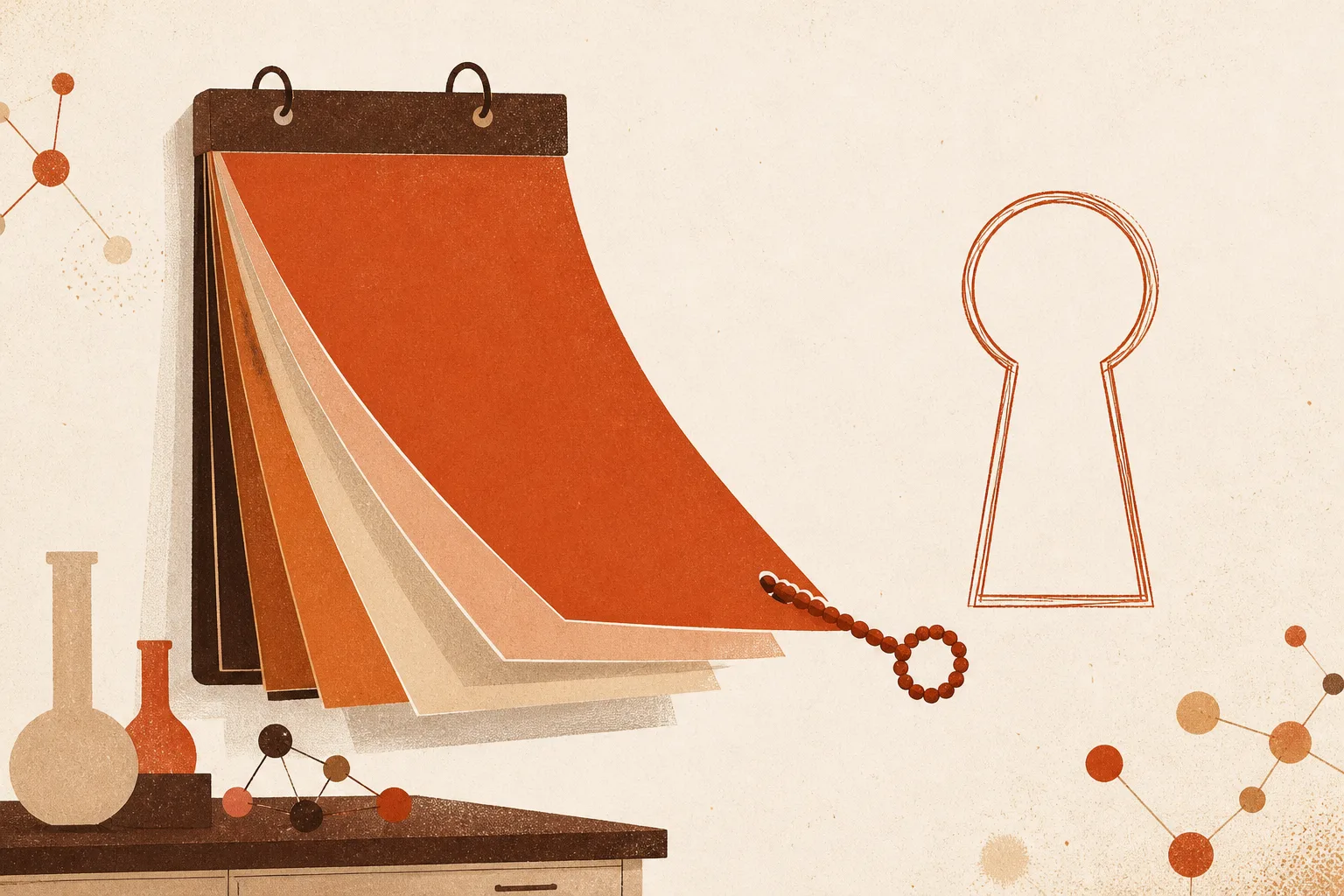
That last point sharpened the puzzle. A compound containing unnatural residues does not look like a copy of a natural messenger, and yet it acted selectively and potently on one cell type. Evidence that it worked through a pathway distinct from the newly characterised growth hormone-releasing hormone made the case for an unknown receptor stronger, not weaker. If a drug acts selectively, something must be on the other side of the lock.
A decade of analogues in search of a target
What followed was a decade of chemistry without biology. Related peptides were made and compared, each a small variation of the last. Some were more stable, some more potent, some more selective. One of the best-known, ipamorelin, came out of industrial research at Novo Nordisk in the 1990s and was described in 1998 as the first selective member of the class 6. The collective name that stuck for the family was growth hormone secretagogues: substances that provoke release of the hormone, with no implication about the mechanism, because there was no mechanism to name.
Pharmaceutical companies took an interest. Merck, in particular, took the peptide as a lead and worked to convert it into small non-peptide molecules, the kind that are easier to manufacture and more stable in a bottle. That is ordinary drug development. It also created a tool: once a non-peptide compound existed that behaved like the peptide, it could be labelled and used as bait.
| Date | Event | Kind of evidence at the time |
|---|---|---|
| Late 1970s | Enkephalin analogues release growth hormone from pituitary cells in culture, by a route that does not look opioid | In vitro (cultured cells) |
| 1982 | Growth hormone-releasing hormone characterised from pancreatic tumours | Human tissue, biochemical purification |
| 1984 | Synthetic hexapeptide GHRP-6 described, with in vitro and in vivo activity | Cultured cells and animals |
| 1996 | Merck team clones an orphan receptor that responds to a non-peptide compound derived from the peptide lead | Receptor cloning, cell-based assays |
| 1999 | Ghrelin purified from rat stomach as the receptor's natural activator, and the human sequence reported | Rat tissue purification, cell-based assays |
Merck, 1996: cloning a receptor for a drug that had no hormone
The 1996 paper in Science from Merck Research Laboratories carried a title that was almost casual: a receptor in pituitary and hypothalamus that functions in growth hormone release 2. Its achievement was to use the synthetic compound as a probe and pull out the matching protein by expression cloning, a method in which genes are tested one pool at a time for the ability to make a cell respond. The protein turned out to be a member of the large family of G-protein-coupled receptors, the cell-surface proteins that also include the receptors for many peptide hormones. It was named the growth hormone secretagogue receptor.
The result was exhilarating and uncomfortable at the same time. A receptor existed, was found where it should be, and was clearly of the type that normally has a peptide key. Biology rarely maintains a receptor with nothing to bind. But the receptor was, in the language of the field, an orphan: a receptor with no known natural ligand. The group could show that their synthetic probes worked on it. They could not say what the body used it for, because the body's own activator had not been found.
Kurume, 1999: the hormone was in the stomach all along
The search for the match was carried out at the National Cardiovascular Center Research Institute in Osaka and at Kurume University, in a collaboration associated with Masayasu Kojima and Kenji Kangawa. Their method was the mirror image of the one that had produced the receptor. Instead of starting with a compound and finding the receptor, they put the receptor into cultured cells, rigged the cells to report when it was activated, and then screened extracts of rat tissues to see which extract made them respond 3.
The most active extract came from the stomach. Purifying the active component, step by step, led to a peptide of 28 amino acids with a peculiarity that no one had predicted: the side chain of its third residue, a serine, carried an eight-carbon fatty-acid group, an n-octanoyl modification, and the activity depended on it 3. A hormone with a fat attached was a new thing in endocrinology, and it explained in hindsight why earlier searches by conventional methods might have missed it. The group named it ghrelin, from a root meaning to grow, and reported the human version alongside the rat one in Nature that year 35.
Bowers himself wrote the retrospective that gave the whole affair its best-known title two years later: unnatural growth hormone-releasing peptide begets natural ghrelin 4. The phrase is accurate as a description of the order of events. The laboratory compound was not an imitation of ghrelin in the sense that chemists had set out to copy it. It was a sibling that happened to fit the same lock.
What reverse pharmacology meant for the field
The ghrelin story did not invent the strategy, and orphan receptors had already been matched to peptide ligands in the 1990s. But it supplied the demonstration that a compound could come first, a receptor second and the hormone last, and that the process could be organised on purpose. In the years after genome sequencing produced hundreds of receptor-like genes with no assigned partner, searching for the missing ligands became a standard programme in pharmaceutical research 5.
It also changed how the earlier compounds were understood. Before 1999 they were secretagogues acting through a mechanism no one could name. After 1999 they were, in effect, mimics of a hormone that had been there all along, and a literature that had been a collection of curious chemistry reorganised itself around a receptor and its natural activator. Careful historians of the field note that this retrospective tidiness can mislead. For fifteen years, researchers working with these peptides did not know what they were imitating.
The compounds that remained research reagents
The peptides built in the decade before the receptor continue to circulate as laboratory reagents, with names such as GHRP-2, GHRP-6 and ipamorelin appearing in the research literature and in catalogues. Their regulatory position differs from compound to compound and from one jurisdiction to another, and this article makes no claim about any of them. A synthetic peptide being old, well described or widely available is a statement about its history, not about whether it is suitable for any purpose.
What the history does give a reader is a caution about naming. A compound called a secretagogue, a releasing peptide or a ghrelin mimetic has been classified by a single assay readout. The category tells you how the compound was first noticed, not what it does in a living system, and the distinction between a cultured-cell result, an animal result and a human result applies to this class as it does to every other.
Where the receptor pharmacology takes over
The chain of events here is short enough to state in a sentence. A chemist followed an unexplained activity; a company built a probe from it and caught a receptor; a second group used the receptor as bait and caught the hormone. Everything that came afterwards, the physiology of ghrelin, the pharmacological comparison of the synthetic agonists, the question of how selective each one is for its target, is a separate literature with its own evidence tiers, and the sister publications in this network cover it in the technical detail it needs.
The story is worth keeping for one reason. In a field that is often described as if each molecule arrived with its purpose attached, this was a case where the purpose was found twenty years after the molecule, by someone else, in a different organ.
References
- On the in vitro and in vivo activity of a new synthetic hexapeptide that acts on the pituitary to specifically release growth hormone
- A receptor in pituitary and hypothalamus that functions in growth hormone release
- Ghrelin is a growth-hormone-releasing acylated peptide from stomach
- Unnatural growth hormone-releasing peptide begets natural ghrelin
- Ghrelin: structure and function
- Ipamorelin, the first selective growth hormone secretagogue