the first syntheses
The Nine Amino Acids That Won a Nobel
In 1953 a laboratory on the East Side of Manhattan worked out the order of nine amino acids in a pituitary hormone, built that order from bottled chemicals, and found the result behaved exactly like the real thing. Everything the field has done since walks out of that room.
On a bench at Cornell University Medical College in 1953, a strip of rat uterus hangs in a bath of warm salt solution, twitching. It twitches when someone adds a dilution of extract from the posterior lobe of an ox pituitary, which is what a century of physiology says it should do. Then it twitches in the same way, at the same dilution, when someone adds a solution made up from a bottle of white powder that has never been inside an animal. The powder was assembled over months from purchased amino acids, one linkage at a time, by a group working under Vincent du Vigneaud. The muscle cannot tell the difference between the two. As it turns out, neither can anything else.
That comparison is the founding event of peptide science, and it is easy to miss how strange the claim behind it was at the time. Hormones had been potencies before they were molecules — things measured in units of effect, prepared by the tonne from slaughterhouse glands, and understood mostly by what happened when you injected them. What happened in 1953 was that one of them stopped being a preparation and became a formula: a specific order of specific residues, which anyone with enough patience and enough starting material could write down and then make.
Following the sulfur
Du Vigneaud arrived at the posterior pituitary by following a chemical element. As a young man in the late 1920s he worked on insulin in John Jacob Abel's laboratory at Johns Hopkins, and what held his attention there was not the clinical drama of the hormone but its sulfur. Insulin was unusually rich in cystine, and nobody could say what the sulfur was for. He spent the next two decades among sulfur-containing compounds — cystine, methionine, biotin, the biological transfer of methyl groups — and his career has the shape of a man following one thread through a series of otherwise unconnected rooms. He said as much when the time came to summarise it, giving his Nobel lecture the title of a trail running from insulin to oxytocin 5.
The posterior pituitary was the room the thread led into. Extracts of the gland's posterior lobe had been known since the beginning of the century to do two quite different things: contract smooth muscle, the uterus especially, and raise blood pressure while cutting urine output. For years it was unclear whether one substance was responsible for both effects or two substances were simply travelling together through every purification anyone tried. In 1928 a group at Parke-Davis led by Oliver Kamm settled the question by separating the two activities into distinct preparations, naming them oxytocin and vasopressin, and putting both on the market as standardised solutions 1. Obstetric wards had already been using the crude extract for twenty years. What was in it remained unknown.
What was known was that the oxytocic material contained cystine — which is to say sulfur, which is to say it was exactly du Vigneaud's kind of problem. He moved to Cornell in 1938, and by the late 1940s his group had the hormone concentrated far enough to be worth attacking: still quantified in units of biological activity rather than in milligrams, still assayed by what it did to a strip of muscle, but at last pure enough to take apart.
Nine residues and a bridge
Taking a peptide apart in 1950 meant hydrolysing it — cutting it into fragments with acid or with enzymes — identifying the fragments, and then reasoning backwards to the only order that could have produced all of them. It is a jigsaw solved through overlaps, and it consumes precious material at every step. Frederick Sanger was doing the same thing to insulin in Cambridge over the same years, on a chain five times longer; the two efforts share a method, an era and a certain willingness to spend years on a single molecule.
By 1953 du Vigneaud, working with Charlotte Ressler and Stuart Trippett, could propose a complete order: nine amino acids in a fixed sequence, with the final residue carrying an amide group rather than a free acid 2. The Vienna chemist Hans Tuppy arrived at essentially the same sequence independently and published it in the same year 3 — the kind of coincidence that lends a structure credibility long before anyone has confirmed it by any other route.
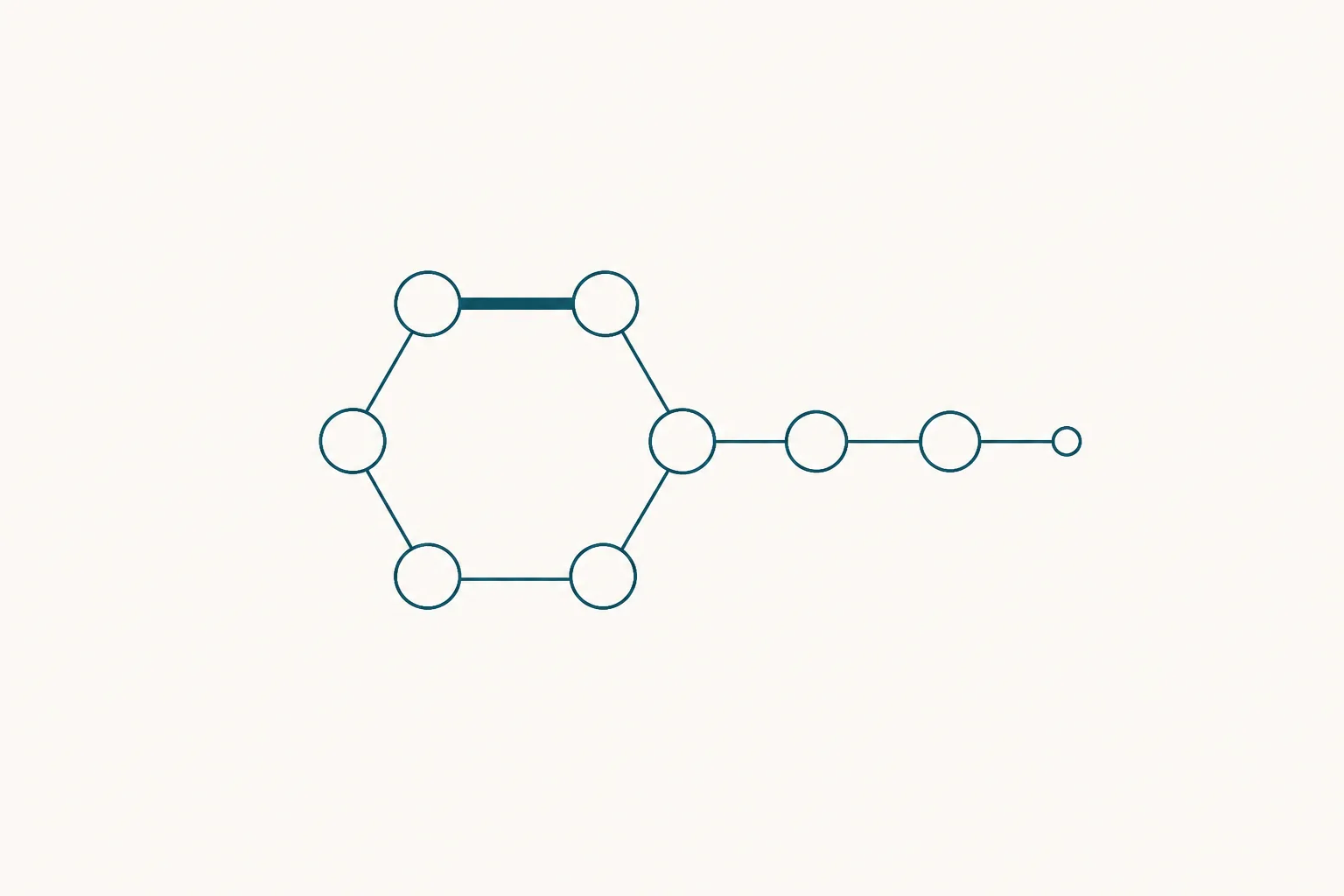
The striking feature was not the length but the shape. Two of the nine residues are cysteines, and their sulfur atoms are joined to each other, folding the front of the chain into a closed six-residue ring with a three-residue tail hanging off it. The bridge is not decoration. A chain of nine residues left open would be a floppy thing sampling thousands of shapes; the ring holds a small molecule in a defined conformation, which is what lets it be recognised. And the same architecture, it emerged, carried the other pituitary principle too. Vasopressin is the identical nine-residue scaffold differing at two positions — a fact that explained decades of failed separations at a stroke, and gave chemistry its first clear demonstration that swapping single residues could change what a hormone does.
| Feature | Oxytocin | Arginine vasopressin |
|---|---|---|
| Chain length | Nine residues | Nine residues |
| Ring | Six residues, closed by a disulfide bridge | Six residues, closed by a disulfide bridge |
| Tail | Three residues, ending in an amide | Three residues, ending in an amide |
| Residue 3 | Isoleucine | Phenylalanine |
| Residue 8 | Leucine | Arginine |
The proof was a bottle of powder
A proposed sequence in 1953 was a hypothesis, not a fact. Degradation methods could mislead; fragments could be artefacts of the acid that made them; a residue could be lost without anyone noticing. There was no crystallography of small peptides to fall back on and no mass spectrometry worth the name. The only decisive test available was to build the molecule the proposal described and see whether it behaved like the hormone.
This was an audacious thing to attempt. Peptide synthesis in 1953 was solution chemistry of the sort invented fifty years earlier: protect the parts of a residue that must not react, couple one amino acid to the growing chain, then isolate and crystallise and purify the intermediate before daring the next step. Nine residues meant eight couplings, plus protecting groups to install and later strip without damaging what they had protected, plus a final oxidation to close the disulfide bridge — a step with its own habit of producing polymers rather than rings if the concentration was even slightly wrong.
It worked. The paper announcing it is barely two pages long, and it is titled as the synthesis of an octapeptide amide, because the two half-cystines joined by the bridge were counted at the time as a single cystine residue 4. We would now call the molecule a nonapeptide. The count changed; the substance did not.
What made those two pages an event was the comparison that followed. The synthetic material was assayed alongside natural hormone in independent systems — contraction of uterine muscle, ejection of milk from a lactating animal, the fall in a bird's blood pressure — and in each it was indistinguishable in potency. It behaved like the hormone in a patient, too, in the trials that followed. This is the argument in its entirety, and it is worth pausing on, because it is the argument every structural claim in the field would rest on for the next thirty years.
Stockholm, 1955
The prize followed two years later, and the wording of the citation shows what the Swedish Academy thought it was rewarding. Not oxytocin as such, and not the sulfur work alone, but the demonstration that a hormone of this kind could be assembled by a chemist.
for his work on biochemically important sulphur compounds, especially for the first synthesis of a polypeptide hormone
The Royal Swedish Academy of Sciences, Nobel Prize in Chemistry 1955
By the time he stood up in December 1955 the group had synthesised vasopressin as well, using the same chemistry on the same scaffold, which turned the single result into a method. The lecture traces the whole route back to the sulfur of insulin, and the framing is deliberate: the synthesis is presented as the end of a long chemical argument rather than as a lucky arrival 5.
What the synthesis established
Three things followed, and they are still the three things that matter. The first is supply. A hormone that can be synthesised no longer depends on the availability of glands, and synthetic oxytocin moved into obstetric use within a few years, displacing an extract whose potency varied with the animal it came from. Every later peptide medicine inherits that logic, and so does the entire apparatus of purity specification and batch analysis that comes with a made molecule rather than a harvested one.
The second is the analogue. Once the sequence is known and buildable, it stops being fixed. You can shorten the tail, swap a residue, remove the free amino group at the front, replace the sulfur bridge with something more stable — and each variant is an experiment about which part of the molecule the body is actually reading. That programme, pursued through the 1960s on oxytocin and vasopressin, produced the first designed peptide analogues and the first evidence that a hormone's message and its durability could be engineered separately. Almost every modified peptide in circulation today is a descendant of that idea.
The third is the ceiling. The synthesis that won a Nobel Prize occupied a well-funded group for the better part of a year to produce a molecule nine residues long, and the cost of each additional residue rose rather than fell as chains got longer, because every intermediate had to be isolated and every isolation lost material. Nobody in 1955 could see a route from that to a protein. As it happened, the answer was being worked out a few streets away — the Rockefeller Institute is a short walk from Cornell's medical school on the same avenue — and within a decade the practice of purifying every intermediate would be abandoned in favour of anchoring the chain to an insoluble bead and simply washing the mess away. That is the next chapter of the story, and it only makes sense because of this one.
What 1953 settled was more fundamental than any technique. Before it, a hormone was a property of tissue, and the reasonable position was that biological activity might depend on something the chemist could not put in a bottle. After it, a hormone was a sequence. The rest of the field — the assays, the analogues, the manufacturing, the arguments about what is really in a vial — is the working out of that single change of category.
References
- The active principles of the posterior lobe of the pituitary gland
- The sequence of amino acids in oxytocin, with a proposal for the structure of oxytocin
- The amino-acid sequence in oxytocin
- The synthesis of an octapeptide amide with the hormonal activity of oxytocin
- A trail of sulfa research: from insulin to oxytocin (Nobel Lecture, 12 December 1955)