the supply chain
How Peptide Manufacturing Moved East
The invention of solid-phase synthesis is told often, usually as a story about elegance. The industrialisation of it is almost never told at all — and it explains far more about what is on the market today.
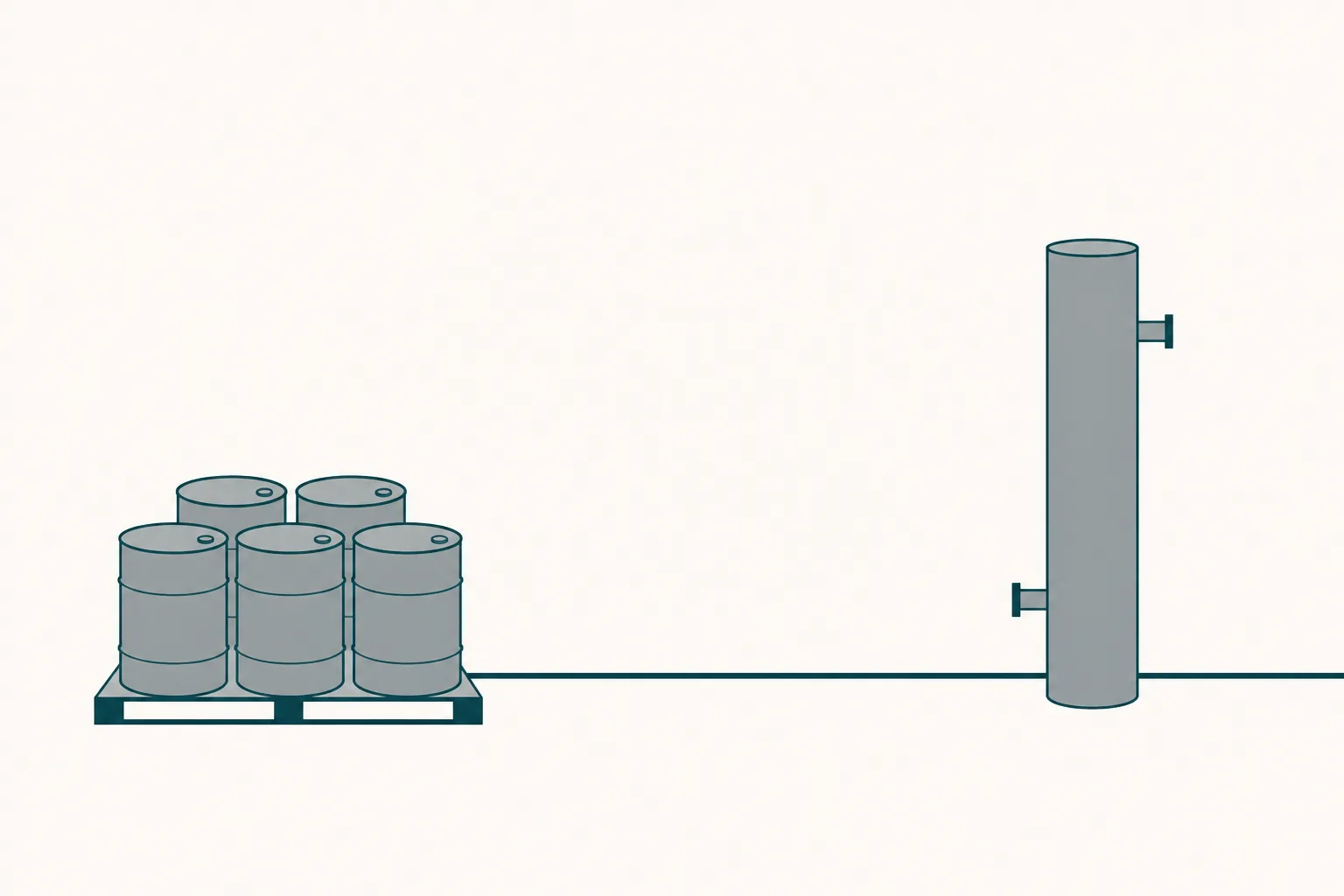
The keg is fibreboard, thirty kilos, closed with a metal ring clamp, and there is nothing on the outside to suggest it sits at the centre of an argument. Inside is a white powder — a single amino acid, its reactive end capped with a protecting group, milled and dried and ready to be tipped into a synthesis vessel. A pallet of these kegs is the raw material for a very large number of vials. The label carries a plant name, a batch number and a date. For most of the past two decades, the plant on that label has been in China or India, and the reasons are not chemical. They are economic, and they took about forty years to resolve.
The invention of solid-phase peptide synthesis gets told often, usually as a story about elegance: a chemist bolts his molecule to a bead and an impossible problem becomes a rinse. The industrialisation of it almost never gets told at all. That is a strange omission, because the second story explains far more about what is actually available today, at what price, and with what attached to it, than the first one does.
A process that stopped being special
The 1963 paper that started this described a tetrapeptide — four residues, a deliberately dull target, chosen because the molecule was not the point 1. The point was the method: anchor the chain to an insoluble bead, drive each coupling with a large excess of reagent, and rinse the excess away rather than purifying it out. What made the method industrial rather than merely clever is a property its author noticed immediately. Every turn of the cycle is the same turn. Deprotect, wash, couple, wash. The fortieth is not harder than the first, and nothing in it requires judgement.
For roughly twenty-five years after that, peptide production stayed close to where the chemistry was invented. The specialist houses were in Switzerland, Germany, Italy, the United States and Japan, and they were small. They made hormone analogues in kilogram quantities for a handful of pharmaceutical customers, and the barrier to entry was knowledge: which resin, which protecting-group strategy, how to coax a difficult sequence past a coupling that stalls.
That barrier came down in pieces. The resins became catalogue items. Fmoc chemistry displaced the older acid-labile strategy and made the whole cycle milder and more forgiving. Coupling reagents that had been laboratory curiosities became bulk products with published procedures. Synthesisers stopped being built in-house. By the late 1990s, essentially everything needed to run a peptide plant could be bought, and the remaining competitive advantage was not knowing how — it was being able to do it at a cost nobody else could match.
The part of the bill nobody photographs
Ask what a peptide costs to make and the intuitive answer is: the amino acids. It is the wrong answer, and the size of the error is startling. Peptide manufacture consumes solvent on a scale that has no equivalent in ordinary drug production. Every deprotection is followed by washes, every coupling by more washes, and the purification that follows runs litres of aqueous acetonitrile through a preparative column to separate a wanted chain from the near-identical ones that failed a step. A working group drawn from the pharmaceutical industry put the total mass of material consumed per unit of peptide produced in the thousands of kilograms per kilogram, orders of magnitude above small-molecule manufacture 2.
Solvent has to be bought, stored, moved, and then — the expensive part — disposed of. The workhorse solvents of the field are dipolar aprotics, principally dimethylformamide and N-methylpyrrolidone, and their regulatory status has deteriorated steadily. Both are classed as reproductive toxicants. The European Union restricted dimethylformamide under its chemicals regulation in 2021, setting concentration limits and exposure conditions for industrial and professional use across the bloc 5. A restriction of that kind does not ban a process. It prices it.
Labour matters too, and it is the reason usually given, because it is the one visible from outside. Peptide production is not the automated dream it is sometimes described as: charging vessels, monitoring couplings, cleaving from resin, collecting and pooling fractions from a preparative column, freeze-drying and filling are all attended operations. But labour is a smaller share of the total than waste and solvent, and the two moved together. A location that was cheap for one was generally cheap for the other.
Selling capacity by the kilogram
The organisational form that absorbed all of this was already familiar from the wider chemical industry. A contract manufacturing organisation owns no molecules. It owns reactors, columns, dryers, cleanrooms and the documentation systems that wrap them, and it sells access to those assets in campaigns. A customer arrives with a sequence and a quantity; the plant schedules a run, produces the material, ships it, cleans down and starts something else. The economics reward one thing above all others: keeping the assets busy.
That single incentive shaped everything that followed. A plant sized for pharmaceutical campaigns has gaps between them, and gaps are expensive. Filling those gaps with smaller, less demanding, less documented work is not a moral failing; it is the arithmetic of a capital-intensive business. It is also, precisely, how a supply base built for regulated medicines came to serve a catalogue trade that nobody planned.
- Reactor time, priced per campaign rather than per molecule
- Purification capacity, usually the true bottleneck rather than synthesis
- Analytical work — identity, purity, residual solvent, water content
- Documentation: batch records, method validation, stability data, change control
- Regulatory standing: inspection history, and the audits a customer is permitted to run
Demand for that capacity was not speculative. The therapeutic peptide field expanded steadily from the 1990s onward, and by the early 2020s the marketed population ran to more than eighty approved peptide drugs with a development pipeline that had grown rather than thinned 3. Every one of those programmes needed material at gram scale for discovery, kilogram scale for trials and tonne scale if it succeeded — and the companies running them had largely stopped owning plants of their own.
One supply base, several grades
The most persistent misunderstanding about all of this is geographical. People speak as though there were a good region and a bad one. There is not. There is one industrial base, spread across a handful of chemical clusters, and within it a stratification that has nothing to do with which country the reactor stands in.
What separates the tiers is administrative. A plant operating to pharmaceutical standards runs validated methods, keeps batch records that reconstruct the run, holds stability data, controls changes formally, and submits to inspection by the regulators of the markets it supplies. A plant selling research-grade material may run the identical chemistry on the identical equipment and simply do none of that — because nobody requires it, and because each of those activities is a cost with no buyer. The molecule can be the same. The evidence that it is the same is what differs.
| Tier | What it is actually selling | What travels with the material |
|---|---|---|
| Regulated pharmaceutical | A validated, inspected process | Full batch record, validated methods, inspection history |
| Contract research supply | A characterised batch | Certificate of analysis, method summary, sometimes raw traces |
| Catalogue research material | A named compound at a quoted purity | A certificate, often for an earlier batch or another seller's batch |
| Repackaged and relabelled | A vial | Whatever the last party in the chain chose to reproduce |
Regulators noticed the asymmetry early and have struggled with it ever since. Oversight of manufacturing abroad depends on physically visiting plants, and government auditors have documented persistent difficulties with that programme for well over a decade — staffing shortfalls, reliance on translators supplied by the inspected firm, and long intervals between visits 4. That is the regulated tier. The unregulated tier is not inspected at all, by anybody, by design.
What consolidation did to price, and to provenance
The 2000s and 2010s were a consolidation decade. Small specialist houses were bought or closed; surviving plants got larger; purification capacity, the real constraint, was installed at scale. The effect on price was exactly what the textbook predicts. A short research peptide that had been a specialist commission became a line in a catalogue, and the price of a milligram fell far enough that the vial, the label, the cold pack and the courier began to rival the contents as a share of the total.
The second effect got much less attention and matters more. Consolidation did not shorten the chain between reactor and buyer; it lengthened it. Between the plant that ran the synthesis and whoever eventually opens the box there may now sit a bulk trader, a domestic importer, a filling and labelling operation, and one or more resellers who never touch the material at all. Each of those parties adds a document. None of them adds an analysis.
This is why provenance became hard in a way that feels disproportionate to the simplicity of the object. A certificate of analysis is a report on a specific batch produced on a specific day by a specific laboratory. Detached from that batch, photographed, cropped and reissued down a chain of intermediaries, it becomes a genre of document rather than a measurement. The paper survives the journey. The link between the paper and the powder does not.
None of that is a conspiracy, and it is worth resisting the temptation to narrate it as one. It is the ordinary consequence of a research technique that turned out to be perfectly repeatable, an industry that learned to sell repeatability by the kilogram, and a regulatory geography that priced the same operation differently on either side of a border. The chemistry moved east because the waste did. Everything else — the catalogues, the price collapse, the documents that travel better than the material — followed from that, several decades later, as arithmetic usually does.
References
- Solid Phase Peptide Synthesis. I. The Synthesis of a Tetrapeptide
- Sustainability Challenges in Peptide Synthesis and Purification: From R&D to Production
- Trends in peptide drug discovery
- Drug Safety: FDA Has Faced Persistent Challenges Overseeing Foreign Drug Manufacturing
- Commission Regulation (EU) 2021/2030 amending Annex XVII to Regulation (EC) No 1907/2006 (REACH) as regards N,N-dimethylformamide